
Decomposition-Based Modular Conformal Prediction for Two-Stage Modeling
Abstract
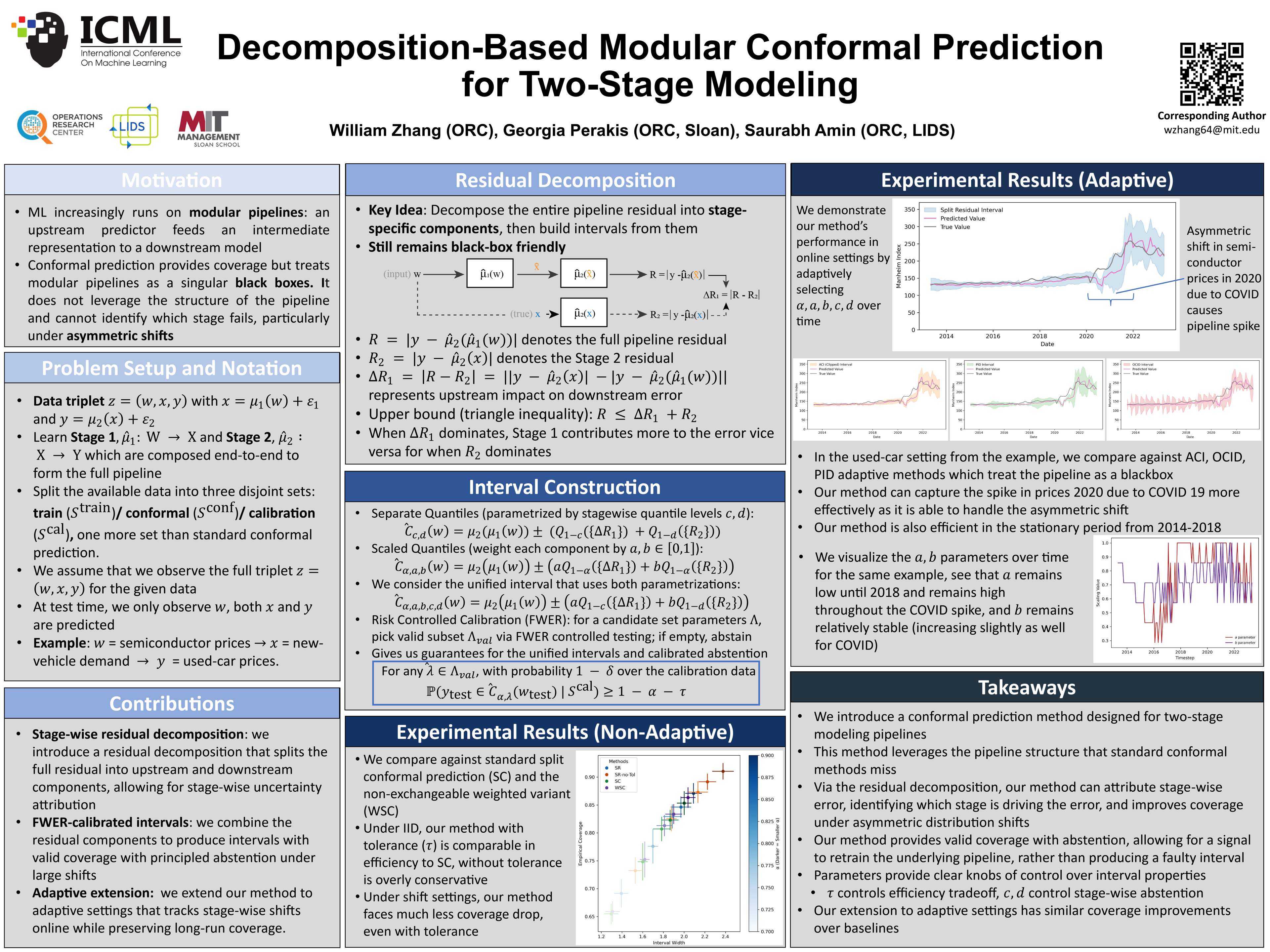
Conformal prediction offers finite-sample coverage guarantees under minimal assumptions. However, existing methods treat the entire modeling process as a black box, overlooking opportunities to exploit and understand modular structure. We introduce a conformal prediction framework for two-stage sequential models, where an upstream predictor generates intermediate representations for a downstream model. By decomposing the overall prediction residual into stage-specific components, our method enables practitioners to attribute uncertainty to specific pipeline stages. We develop a risk-controlled parameter selection procedure using family-wise error rate (FWER) control to calibrate stage-wise scaling parameters, and introduce an adaptive extension for non-stationary settings. Experiments on synthetic distribution shifts, as well as real-world supply chain and stock market data, demonstrate that our approach improves coverage under structural, stage-wise shifts compared to standard conformal methods, while identifying stage-wise error contribution. This framework offers diagnostic advantages and robust coverage that standard conformal methods lack.
Lay Summary
Many ML systems make predictions in sequence, where one model's output becomes the next model's input. For example, to forecast used-car prices, a system might first predict supply-chain conditions and then convert those into a price. Whenever we rely on such predictions, we want to provide intervals that tell us how much to trust them. Existing tools can produce these intervals, but they treat the whole chain as a single black box — so when predictions start to drift, for instance due to shifts such as COVID, the existing tools do not provide enough information. We developed a way to split the overall uncertainty into the amount contributed by each part of the sequence, build in from thtervalsose separate pieces, and flag which step is driving the errors. As a result, the intervals stay reliable even when conditions shift, and they point practitioners to the specific part of the system that needs fixing. We demonstrate this on real forecasting tasks, including used-car prices and stock prices.