
How Hard Can It Be? Hardness-Aware Multi-Objective Unlearning
Abstract
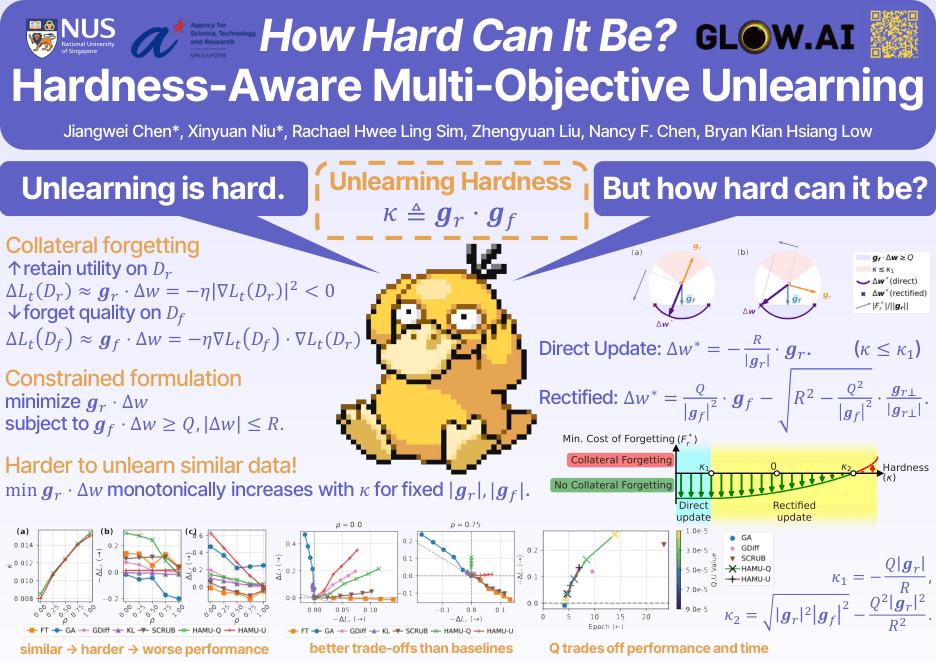
Machine unlearning aims to remove the influence of specific forget training data due to privacy, copyright or bias concerns while maintaining the model performance on the remaining retain data. Existing unlearning algorithms, such as optimizing a weighted combination of losses, have tried to achieve these objectives of improving forget quality and maintaining retain utility. However, they do not guarantee that these objectives can be improved by a specified extent for all forget and retain data. In this work, we address this limitation with a novel and theoretically-grounded approach from a constrained optimization perspective. Firstly, we identify that the hardness of reconciling both objectives can be quantified by the similarity between the forget data and the retain data. Next, we derive an unlearning algorithm (HAMU) with the overall goal of guaranteeing a specified improvement in forget quality while minimizing the retain utility cost/degradation by updating the model weights based on our hardness measure. Our hardness measure also informs users when retain utility degradation is unavoidable, i.e., both objectives cannot be improved simultaneously, and stopping should be considered. Our algorithm is applicable to non-convex models and is easily parallelizable, making it readily deployable in real-world scenarios. We empirically demonstrate HAMU's superior performance over baselines on both image and text datasets using large models. Our code is available at https://github.com/aoi3142/HAMU.
Lay Summary
Computers can be taught to understand images or texts. However, it can be difficult to teach a computer to forget certain images or texts it has already learned. For example, if a computer has access to multiple copies of an image, forgetting just one of the copies is impossible. We measure how hard it is to forget certain images or texts by assessing how similar the images/texts to be forgotten are to the ones the computer still has access to. We use this measure to predict the forgetting quality, and come up with a method that adapts based on this measure, and can improve the forgetting quality without hurting what the computer has already learned. The difficulty of forgetting is often overlooked. We bridge this gap and provide a practical and scalable forgetting method that can be adopted in real-world scenarios to reduce the damage caused by the unintended information learned by computers.