
A Conflict-aware Evidential Framework for Reliable Sleep Stage Classification
Abstract
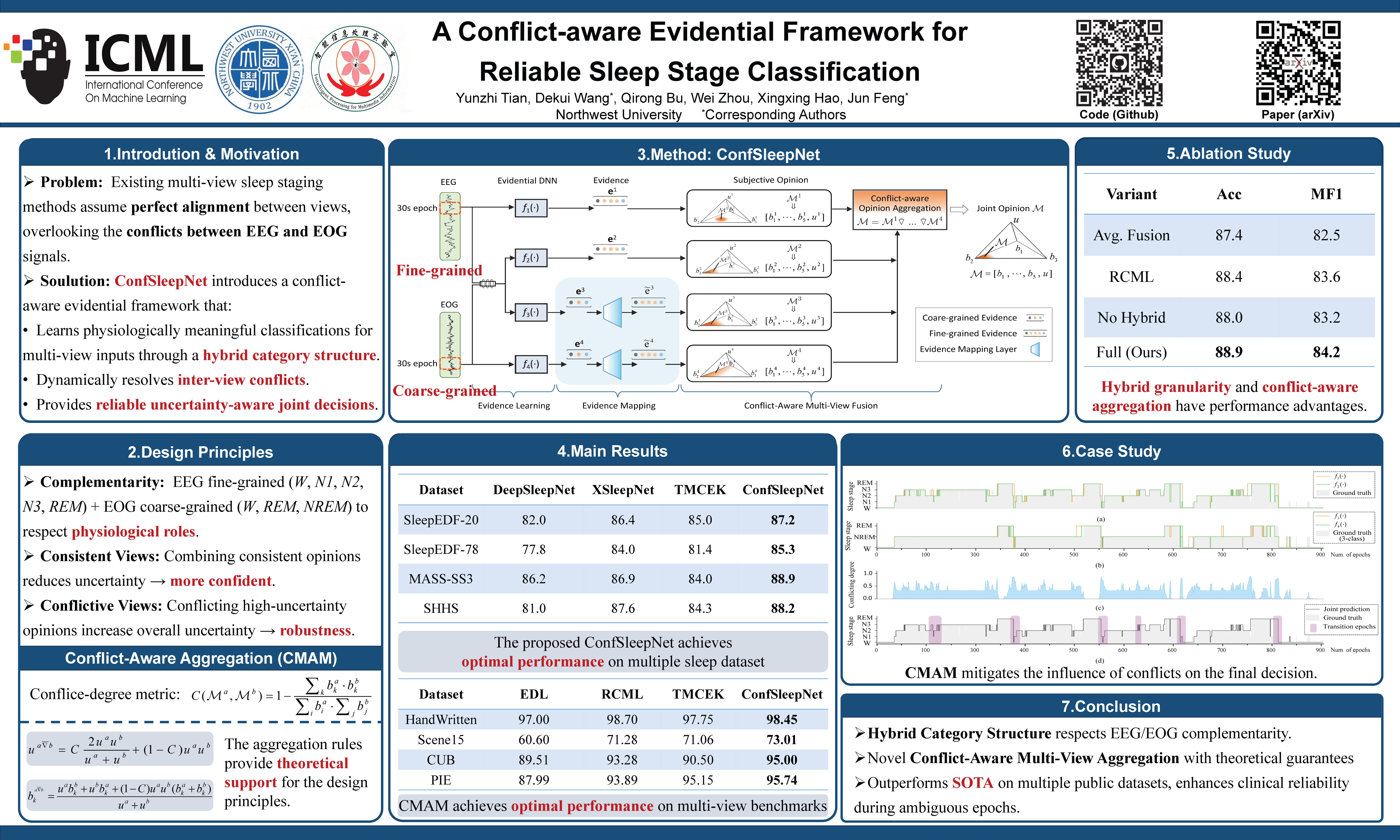
Multi-view learning has been widely applied for sleep stage classification using multi-modal data. However, existing methods typically assume that different modalities are well-aligned, which is often unattainable in real-world scenarios, thereby compromising the reliability of the staging results. In this paper, we propose ConfSleepNet, a conflict-aware evidential framework that dynamically resolves inter-view conflicts. The framework consists of multi-view evidence extraction and conflict-aware aggregation. In the first phase, it learns category-related evidence from different modalities, which represents the degree of support for individual sleep stages. Considering the inherent characteristics of varying modalities, we propose hybrid category structures for different modalities to promote more reasonable evidence learning. In the second phase, view-specific opinions, including prediction results and uncertainty, are constructed from the learned evidence. Notably, we propose a novel conflict-aware aggregation method that integrates these view-specific opinions into a reliable joint decision. This mechanism can effectively resolve conflicts among opinions and synthesize them into a reliable joint decision. Both theoretical analysis and experimental results demonstrate the effectiveness of ConfSleepNet in sleep staging tasks. The code is available at https://github.com/By4te/ConfSleepNet_ICML2026/.
Lay Summary
Sleep is essential for people's physical and mental health. Sleep staging, which determines which stage of sleep a person is in, is a prerequisite for assessing sleep quality. Traditionally, this task is performed manually by medical professionals analyzing overnight sleep recordings. This process is both time-consuming and labor-intensive. Recently, deep learning has been used for automatic sleep staging, typically relying on physiological signals such as electroencephalogram (EEG) and electrooculogram (EOG). However, existing methods often assume that the information provided by different signals is consistent. In practice, these signals may conflict due to noise, individual differences, or physiological variations. For example, EEG may suggest one sleep stage while EOG indicates another. Such conflicts can seriously compromise the reliability of staging results. Thus, we propose a novel intelligent framework called ConfSleepNet. This framework can identify whether the information from different signals is conflicting and dynamically adjust the credibility of each signal source accordingly. This leads to more reliable staging decisions. In addition, we design differentiated processing strategies based on the unique characteristics of each signal. For instance, we allow EOG to focus specifically on identifying eye movement states during sleep. Experimental results show that ConfSleepNet achieves state-of-the-art performance on multiple public datasets. It holds promise as a more reliable auxiliary tool for clinical sleep disorder diagnosis.