
InstEmb: Instruction-Following Embeddings through Glimpses of the Future
Abstract
Lay Summary
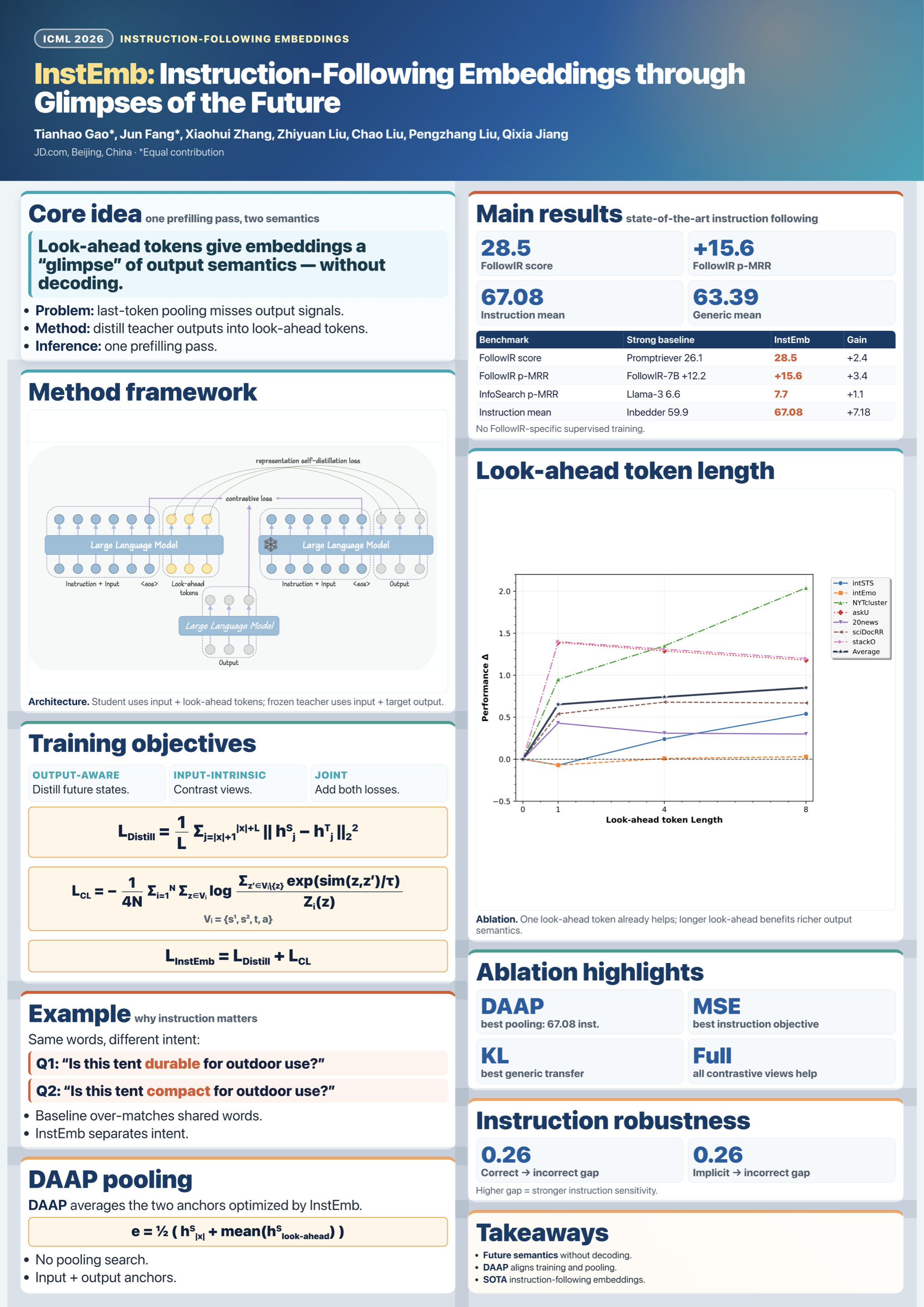
Here’s a lay summary of the paper based on the abstract: --- Lay Summary Large language models (LLMs) are very good at following detailed instructions when generating text. However, when we try to convert text into numerical representations called embeddings (which help computers understand meaning), current methods have two big problems. First, they usually only look at the very last word of the input, missing important meaning that might be spread across the entire output. Second, when they try to turn discrete words into continuous embeddings, some meaning gets lost. To fix this, the researchers propose a new framework called InstEmb. It learns two kinds of information at the same time: 1. Input-intrinsic meaning – using a technique that focuses on the last input token while comparing different examples. 2. Output-aware meaning – using a clever trick with "look‑ahead" tokens that anticipate future outputs, without slowing down the system. They also introduce a new method called Dual‑Anchor Alignment Pooling (DAAP) that aligns perfectly with these two goals. Experiments show that InstEmb works better than existing methods on several instruction‑following tests – and it does this without needing any special training data for those specific tests. In simple terms: InstEmb helps computers understand instructions more fully, by paying attention to both the input and the output, leading to more accurate and meaningful text embeddings.