
Narrowing the ANN–SNN Gap for Continuous 1D Temporal Signal Classification with Multi-Scale Temporal Encoding and Sparsity-Regularized Transform Encoding
Abstract
Lay Summary
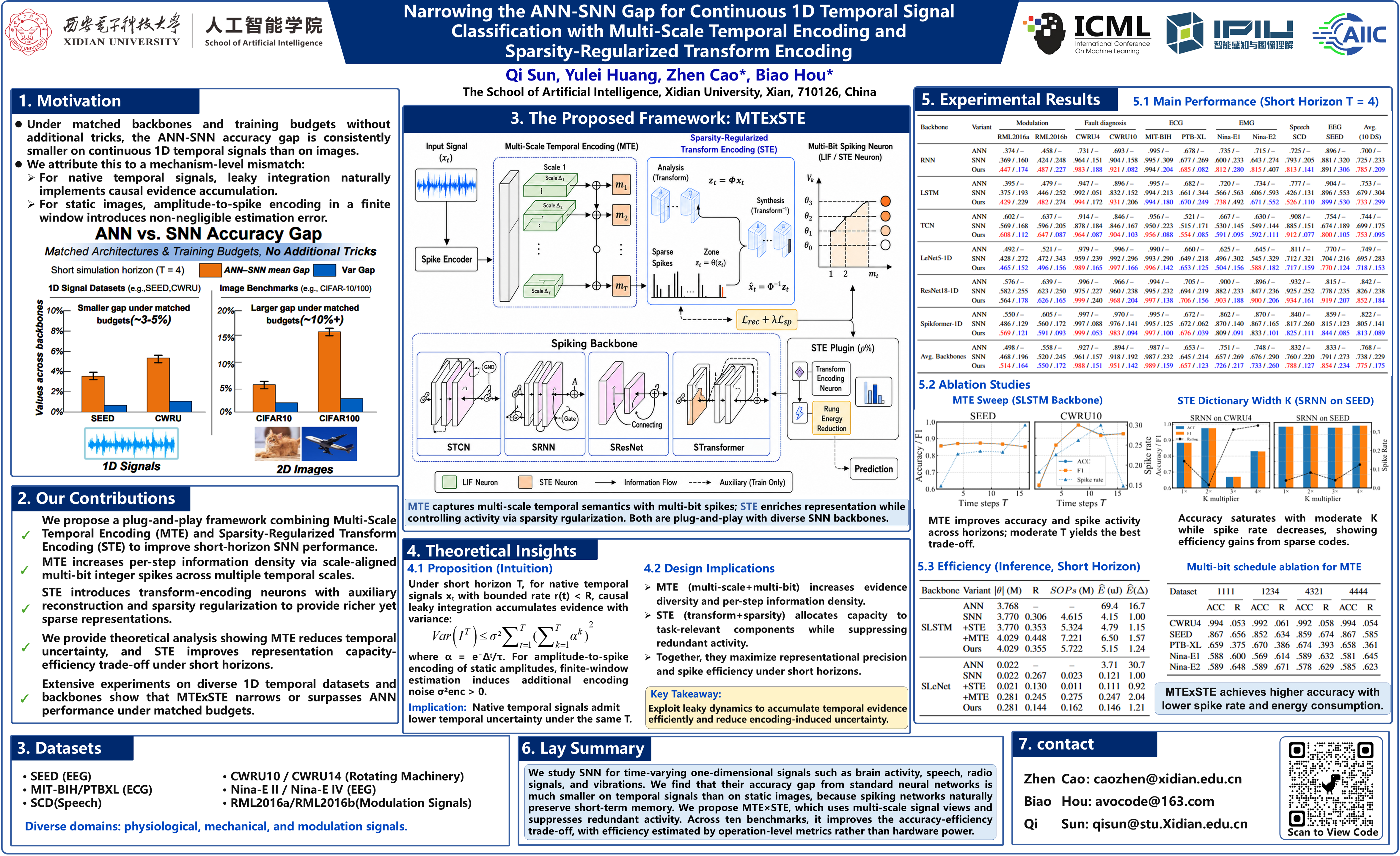
Many real-world signals, such as brain activity, heartbeats, muscle movements, speech, radio signals, and machine vibrations, change over time. This paper studies a type of brain-inspired neural network called a spiking neural network, which processes information using short bursts of activity and has the potential to be more efficient than standard neural networks. A common concern is that spiking neural networks often lose accuracy compared with standard neural networks, especially when they are allowed to run for only a few time steps. We find that this accuracy gap is much smaller for real time-varying one-dimensional signals than for static images. This is because spiking networks naturally keep short-term memory over time, which fits temporal signals better than images that must first be converted into artificial time sequences. Based on this observation, we propose a new method called MTE×STE. It gives the spiking network several time-scale views of the input signal and encourages the network to keep useful activity while suppressing redundant activity. Across ten signal classification benchmarks and several model types, our method improves the balance between accuracy and estimated computational efficiency compared with standard spiking baselines, and in some cases matches or surpasses standard neural networks. The efficiency results are based on commonly used operation-level estimates, not direct hardware power measurements.