
Where Detectors Fail: Probing Generative Space for Generalizable AI-Generated Image Detection
Abstract
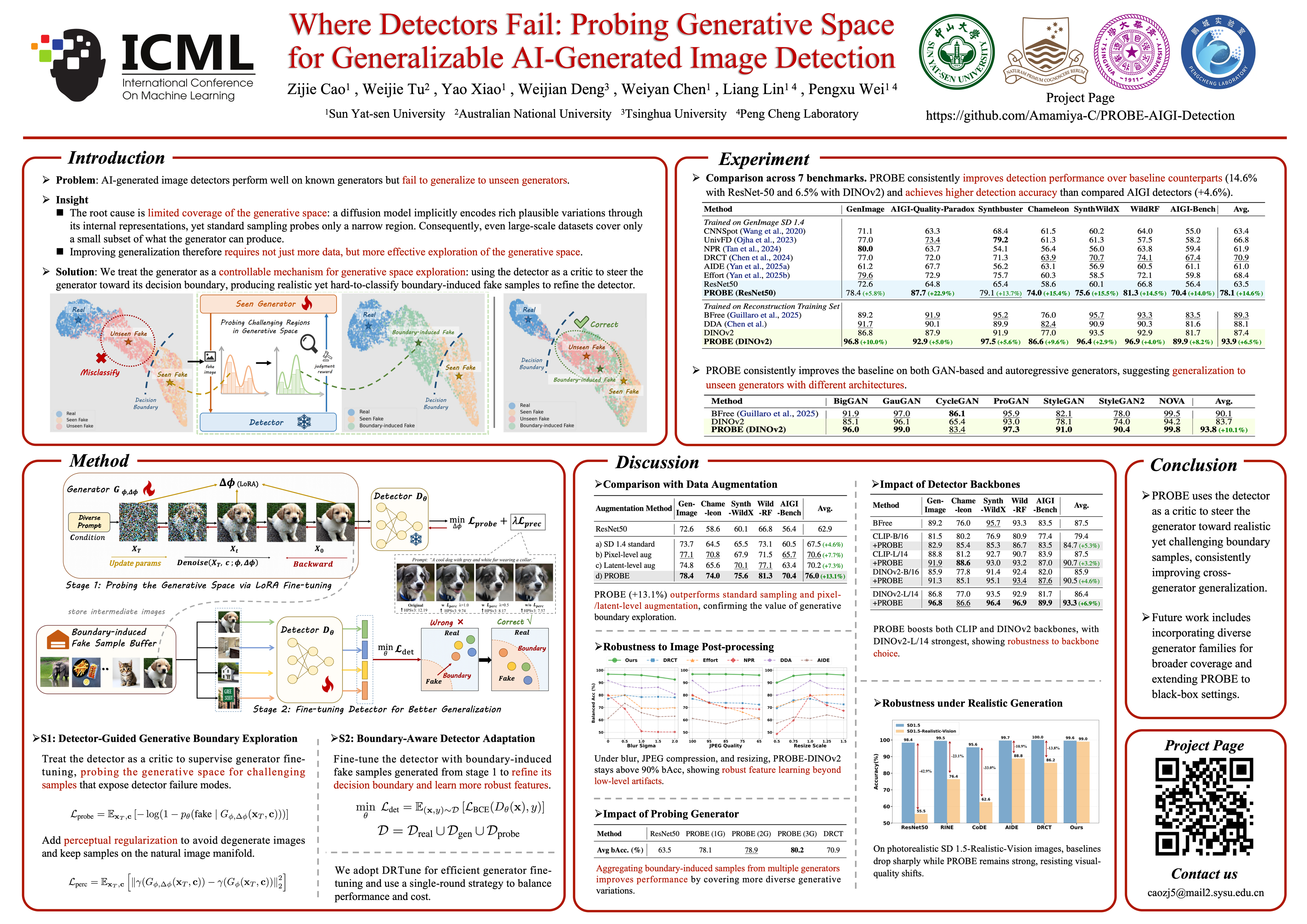
Detecting AI-generated images (AIGI) remains challenging because detectors often fail to generalize to unseen generators. Although existing methods are trained on large datasets, their performance still degrades when generation settings change, indicating that data scale alone is insufficient and that limited coverage of generative variations during training is a key factor. Studies on generative model editing show that small changes in internal representations can produce diverse and meaningful image variations, many of which are not explored under standard sampling. Leveraging this insight, we propose PROBE (Probing Robustness via Boundary Exploration), a framework that improves detector generalization by actively exploring challenging regions of the generative process. Instead of treating the generator as a fixed data source, PROBE uses the detector as a critic to steer the generator through manifold-level modifications, producing realistic samples that are difficult to classify. These samples expose failure cases that are uncommon under standard data sampling strategies and are used to refine the detector. Experimental results across multiple benchmarks indicate that PROBE enhances generalization to unseen generators, resulting in more generalizable AIGI detection performance.
Lay Summary
AI image generators now produce pictures nearly indistinguishable from real photographs, and the detectors built to flag them have a frustrating weakness: they work well on images from generators they were trained on, yet stumble on pictures from new or modified ones. Simply collecting more training images has not solved this, because each generator can produce a vast range of subtly different images that standard collection barely samples. We took a different approach. Instead of treating the generator as a fixed source of training pictures, we let the detector itself act as a critic that steers the generator toward exactly the kinds of images it finds hardest to judge — realistic images that sit right on the edge of the detector's confidence. We then retrain the detector on these revealing "blind-spot" images. Tested across seven benchmarks, our method, PROBE, consistently improves detectors' ability to spot fakes from unfamiliar generators, beating the previous best approach by about 4.6%. This brings us closer to detectors that stay reliable as image-generation technology keeps evolving.