
SARL: Structure-Aligned Reinforcement Learning for Bridging the Perception-Action Gap in Airspace
Abstract
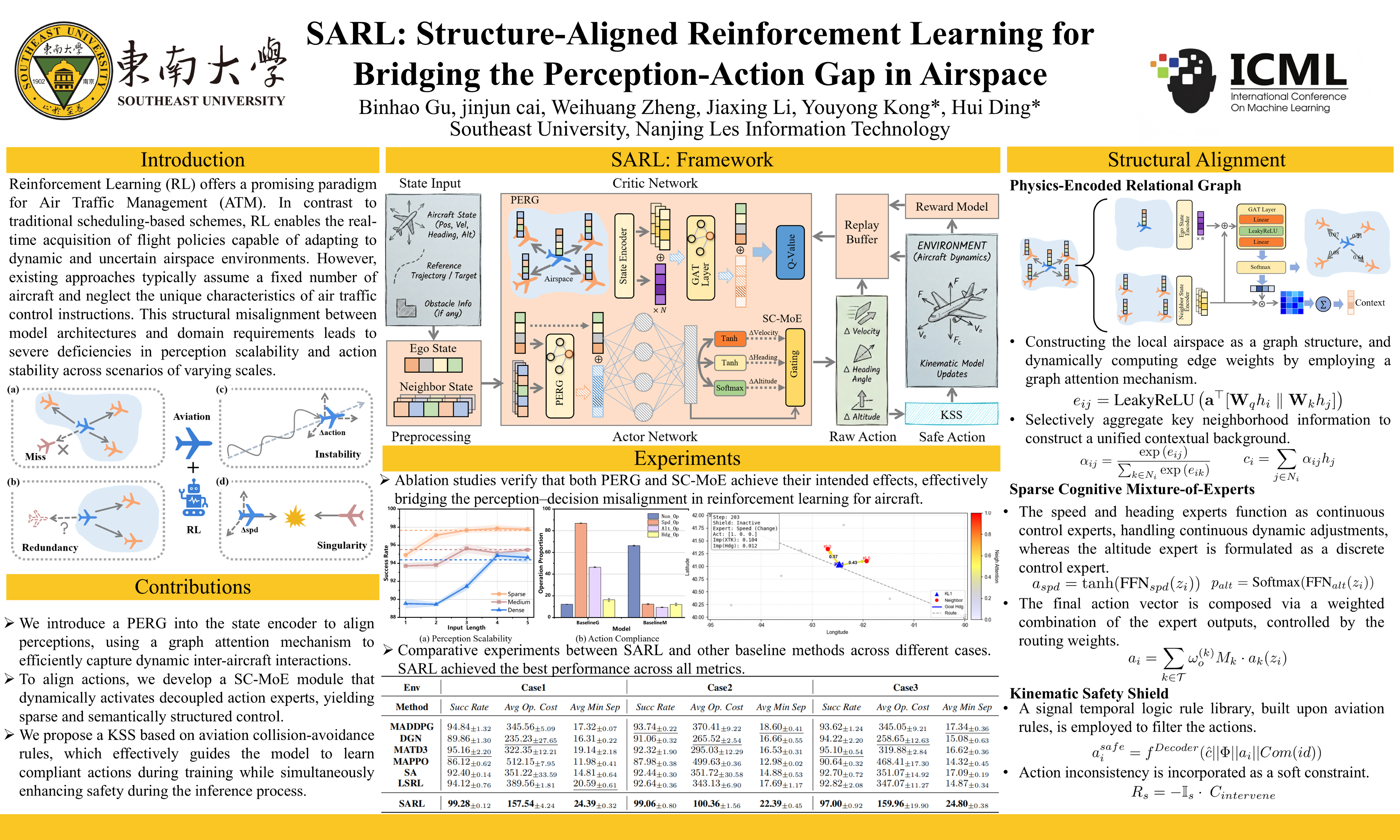
Multi-Agent Reinforcement Learning (MARL) has been widely applied to automated aircraft conflict resolution due to its strong capability for cooperative control and distributed decision-making. However, existing approaches typically assume a fixed number of aircraft and neglect the unique characteristics of air traffic control instructions. This structural misalignment between model architectures and domain requirements leads to severe deficiencies in perception scalability and action stability across scenarios of varying scales. To address these challenges, we propose Structural-Aligned Reinforcement Learning (SARL), which aims to bridge the gap between perception and action. First, the Physics-Encoded Relational Graph (PERG) effectively resolves the fixed input dimensionality issue by incorporating physical inductive biases into a graph attention mechanism. Second, we design the Sparse Cognitive Mixture-of-Experts (SC-MoE) to enhance decision stability. In addition, we introduce a Kinematic Kafety Shield (KSS) based on aviation rules, which not only improves inference-time safety but also effectively guides the model to generate semantically meaningful actions that comply with aviation standards. Simulation experiment results demonstrate that SARL significantly outperforms existing reinforcement learning baselines across diverse scenarios in terms of both success rate and operational efficiency.
Lay Summary
How can we teach Artificial Intelligence to safely direct airplane traffic just like a human controller? We wanted to tackle this because standard AI systems get overwhelmed when the number of planes in a sector constantly changes. Worse, to prevent collisions, they often issue overly complex instructions—like telling a pilot to simultaneously turn, change speed, and drop altitude—which is dangerous and impractical in real life. To solve this, we designed a new AI framework that mimics professional air traffic control logic. First, we gave the AI a flexible way to "see" the airspace, allowing it to smoothly track a varying number of planes. Then, instead of mixing commands, we built a specialized decision tool that issues clear, single-action instructions (like only adjusting the heading). Finally, we wrapped the system in a mathematical "safety net" based on strict real-world aviation rules. Our simulations revealed that this human-aligned approach is significantly safer and more efficient at managing high-density skies than previous models. This work brings us a step closer to practical, automated air traffic control that pilots can actually trust and execute.