
Taming the Recent-Data Bias: Towards Robust Time Series Forecasting with Global Context
Abstract
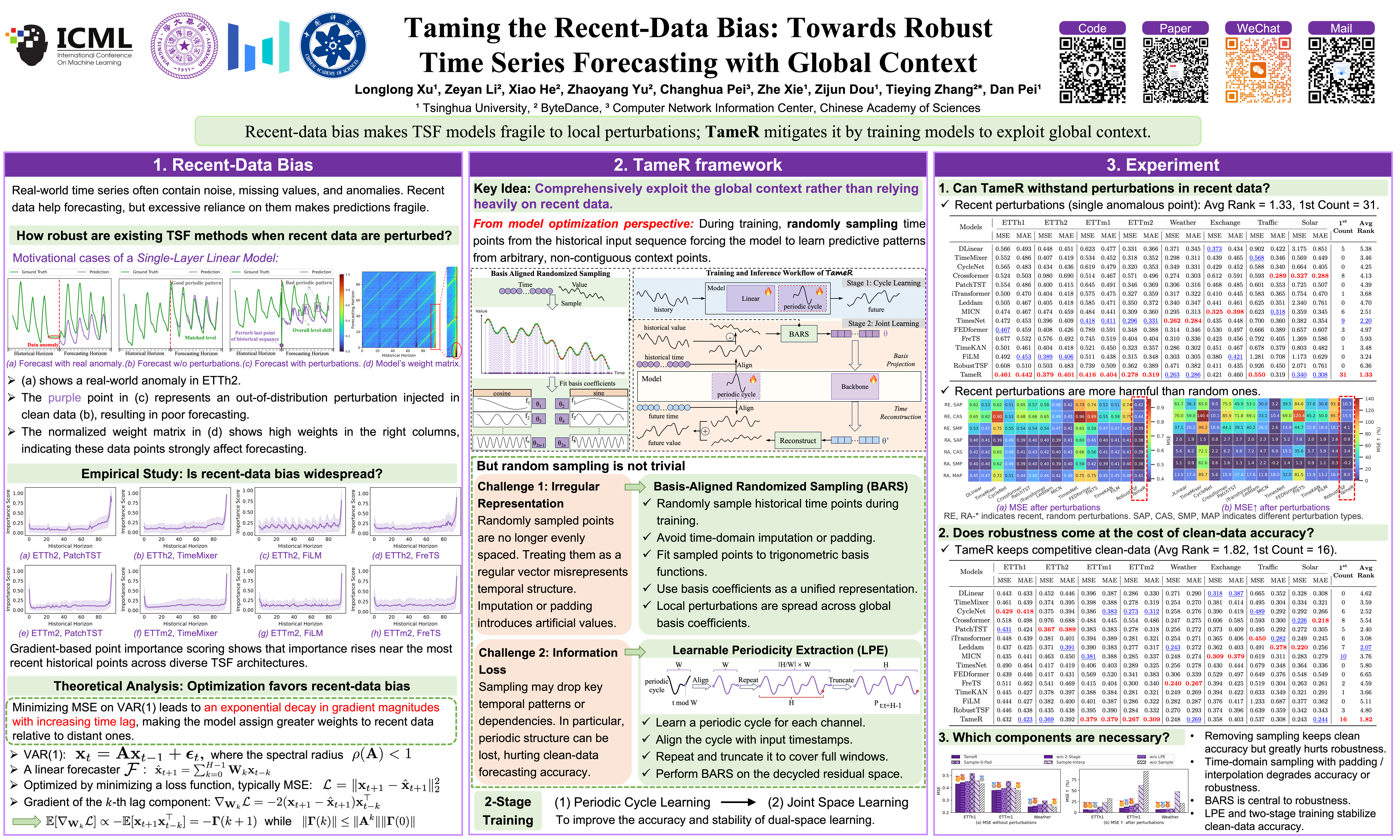
Time series forecasting plays a vital role in numerous domains. However, real-world time series are frequently contaminated by noise, missing values, and anomalies, posing significant challenges to reliable forecasting. In this work, we first systematically investigate a fundamental limitation prevalent in existing forecasting methods: an excessive reliance on the most recent observations---termed "recent-data bias". This bias renders forecasts highly vulnerable to perturbations in recent data, severely undermining prediction reliability. To address this issue, we propose TameR, a novel approach for robust time series forecasting that effectively mitigates recent-data bias via enhancing the utilization of global context. Specifically, it employs a basis-aligned randomized sampling strategy to reduce dependence on any specific recent data. Furthermore, TameR incorporates a learnable periodicity extraction module coupled with a two-stage learning protocol to robustly separate periodic patterns from the sampled residual components. Comprehensive experiments demonstrate that TameR significantly outperforms state-of-the-art methods in robustness against diverse perturbation scenarios, while achieving comparable accuracy on clean data. Code is available at https://github.com/NetManAIOps/TameR.
Lay Summary
Forecasting future values from past measurements is used in many everyday systems, such as power grids, traffic planning, weather monitoring, and online services. A common problem arises when measurements are sometimes wrong, missing, or anomalous. Many forecasting models overly emphasize the most recent data, so one bad recent point can lead to a poor prediction. Our work studies this problem and proposes TameR, a method that encourages a model to look at the whole history, not just the most recent data. During training, TameR practices making predictions when some past points are hidden, which helps it learn more stable patterns. It also keeps repeating patterns, such as daily or weekly cycles, separate from irregular changes. As a result, TameR can make forecasts that stay accurate when the input data are clean and are more reliable when recent data contain noise, missing values, or anomalies.