
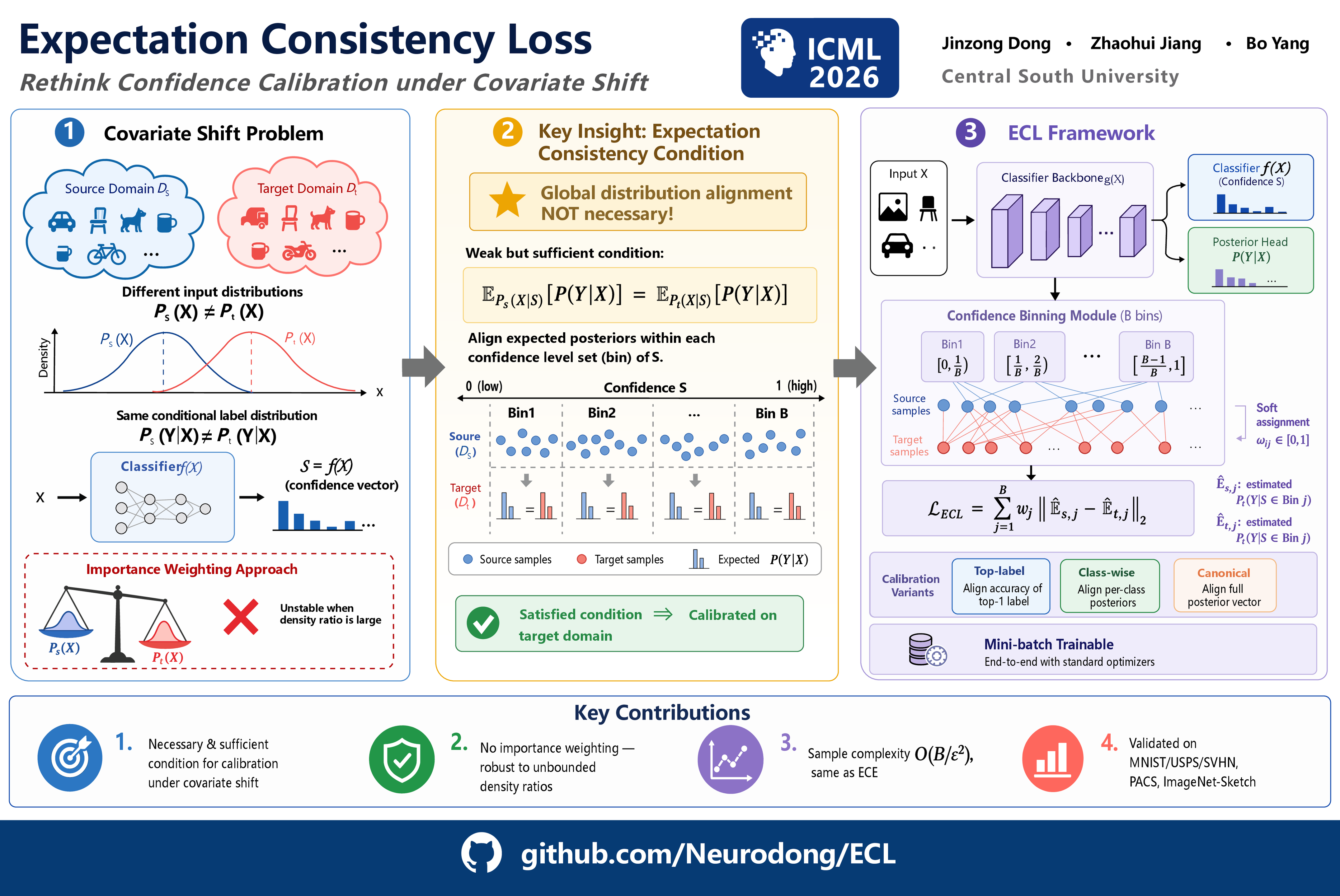
Expectation Consistency Loss: Rethink Confidence Calibration under Covariate Shift
Abstract
Lay Summary
Machine learning models are increasingly used in safety-critical decisions—such as diagnosing diseases or assessing medical risks—where being accurate isn't enough. They also need to honestly report how uncertain they are. For example, a model should know when to say "I'm only 60% sure" and defer to a human doctor. However, this self-awareness often breaks down under covariate shift—a scenario where the input data looks different but the underlying rules stay the same, such as when a model trained on one hospital's X-ray images is deployed in another with different equipment. Our research uncovered a surprising insight: you don't need to align entire data distributions to fix this. Instead, we proved that it is enough to ensure that at each confidence level, the model's expected accuracy stays consistent across environments—a much weaker and more practical condition. Building on this idea, we developed a training method that helps models maintain reliable confidence under covariate shift, without the instability issues of previous approaches. This could make AI systems safer and more trustworthy in real-world deployments where the data we face rarely matches the data we trained on.