
Fixed Aggregation Features Can Rival GNNs
Abstract
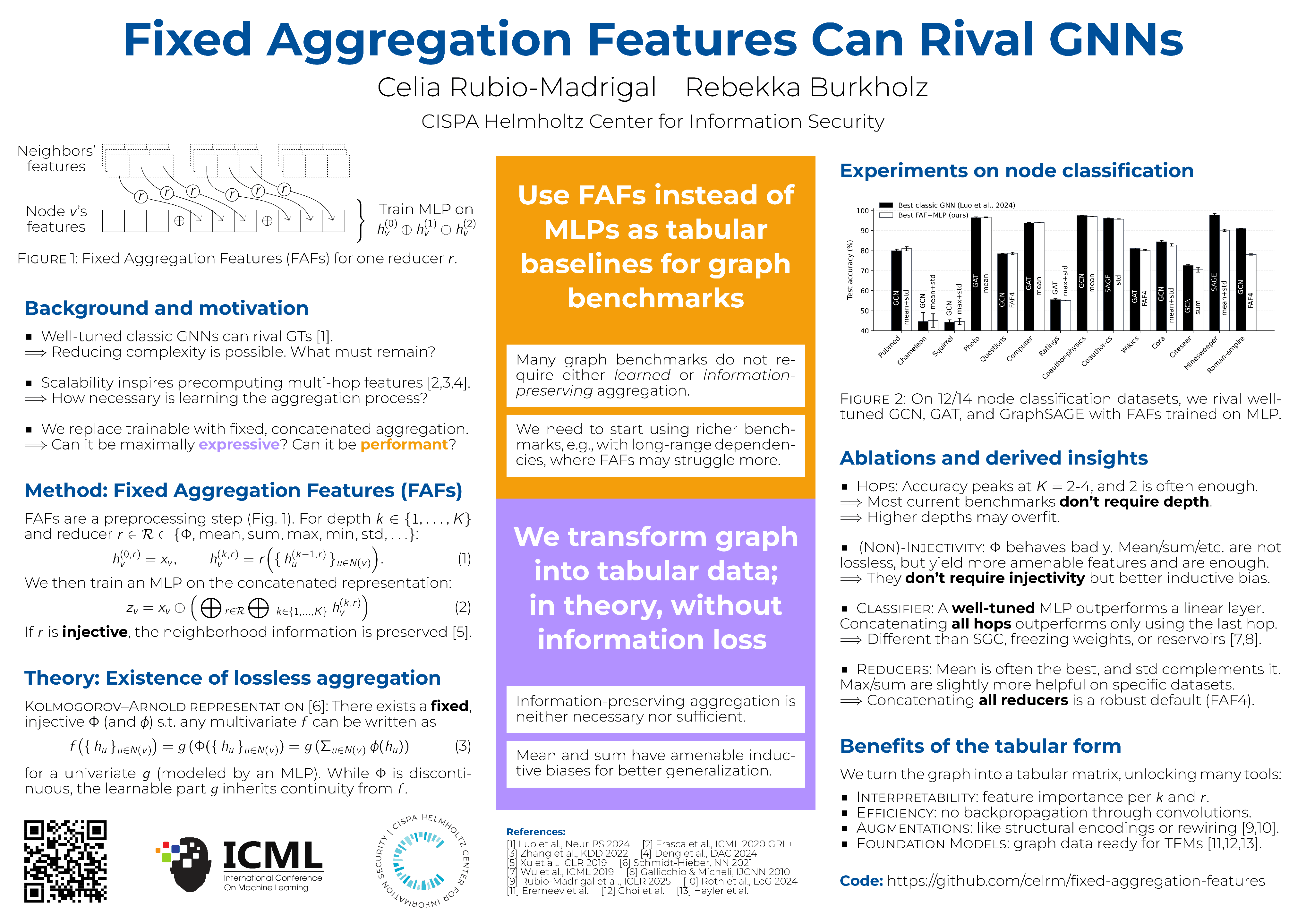
Graph neural networks (GNNs) are widely believed to excel at node representation learning through trainable neighborhood aggregations. We challenge this view by introducing Fixed Aggregation Features (FAFs), a training-free approach that transforms graph learning tasks into tabular problems. This simple shift enables the use of well-established tabular methods, offering strong interpretability and the flexibility to deploy diverse classifiers. Across 14 benchmarks, well-tuned multilayer perceptrons trained on FAFs rival or outperform state-of-the-art GNNs and graph transformers on 12 tasks—often using only mean aggregation. The only exceptions are the Roman Empire and Minesweeper datasets, which typically require unusually deep GNNs. To explain the theoretical possibility of non-trainable aggregations, we connect our findings to Kolmogorov–Arnold representations and discuss when mean aggregation can be sufficient. In conclusion, our results call for (i) richer benchmarks benefiting from learning diverse neighborhood aggregations, (ii) strong tabular baselines as standard, and (iii) employing and advancing tabular models for graph data to gain new insights into related tasks.
Lay Summary
Many real-world data sets can be viewed as networks: people connected by social ties, papers connected by citations, or proteins connected by interactions. Today, these problems are often solved with graph neural networks, which repeatedly learn how each item should combine information from its neighbors. We ask whether this neighborhood-combining step has to be learned. We introduce Fixed Aggregation Features, a simple method that first summarizes each item’s neighbors using fixed statistics such as averages, sums, maximums, and minimums, and then gives these summaries to a standard machine-learning model for tables. This makes graph learning simpler, easier to inspect, and often cheaper to train. Surprisingly, across the majority of common benchmarks, this approach matches or beats much more complex graph models, often using only average neighbor information. The two cases where it falls behind suggest that some problems really do need deeper or more flexible ways of combining neighborhood information. Our results show that many current graph benchmarks may not require the sophisticated learning mechanisms they are meant to test. We argue that future graph-learning research should include our strong simple baseline, and design harder benchmarks that reveal when learned aggregation is truly needed.