
Reusing Trajectories in Policy Gradients Enables Fast Convergence
Abstract
Lay Summary
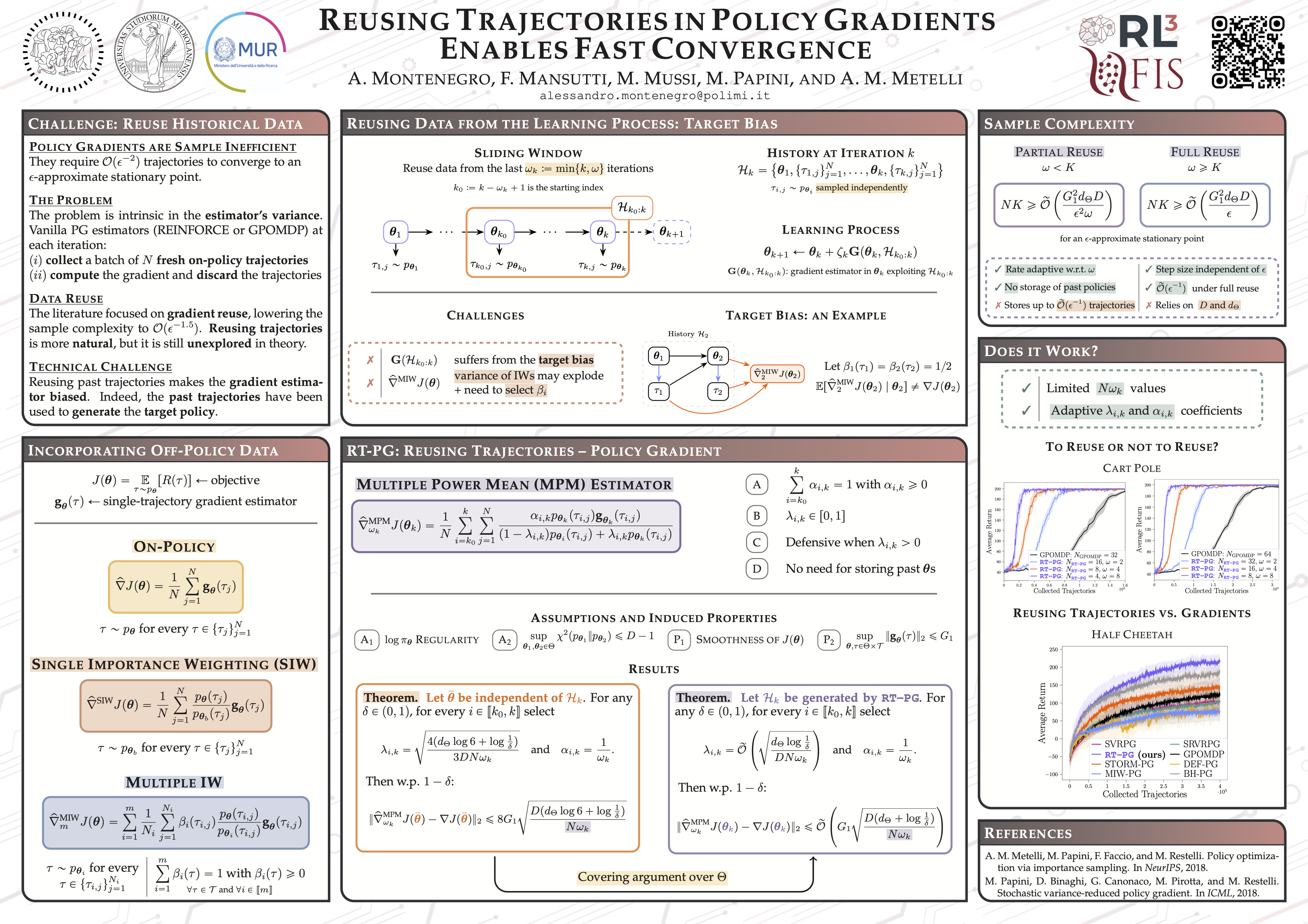
Reinforcement Learning (RL) is a framework where agents are trained to solve sequential decision-making problems via interaction with an environment. Policy Gradients (PGs), a popular and effective family of RL methods, learn by collecting experience, updating the agent, then discarding the data. This paradigm of exploiting data just for a single update makes PGs sample inefficient. While prior work has shown that reusing past information can accelerate learning, existing approaches reuse gradient estimates rather than raw experience, requiring storage of past model parameters. We instead ask: can directly reusing past interaction trajectories provably accelerate learning? We introduce RT-PG, an algorithm that combines fresh and past trajectories through a novel multiple importance weighting estimator with a power mean correction, which carefully balances the trade-off between bias and variance introduced by reusing old data. We prove that RT-PG achieves an improved theoretical sample complexity without retaining past models, and validate this gain empirically on continuous control benchmarks. Our results establish trajectory reuse as a principled and practical strategy for making RL agents learn faster with less data.