
A Regret Minimization Framework on Preference Learning in Large Language Models
Abstract
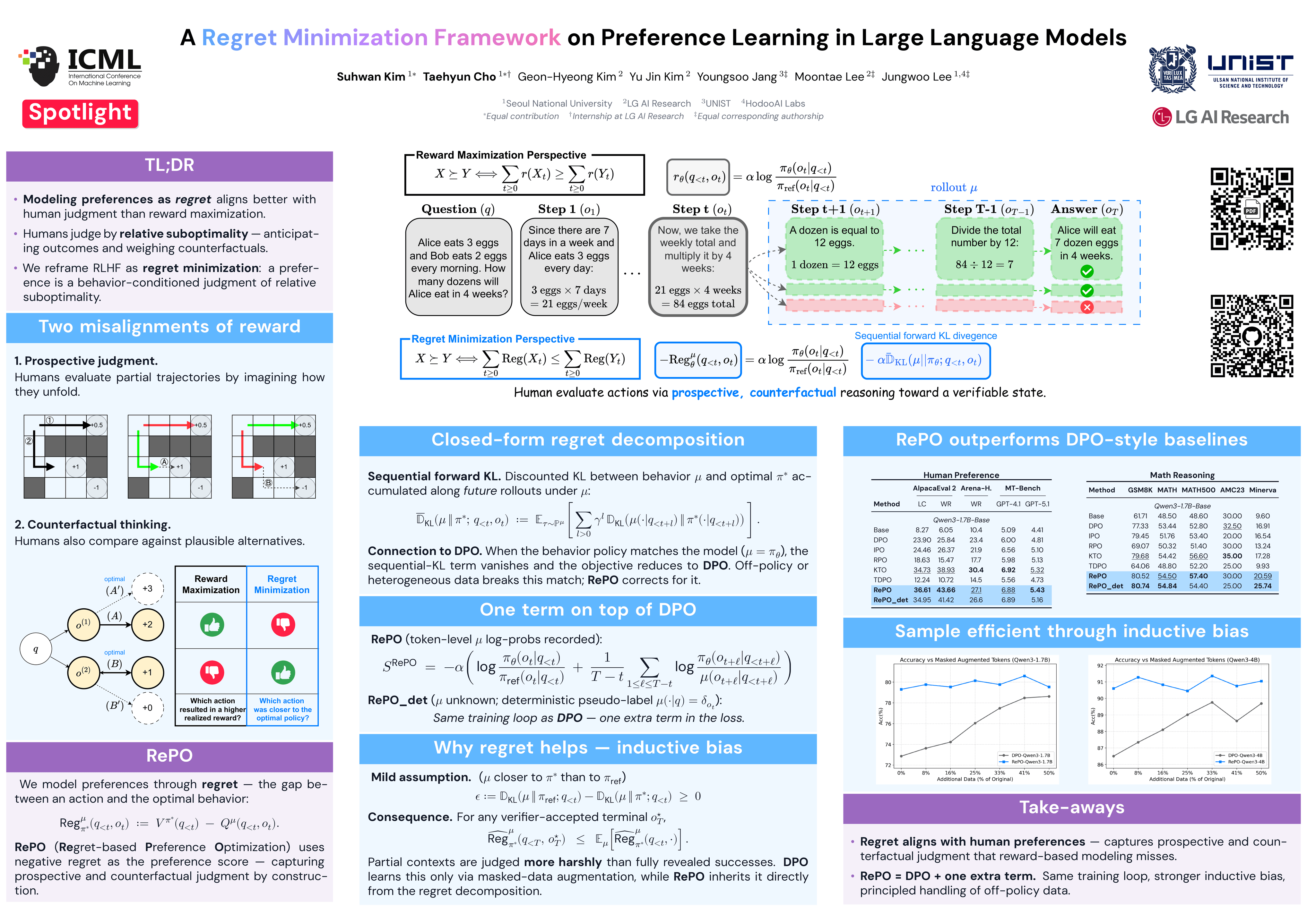
Reinforcement learning with verifiable rewards (RLVR) has enabled progress on reasoning-intensive tasks by relying on task-specific verifiers that provide automated correctness signals. However, many realistic language tasks are difficult to equip with reliable verifiers, motivating a growing reliance on reinforcement learning from human feedback (RLHF). In this setting, we argue that a closer examination of how human feedback should be interpreted is essential. We introduce Regret-based Preference Optimization (RePO), which reframes RLHF through regret minimization rather than reward maximization. Human preferences are often shaped by prospective anticipation of outcomes and counterfactual comparisons to alternative behaviors, rather than by immediate, outcome-independent utility. RePO captures this structure by modeling preferences as behavior-conditioned assessments of relative suboptimality. Within a KL-regularized reinforcement learning framework, RePO admits a closed-form policy update compatible with direct preference optimization. Experiments on mathematical reasoning benchmarks and human-annotated preference datasets demonstrate consistent performance gains, indicating that regret-based preference learning is an effective and human-aligned approach for training large language models.