
Mind the Gap: Catching Hallucinations via Evidence Drop on the Reasoning Manifold
Abstract
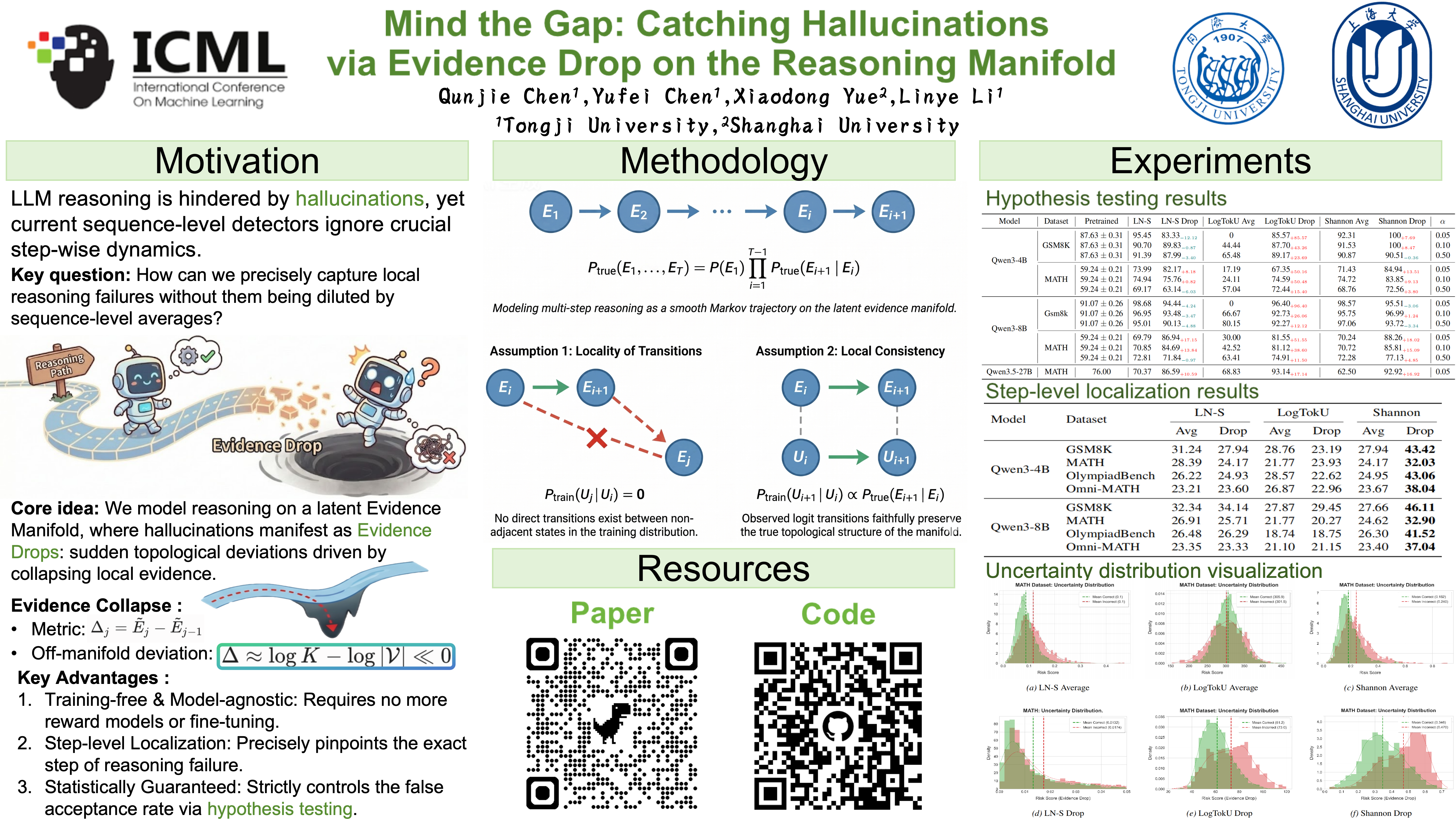
Large Language Models (LLMs) show strong reasoning abilities, yet their reliability is hindered by hallucinations, where fluent reasoning becomes factually or logically incorrect. Most existing uncertainty-based detectors rely on sequence-level averaging, which ignores the step-wise dynamics of reasoning and often misclassifies hard-but-correct or easy-but-wrong samples. We propose a dynamic perspective that models reasoning as a trajectory on a latent Evidence Manifold, where each step is supported by local evidence. Hallucinations are characterized as Evidence Drops, i.e., sudden declines in local evidence support that indicate topological deviations from this manifold. Based on this insight, we design a training-free and model-agnostic detector that identifies hallucinations via the worst-case Evidence Drop and enables step-level error localization. Experiments on GSM8K, MATH, and ProcessBench show consistent improvements over sequence-level uncertainty baselines in selective accuracy and risk–coverage trade-offs.
Lay Summary
Large Language Models often make convincing but flawed logical mistakes called "hallucinations." Previously, researchers tried to catch these errors by measuring the AI's average uncertainty across an entire answer, which easily misses a single fatal mistake hidden within a long reasoning chain. To solve this, we monitor the AI's reasoning process as a continuous journey, looking for a sudden, sharp drop in its internal confidence between consecutive steps—a phenomenon we call the "Evidence Drop." Using a strict statistical framework, our method accurately pinpoints the exact step where the logic breaks down without requiring extra training, making AI systems safer and more reliable for high-stakes real-world applications.