
Imposing Boundary Conditions on Neural Operators via Learned Function Extensions
Abstract
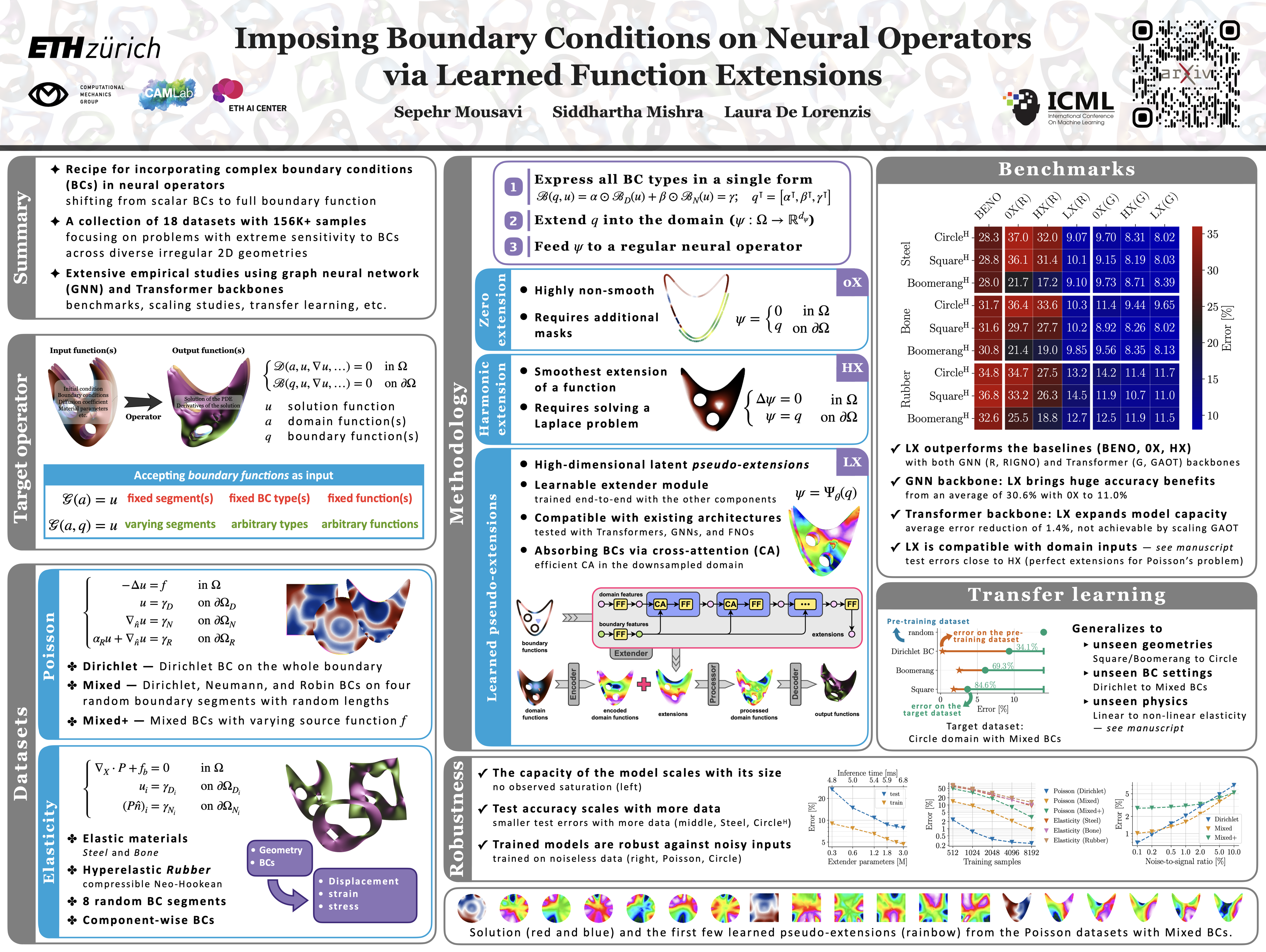
Neural operators have emerged as powerful surrogates for the solution of partial differential equations (PDEs), yet their ability to handle general, highly variable boundary conditions (BCs) remains limited. Existing approaches often fail when the solution operator exhibits strong sensitivity to boundary forcings. We propose a general framework for conditioning neural operators on complex non-homogeneous BCs through function extensions. Our key idea is to map boundary data to latent pseudo-extensions defined over the entire spatial domain, enabling any standard operator learning architecture to consume boundary information. The resulting operator, coupled with an arbitrary domain-to-domain neural operator, can learn rich dependencies on complex BCs and input domain functions at the same time. To benchmark this setting, we construct 18 challenging datasets spanning Poisson, linear elasticity, and hyperelasticity problems, with highly variable, mixed-type, component-wise, and multi-segment BCs on diverse geometries. Our approach achieves state-of-the-art accuracy, outperforming baselines by large margins, while requiring no hyperparameter tuning across datasets. Overall, our results demonstrate that learning boundary-to-domain extensions is an effective and practical strategy for imposing complex BCs in existing neural operator frameworks, enabling accurate and robust scientific machine learning models for a broader range of PDE-governed problems.
Lay Summary
Researchers are developing artificial intelligence (AI) systems that can understand and predict how physical systems behave, such as how air flows around a car based on its shape, speed, and surrounding conditions. One major challenge is teaching these AI systems to account for external effects acting directly on the surface of an object. In the car example, this could include localized heat sources or the influence of air grilles and vents on the car’s surface. We introduce a new method that allows AI models to incorporate these external influences in a consistent way alongside other inputs, helping the models learn how they affect physical behavior. This approach enables AI models to tackle a broader range of scientific and engineering problems that were previously difficult to model. We demonstrate the effectiveness of our method in several challenging scenarios, including predicting how steel, bone, and rubber-like materials respond to complex forces.