
No Data? No Problem: Robust Vision-Tabular Learning with Missing Values
Abstract
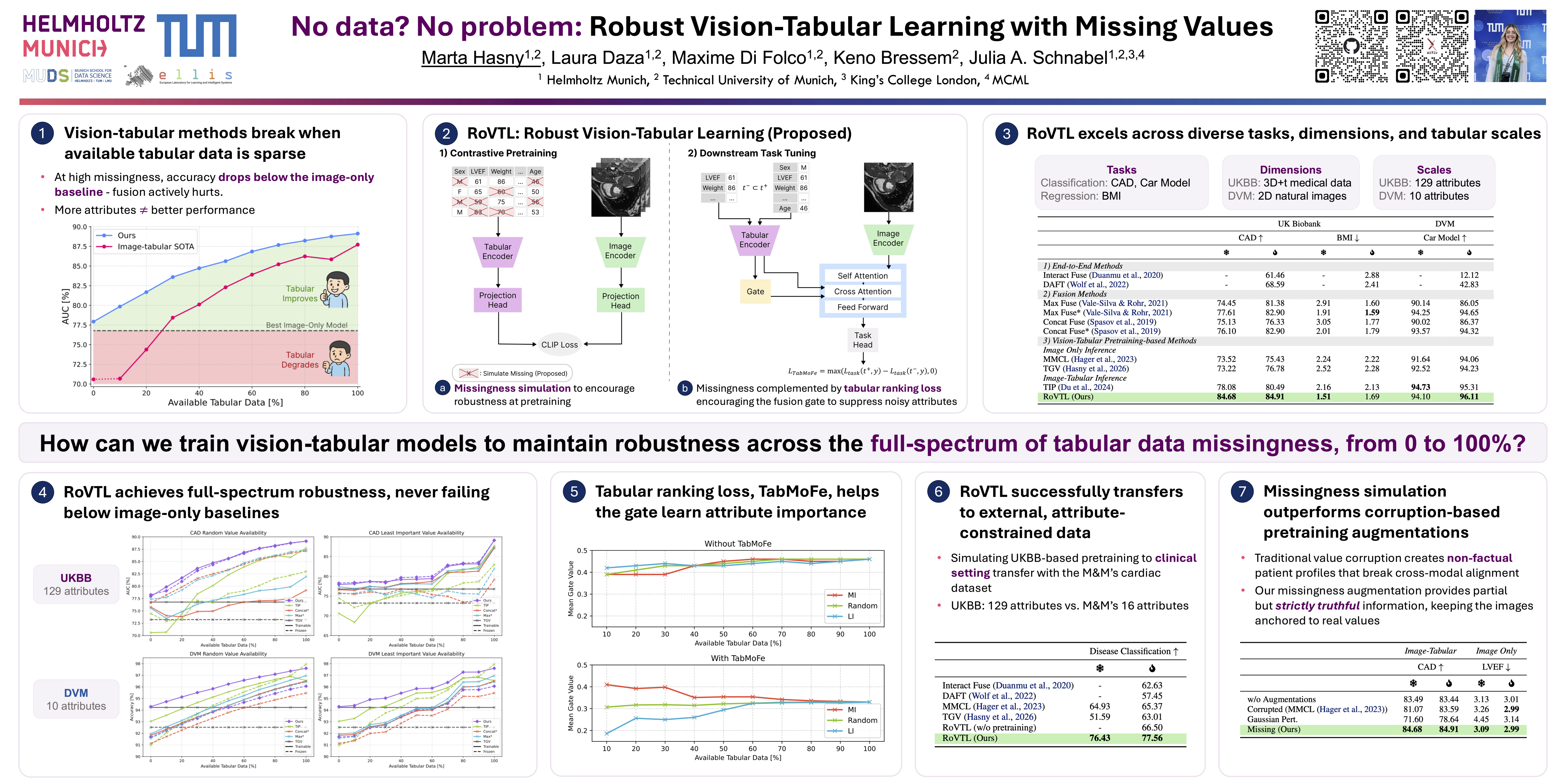
Large-scale medical biobanks provide imaging data complemented by extensive tabular information, such as clinical measurements or demographics. However, this abundance of tabular attributes does not reflect real-world datasets, where only a subset of attributes may be available. This discrepancy calls for methods that remain robust to missing values at inference. To address this challenge, we propose RoVTL (Robust Vision-Tabular Learning), a framework designed to handle any level of tabular data availability, from 0% to 100%. RoVTL comprises two key stages: contrastive pretraining, where we introduce tabular attribute missingness as data augmentation to promote robustness, and downstream task tuning, where tabular missingness is complemented by a novel Tabular More vs. Fewer loss that ranks performance based on the amount of available tabular data. Combined with gated-cross attention fusion module, our tuning approach enables consistent performance across all tabular data completeness scenarios. We evaluate RoVTL on cardiac MRI scans from the UK Biobank, demonstrating superior robustness to missing tabular data compared to prior methods. Furthermore, RoVTL successfully generalizes to an external cardiac MRI dataset for multimodal disease classification, and extends to the natural images domain, achieving robust performance on a car advertisements dataset. The model weights and code are available at https://github.com/marteczkah/RoVTL.
Lay Summary
Medical records often include both images, such as heart scans, and tabular information like age, blood pressure, or smoking history. While combining these data types can improve AI predictions, real-world healthcare data is often incomplete because many patient records are missing some clinical information. Most existing AI systems struggle in these situations and may even perform worse when partial data is added. We developed a new AI framework called RoVTL that remains reliable even when little or no tabular data is available. During training, we intentionally hide random parts of the data tables to teach the system how to handle missing entries without making faulty guesses. We also introduced a novel ranking penalty that forces the AI to prioritize useful information and ignore unhelpful data noise. We tested RoVTL on large-scale heart imaging datasets and a separate real-world clinical dataset, as well as on a non-medical car dataset. Across all settings, our method consistently outperformed previous approaches, especially when tabular data was scarce. This work brings AI systems closer to practical clinical use, where patient information is often incomplete and inconsistent.