
CRPO: Character-centric Group Relative Policy Optimization for Role-aware Reasoning in Role-playing Agents
Abstract
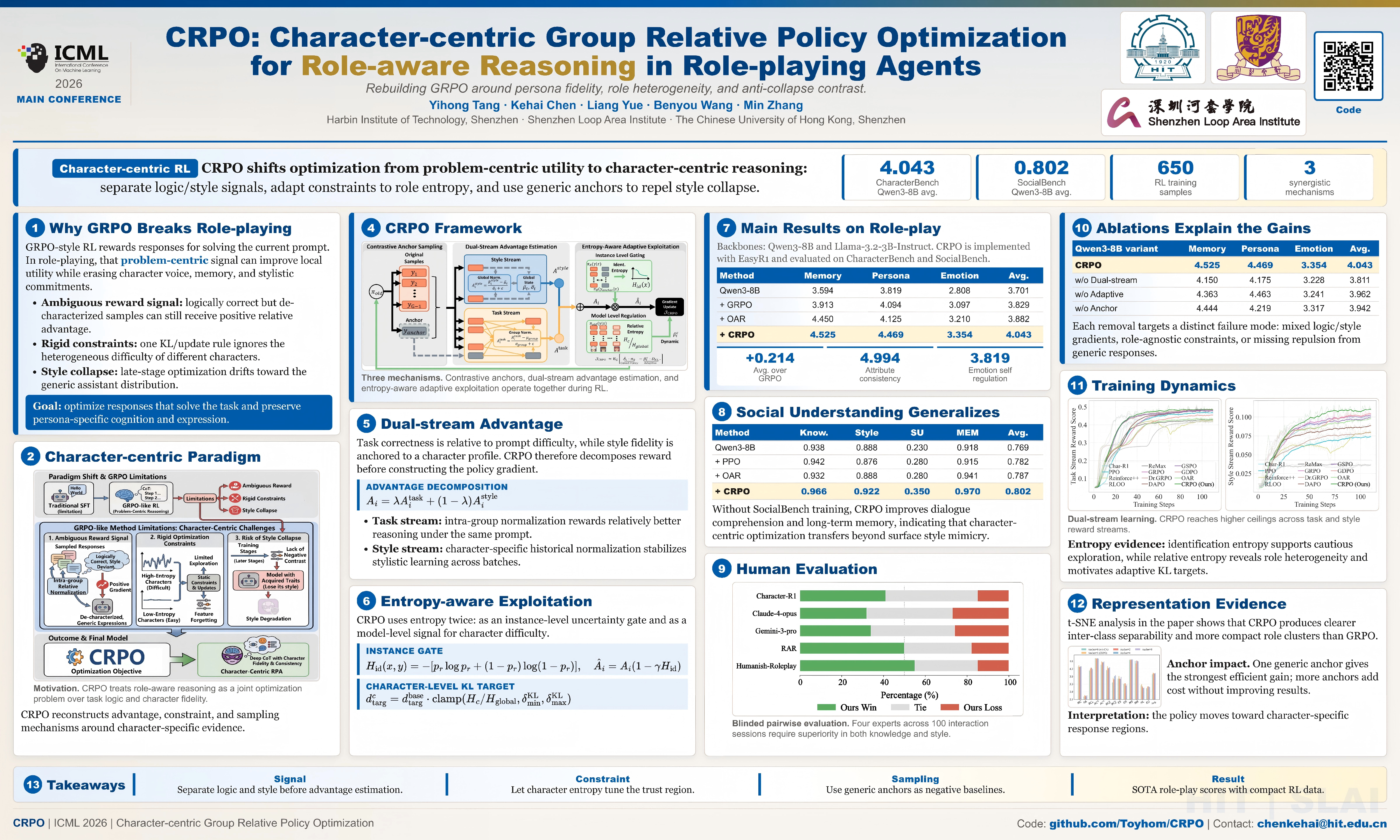
Recent advancements in Reinforcement Learning (RL), particularly Group Relative Policy Optimization (GRPO), have significantly enhanced the reasoning capabilities of Large Language Models. However, applying these problem-centric optimization methods to role-playing agents often leads to a loss of character fidelity and style collapse, as they prioritize context-specific utility over persona alignment. To address this, we propose Character-Centric Group Relative Policy Optimization (CRPO), a framework designed to realign RL objectives with the role-playing task. CRPO improves character distinctiveness through three mechanisms: decoupling task logic from stylistic rewards to resolve gradient conflicts, dynamically adapting optimization constraints based on character complexity, and utilizing generic responses as negative baselines to prevent the model from reverting to a common distribution. Extensive experiments demonstrate that CRPO outperforms existing methods in consistency, emotion and others.
Lay Summary
When people talk to an AI character, they expect it to remember who it is, speak in a consistent voice, and avoid saying things that break the illusion. But current training methods can make these characters sound more generic: they may answer the question correctly while forgetting important details about their background or personality. We built a new way to train AI role-playing agents so that they do not just give useful answers, but also stay true to the character they are playing. Our method encourages the model to keep track of character-specific information, avoid bland responses, and balance helpfulness with consistency. This can make AI characters more reliable and believable in applications such as games, storytelling, education, and personalized assistants.