
TimeMRA: LLM-Empowered Time Series Forecasting via Multi-Scale Retrieval-Augmented Representations
Abstract
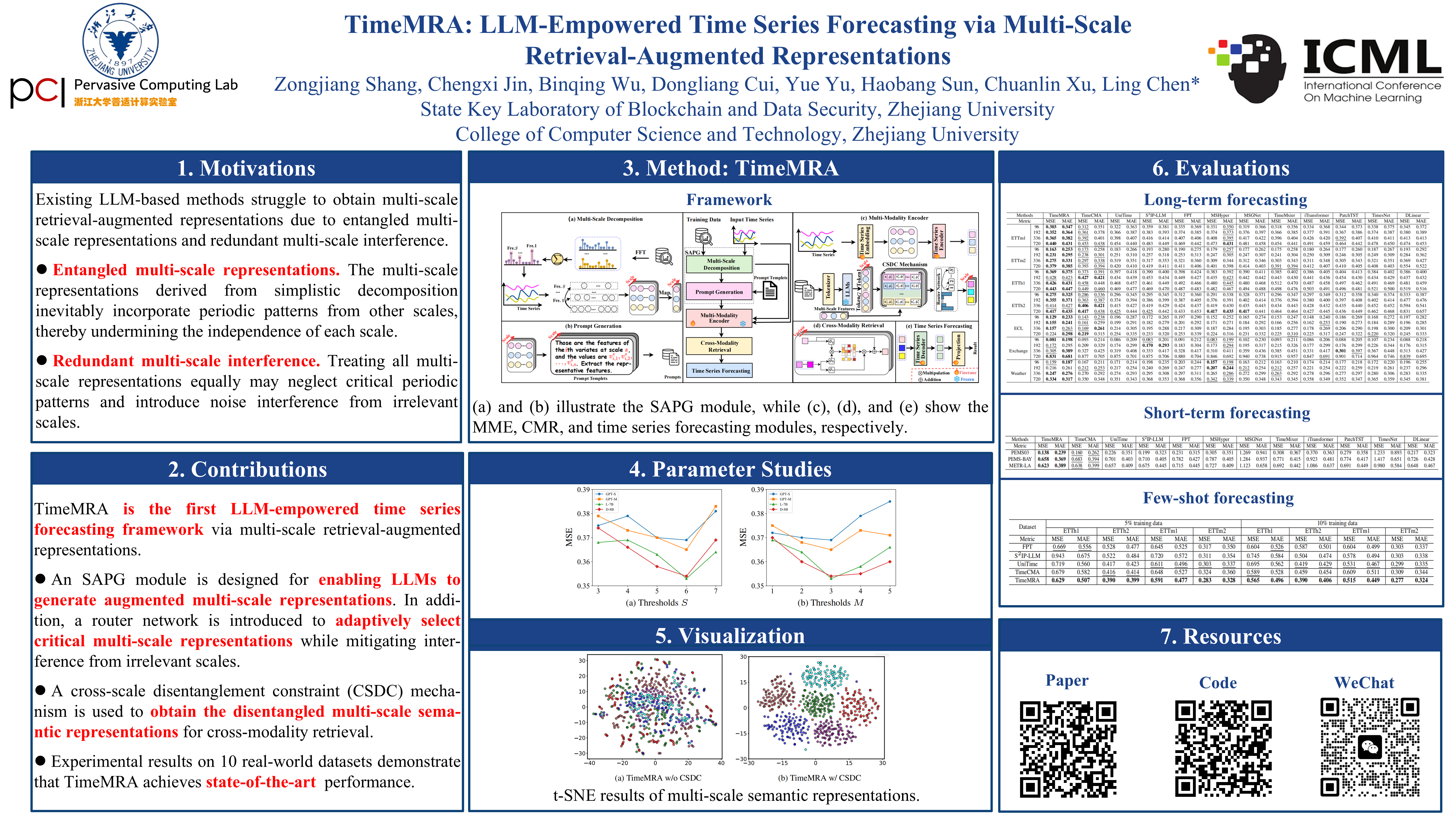
Time series forecasting plays a pivotal role in data-driven decision-making across various time series domains. Recently, leveraging their ability to extract semantically rich representations, Large Language Models (LLMs) have achieved promising results in time series forecasting. However, existing LLM-based methods struggle to obtain multi-scale retrieval-augmented representations due to entangled multi-scale representations and redundant multi-scale interference. To address this, we propose TimeMRA, an LLM-empowered Time series forecasting framework via Multi-Scale Retrieval-Augmented representations. Specifically, a scale-aware prompt generation (SAPG) module is designed to decompose time series into multiple scales and generate augmented multi-scale representations. Then, a cross-scale disentanglement constraint (CSDC) mechanism with a router network is designed to obtain the disentangled multi-scale semantic representations while mitigating interference from irrelevant scales. Finally, a cross-modality retrieval module is designed to obtain multi-scale retrieval-augmented representations for time series forecasting. Experiments on 10 real-world datasets demonstrate that TimeMRA achieves state-of-the-art (SOTA) performance.
Lay Summary
Time series forecasting plays a pivotal role across various domains (e.g., financial forecasting, medical diagnostics, and environmental surveillance). Recently, leveraging their ability to extract semantically rich representations, Large Language Models (LLMs) have achieved promising results in time series forecasting. However, existing LLM-based methods struggle to obtain multi-scale retrieval-augmented representations. In this paper, we propose TimeMRA, the first framework that combines LLMs with multi-scale pattern retrieval for time series forecasting. TimeMRA first analyzes time series data at different temporal scales, and then uses LLMs to generate richer semantic representations for each scale. To further improve forecasting accuracy, we introduce a mechanism to adaptively select critical multi-scale representations while mitigating interference from irrelevant scales. Experimental results on multiple real-world datasets show that TimeMRA consistently achieves state-of-the-art results, especially in challenging scenarios with limited training data.