
Hi-Time: Hierarchical Latent Prediction for Multivariate Time Series Classification
Abstract
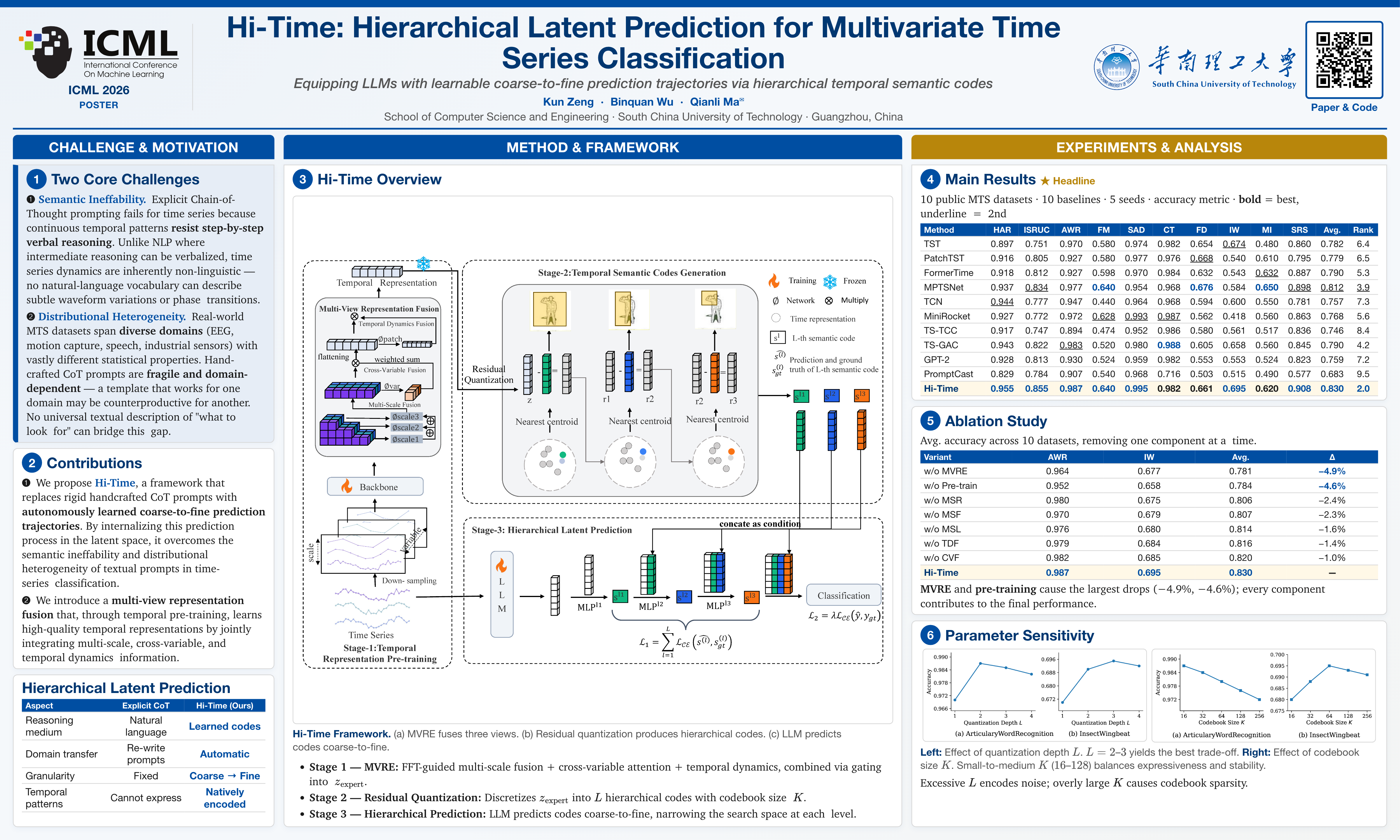
Integrating Large Language Models (LLMs) into time series tasks has yielded impressive performance. While some works aim to enhance accuracy by explicitly designing step-by-step reasoning into prompts, such explicit Chain-of-Thought (CoT) approaches are difficult to generalize to time series. This is because it is difficult to clearly define the reasoning trajectories of time series. In addition, the high heterogeneity across time series often requires specialized prompt designs, limiting the model's scalability. To address these challenges, we propose Hi-Time, a hierarchical latent prediction framework based on temporal semantic codes for multivariate time series classification. This framework automatically constructs scenario-specific coarse-to-fine prediction trajectories based on the characteristics of time series, thereby providing structured supervision for the LLM. Specifically, Hi-Time first performs temporal representation pre-training with a multi-view temporal representation fusion to acquire high-quality temporal embeddings. We then discretize these temporal embeddings into hierarchical temporal semantic codes that form the coarse-to-fine prediction trajectory. Finally, the LLM predicts temporal semantic codes in a stepwise manner and then infers the final label, thereby establishing a coarse-to-fine decision process. Experiments on ten public multivariate time series datasets demonstrate that Hi-Time effectively adapts to diverse datasets and outperforms state-of-the-art methods. Our code is available at .
Lay Summary
Large Language Models (LLMs) excel at solving complex problems by reasoning "step-by-step" using text. However, many real-world applications rely on time-series data—such as readings from heart monitors, stock market trends, or industrial sensors—which consist of continuous, fluctuating signals rather than words. It is incredibly difficult for humans to define a clear, text-based reasoning process to explain these abstract patterns to a model. To solve this, we created Hi-Time, a framework that allows the model to develop its own internal reasoning path. Instead of forcing the model to rely on human language, our approach translates continuous signals into a sequence of hidden "codes." The model is then trained to predict these codes step-by-step, starting with broad, high-level patterns and progressively zooming in on finer details. Once this coarse-to-fine "thinking" process is complete, the model makes its final prediction. This approach enables models to naturally understand complex sensor data across diverse fields, from human activity tracking to equipment monitoring. By allowing the model to build its own structured reasoning process, our method significantly outperforms existing approaches.