
Hidden in Plain Tokens: Simply Robust, Gradient-Free Watermark for Synthetic Audio
Abstract
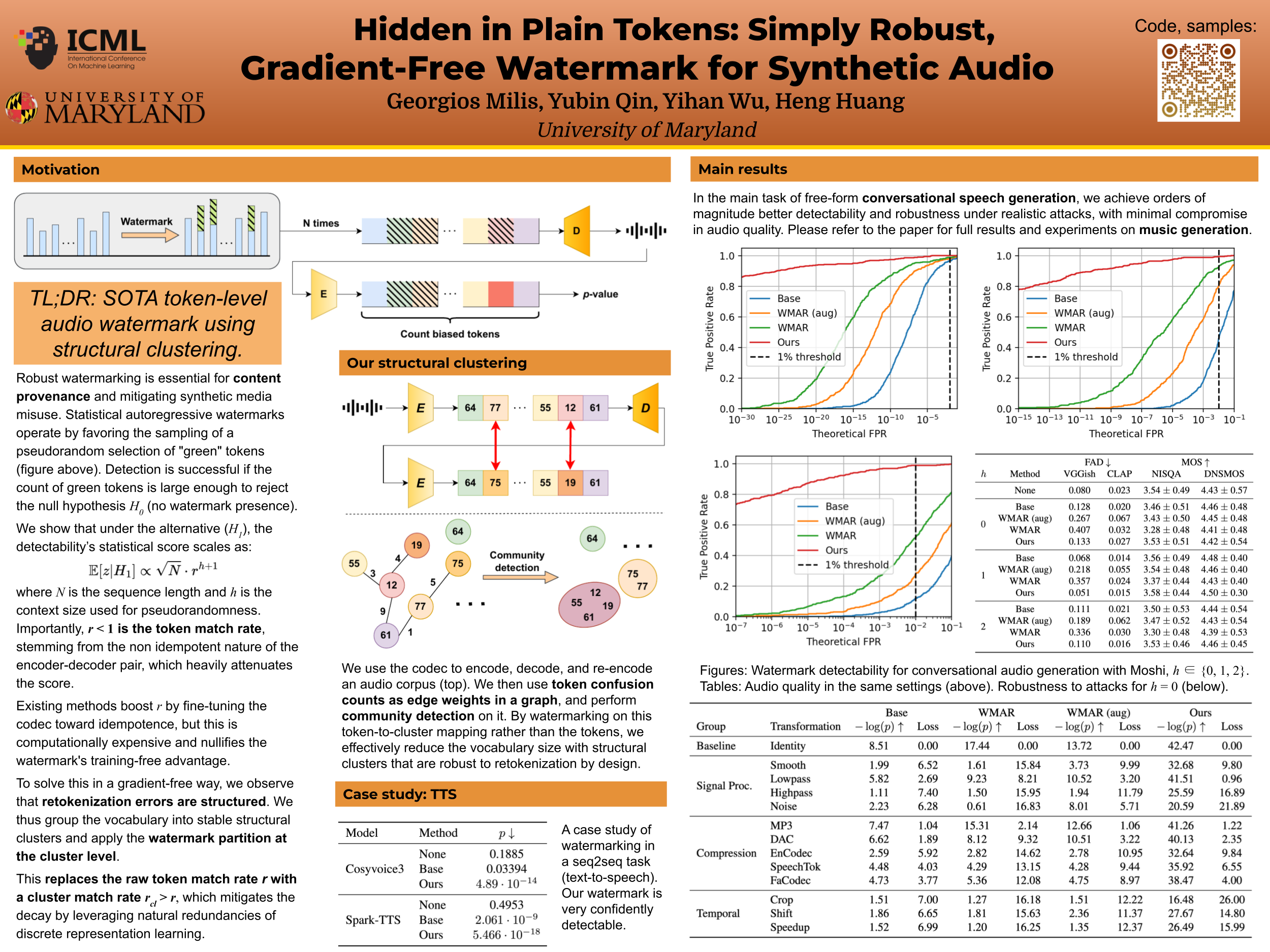
As policy catches up with the capabilities of generative AI, watermarking is central to content provenance efforts. Inference-time watermarks for autoregressive models are unfit for continuous modalities due to discretization inconsistencies. Existing methods overcome this by finetuning the modality tokenizers, nullifying the watermark's training-free advantage. In this work, motivated by the vocabulary redundancy of discretization, we propose an elegant solution for powerful and robust watermarking of synthetic audio. We theoretically analyze the impact of token errors on watermark detection, and effectively mitigate them using a reduced vocabulary obtained via community detection. Thorough experiments showcase that our gradient-free method can boost detectability by several orders of magnitude, while also achieving built-in robustness to audio modifications. Broadly, we discover a new state-of-the-art for token-level watermarks in multimedia, which simply arises from the nature of discrete representation learning.
Lay Summary
The rise of generative AI has brought attention to watermarking techniques, which modify AI-generated content in a way that is imperceptible to humans, but easily detectable algorithmically. In the context of audio, this enables to test whether an audio clip is real or synthetic, an important step towards combating fraud and misinformation. This work proposes a novel type of audio watermark, which remains robustly detectable even after processing the audio clip, such as speech or music, as is common in social media. We achieve this robustness without modifying the audio generator itself, as the previous methods did. Rather, we capture similar sounds and group them together, so that processing the audio does not change the high-level structure of our hidden watermark.