
PGD-NO: A Neural Operator with Precomputed Geometry Decomposition for 3D Million-Scale Physics Simulations
Abstract
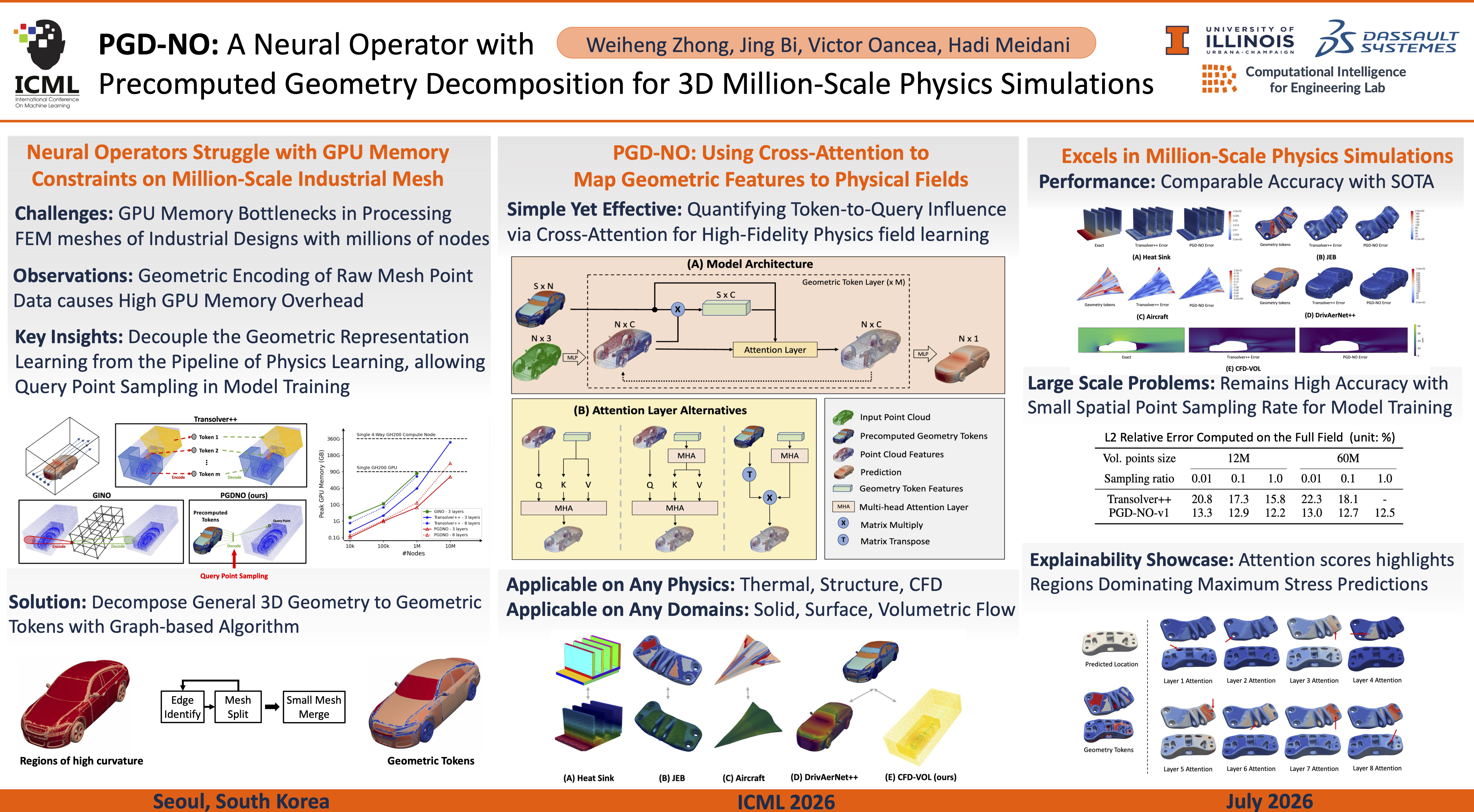
While neural PDE solvers have demonstrated significant potential for accelerating engineering simulations, existing architectures remain constrained by high memory consumption and the "single-node bottleneck," where the maximum processable mesh resolution is strictly limited by the VRAM of a single compute unit. To address these challenges, we propose PGD-NO, a neural operator with Precomputed Geometry Decomposition, that relocates the computational overhead of geometric encoding to a deterministic pre-computation phase. By utilizing an iterative geometry decomposition algorithm to extract "geometry tokens," our model decouples feature extraction from solution querying. This architecture enables linear memory scalability, allowing high-fidelity learning on meshes exceeding 10 million nodes—a scale where existing architectures typically encounter memory exhaustion. PGD-NO demonstrates competitive predictive accuracy across diverse industrial benchmarks and provides intrinsic interpretability through attention mechanisms. By effectively overcoming traditional mesh-size constraints, PGD-NO offers a robust and efficient solution for the next generation of large-scale, high-fidelity industrial design applications.
Lay Summary
Using AI to simulate complex engineering designs, like cars or airplanes, drastically speeds up manufacturing. However, current AI models hit a wall: they run out of memory when a design requires a highly detailed, high-resolution simulation. To overcome this, we created a new AI method that fundamentally changes how models learn physical simulations. Instead of using traditional "encoder-decoder" setups that try to process the huge point cloud, our system pre-processes the geometries using an intelligent decompostion algorithm to extract meaningful geometry tokens, allowing the AI to learn the physics using a more streamlined "decoder-only" architecture. This breakthrough allows our AI to handle massive design evaluations with up to 100 million data points. Ultimately, this work makes it practical for industries to use AI to design the next generation of large-scale, high-fidelity engineering products efficiently and safely.