
Ski Rental with Distributional Predictions of Unknown Quality
Abstract
Lay Summary
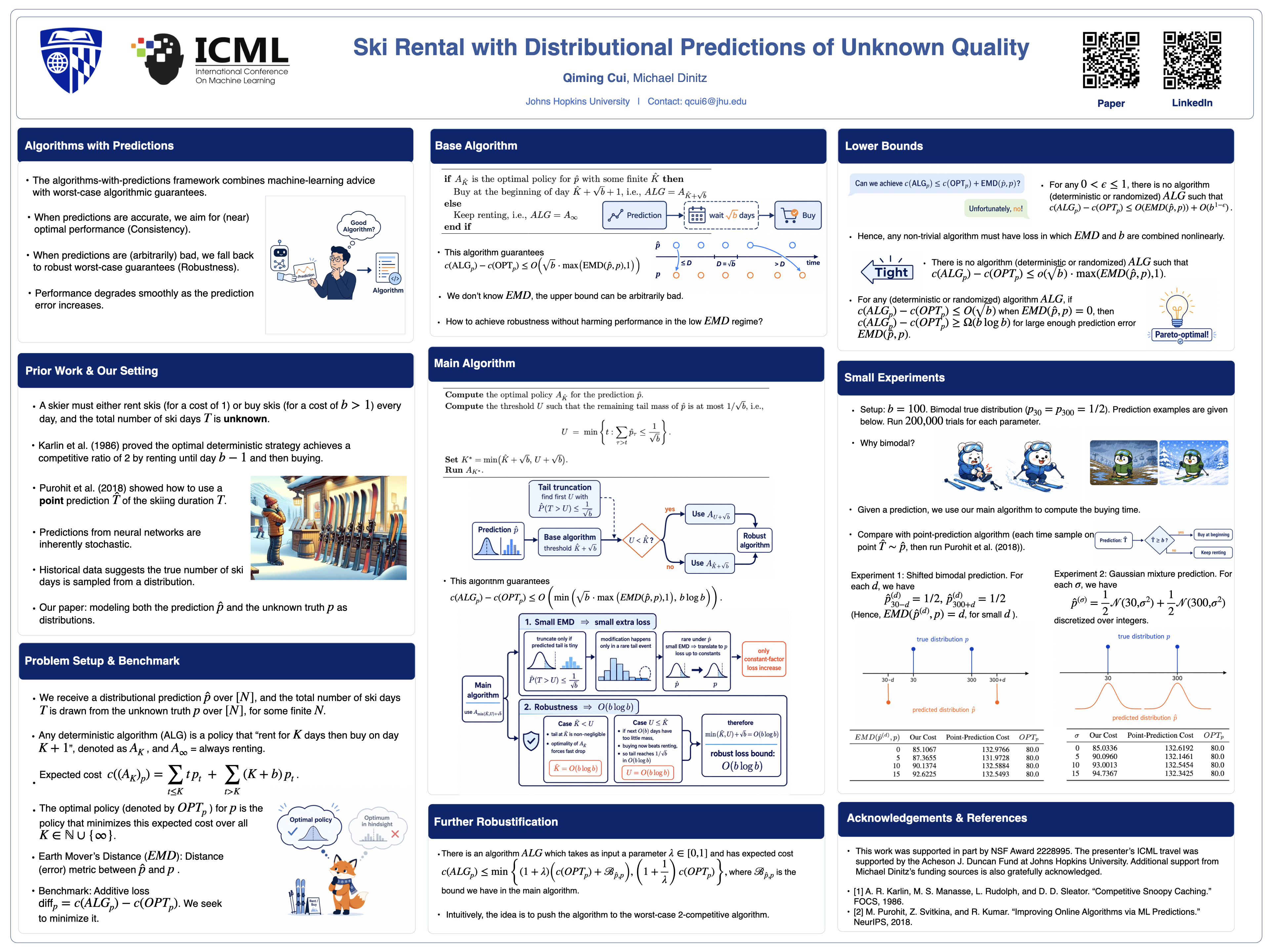
Suppose you go skiing for the winter. Every day, you face a choice: rent skis for a small daily fee, or buy them for a large upfront cost. If you buy, you never pay again. Since buying is more expensive than renting, you would like to buy at the beginning of the season if you will ski many days, but rent every day if you will not ski many days. The catch is that you do not know how many ski days you will get. This is a classical online decision problem known as "ski rental", which models and exemplifies a common "rent-or-buy" question which arises in many important online decision-making scenarios (e.g., renting or buying infrastructure or equipment). Due to its combination of importance and simplicity it has been studied for over 40 years. We consider a variant of this problem which has "predictions": what if the true number of ski days is drawn from an unknown distribution, but we are given a "predicted" distribution (possibly based on past data)? If our prediction is highly accurate then we want our algorithmic performance to be nearly optimal, but if the prediction is wildly incorrect then we still need a guarantee that our costs won't be arbitrarily bad. We design new algorithms which we prove achieve the best of both worlds: smoothly degrading performance as prediction error increases, but also robust guarantees in the worst case.