
GaussTrace: Provenance Analysis of 3D Gaussian Splatting Models with Evidence-based LLM Reasoning
Abstract
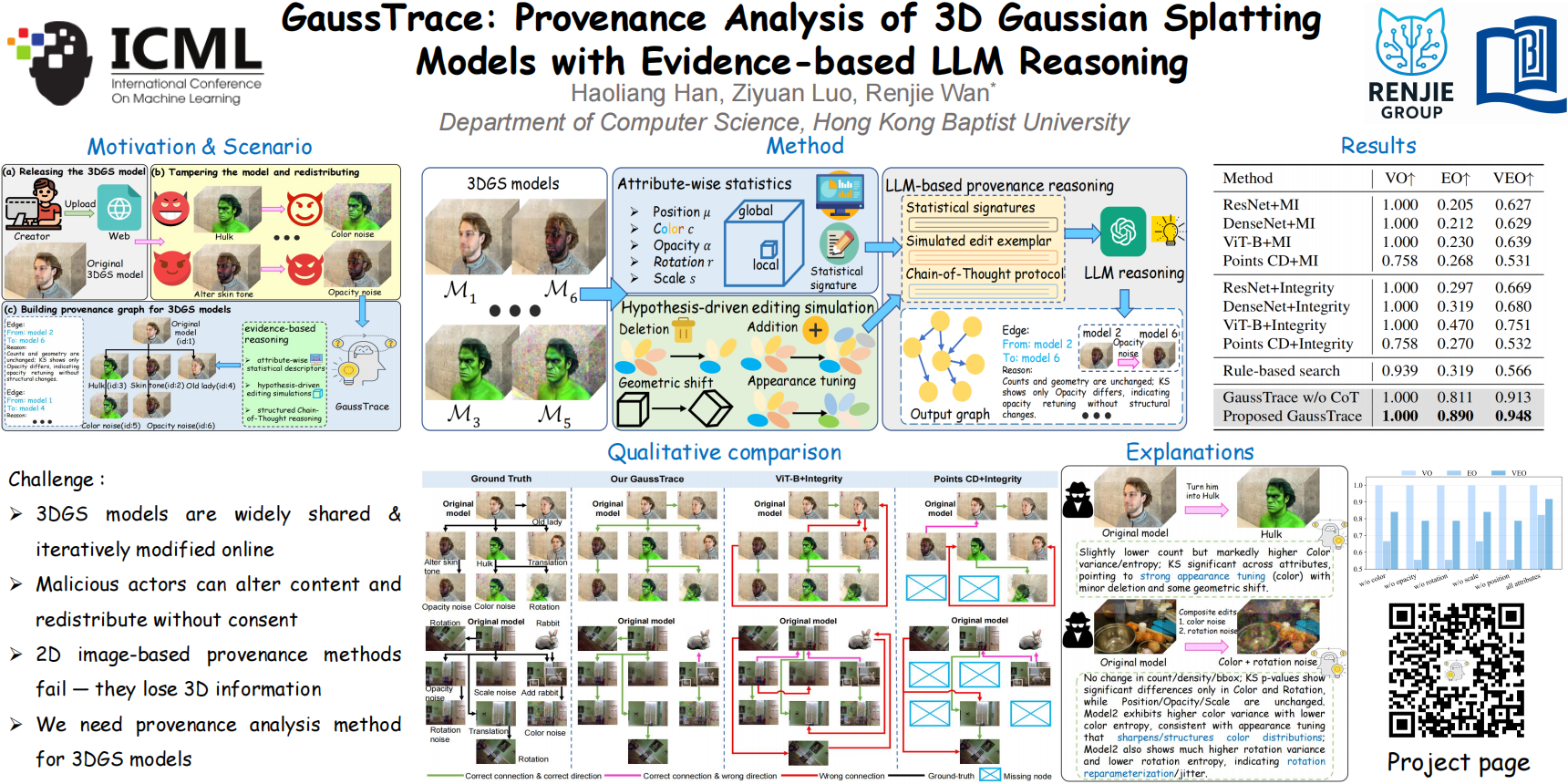
3D Gaussian Splatting (3DGS) is a powerful technique for creating high-fidelity 3D assets. However, the widespread sharing and iterative modification of 3DGS models across digital platforms create pressing challenges for intellectual property protection and forensic traceability. To address this, we propose GaussTrace, a novel framework for constructing directed provenance graphs for 3DGS models. GaussTrace formulates provenance analysis as an evidence-based reasoning problem. It builds upon attribute-wise statistical profiling of 3DGS parameters to capture intrinsic properties. Moreover, we introduce hypothesis-driven editing simulations of common operations to provide auxiliary evidence for plausible transformation pathways. These statistical and simulated cues jointly enable a Large Language Model (LLM) to perform structured Chain-of-Thought (CoT) reasoning, yielding directional provenance inferences and explainable edge reasons. Experimental results demonstrate that GaussTrace effectively constructs evolutionary relationships among diverse 3DGS models, delivering accurate, interpretable, and robust provenance graphs without requiring model training or access to editing histories. Project page: https://haolianghan.github.io/GaussTrace.
Lay Summary
Modern 3D creation tools make it easy to edit and share highly realistic 3D scenes. However, once these assets are modified and redistributed across multiple users or platforms, it becomes difficult to determine where a model originally came from, how it was changed, or whether it has been maliciously manipulated. This creates important challenges for digital ownership, content authenticity, and forensic analysis. In this work, we introduce GaussTrace, a novel framework designed to trace the evolutionary lineages of 3D assets created with 3D Gaussian Splatting (3DGS), a rapidly emerging representation for realistic 3D scenes. GaussTrace analyzes statistical patterns inside 3DGS models together with simulated editing evidence, and uses reasoning techniques to infer modification relationships between 3D assets. It can reconstruct provenance graphs that describe how models evolve through editing and redistribution, while also generating human-readable explanations for inferred relationships. Experiments across diverse editing scenarios show that GaussTrace can accurately recover complex editing histories. By improving the traceability and transparency of evolving 3D assets, our work supports more trustworthy management, sharing, and verification of digital 3D content.