
R2R2: Robust Representation for Intensive Experience Reuse via Redundancy Reduction in Self-Predictive Learning
Abstract
Lay Summary
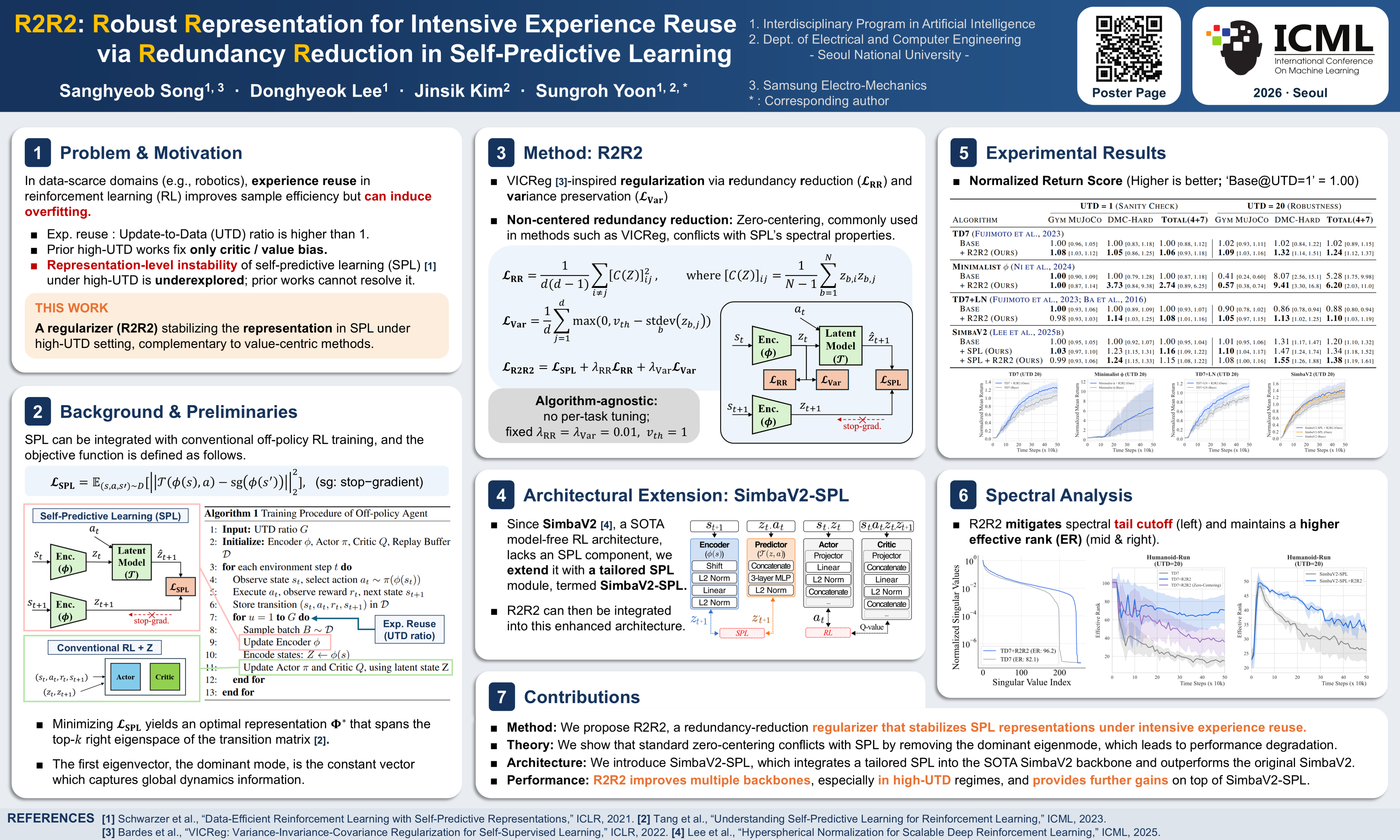
Training AI for real-world robots is challenging because collecting physical data is slow and expensive. To learn efficiently, AI systems must reuse the same limited data many times. However, this intensive reuse often causes the AI to simply memorize the data rather than learn general skills, a problem known as overfitting. We found that a major cause of this failure is that the AI's internal representation of the environment becomes highly unstable when data is reused too heavily. To solve this, we developed a method called R2R2. It improves how the AI learns to view its environment by actively reducing unnecessary, redundant information. We carefully designed our mathematical objective to preserve the essential features of the data, keeping the AI's internal representations highly stable even under aggressive data reuse. We tested our method across 11 complex virtual robot tasks. By adding R2R2 to various standard and state-of-the-art AI architectures, we successfully mitigated the overfitting issue. It improved the performance of existing methods, TD7, by about 22% and pushed the current top-performing systems to even higher scores. This work provides a more reliable way to train capable AI agents using limited data.