
DTop-p MoE: Sparsity-Controlled Dynamic Top-p MoE for Foundation Model Pre-training
Abstract
Lay Summary
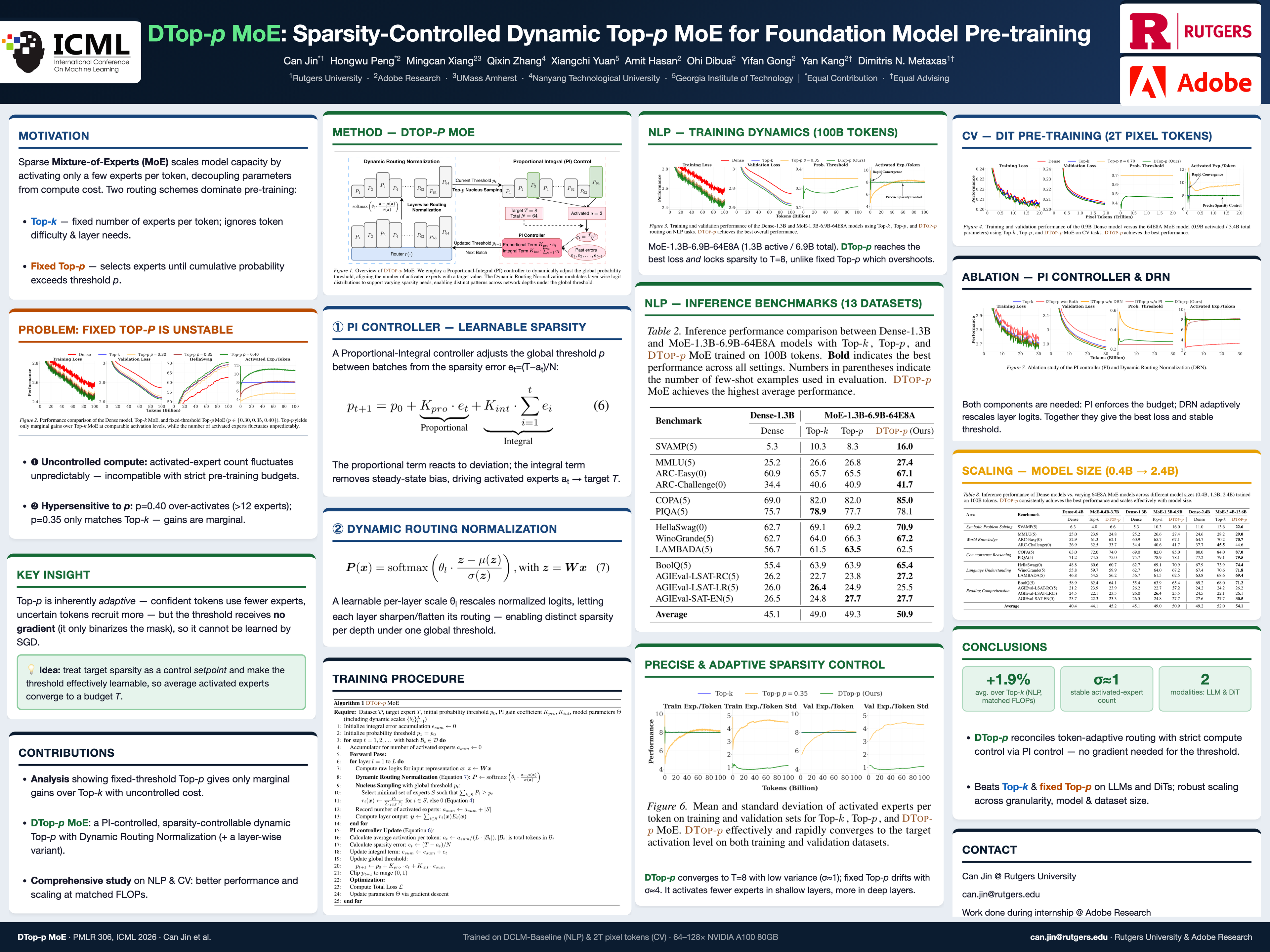
Modern AI systems like large language models are enormous, and running every part of them for every word they process is wasteful and expensive. A popular fix is "Mixture-of-Experts": instead of using the whole network, the model routes each piece of text to a small handful of specialized sub-networks, or "experts." The standard approach forces every input to use the same fixed number of experts. But that's like assigning the same number of staff to every task regardless of difficulty—simple inputs get more help than they need, while hard ones get too little. A natural alternative lets the model decide how many experts to use per input, but existing versions of this idea are unpredictable: the computing cost swings wildly during training, which makes them hard to budget for and prone to crashing. We borrowed a tool from classical engineering—the same kind of feedback controller that keeps a thermostat steady—to automatically tune how many experts get used, holding the average cost to a fixed target while still letting individual inputs draw on more or fewer experts as needed. Across language and image tasks, our method beats the standard approach at the same computing cost. This makes large AI models more efficient and easier to scale under practical training budgets.