
Scene Graph Thinking: Reinforcing Structured Visual Reasoning for Multimodal Large Language Models
Abstract
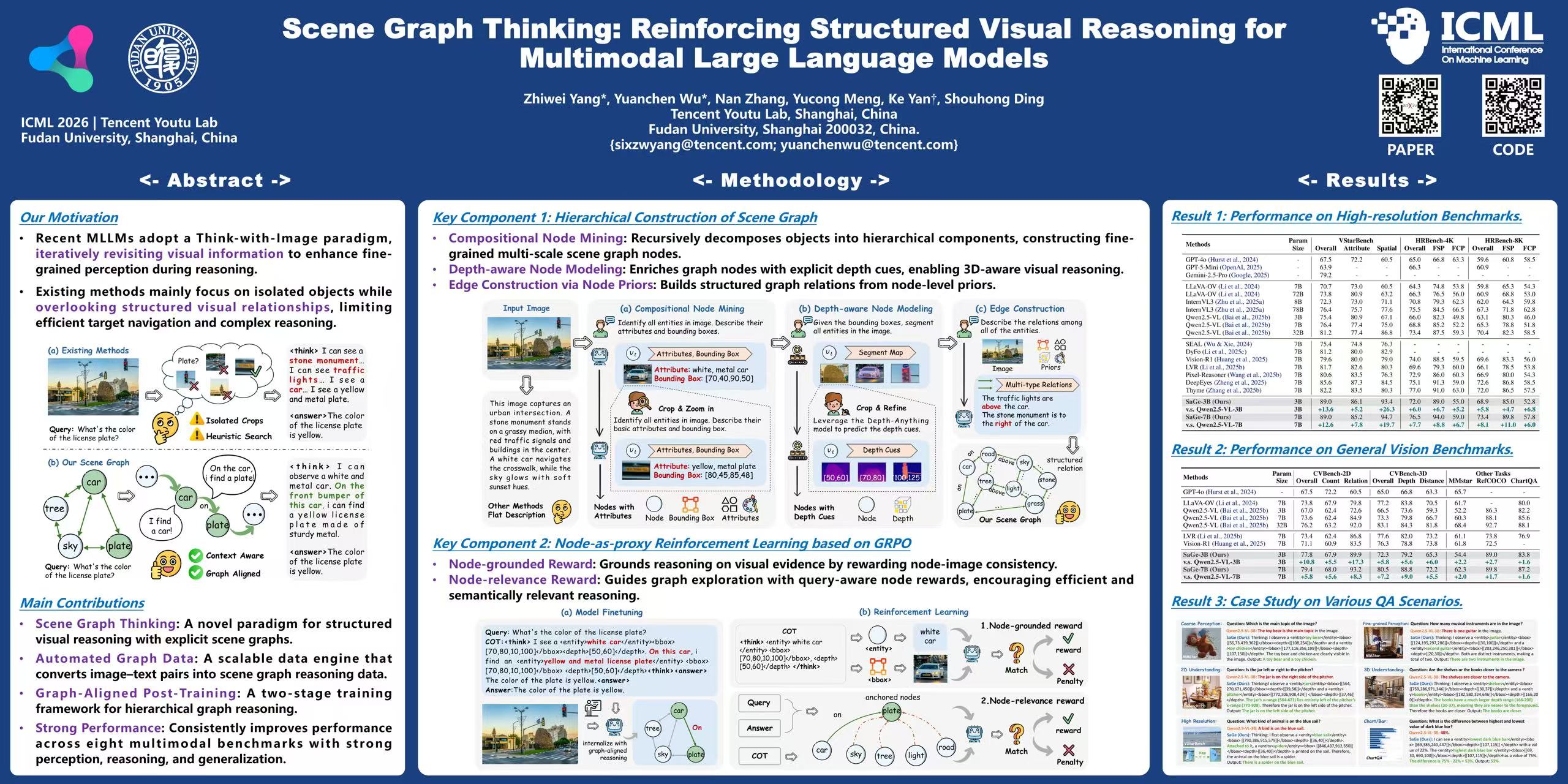
Multimodal Large Language Models (MLLMs) have demonstrated strong perception and reasoning capabilities. However, most existing models focus on isolated objects and neglect structured relationships for efficient target navigation, limiting their performance on visually intensive tasks. To address this challenge, we introduce Scene Graph Thinking (SaGe), a novel paradigm that enables fine-grained and structured visual reasoning through explicit scene-graph representations. Specifically, we first introduce an automated data engine that converts flat image–text corpora into structured scene graphs, where hierarchical entities constitute the nodes and diverse visual relations define the edges. Building upon this, we construct 120K high-quality training data by sampling reasoning traces from scene graphs. Then two-stage graph-aligned post-training paradigms are introduced, where supervised fine-tuning internalizes MLLMs with structured reasoning, and subsequent reinforcement fine-tuning proposes node-as-proxy graph rewards to consolidate efficient graph exploration. With curated data and graph-aligned training, our approach achieves significant improvements across eight multimodal benchmarks, demonstrating strong effectiveness on fine-grained perception and reasoning tasks.
Lay Summary
Modern AI systems that combine vision and language, known as Multimodal Large Language Models (MLLMs), can recognize objects in images and answer questions about them.However, many existing models still struggle to perceive fine-grained visual details in complex scenes. For example, while a model may correctly recognize a “person,” it often fails to notice smaller but important objects such as a watch, necklace, or badge, especially when these details are subtle or partially occluded. This limitation reduces the model’s ability to perform accurate visual reasoning and understand rich real-world interactions. In this work, we introduce Scene Graph Thinking (SaGe), a new training framework that teaches AI systems to reason about images in a more structured and human-like way. Our approach represents a scene as a graph: objects become nodes, while relationships between objects become edges. This allows the model to explicitly understand how different parts of an image are connected, while also helping it identify and focus on small but important objects through these structural relationships. To train the model, we develop an automated pipeline that converts large collections of image–text data into structured scene graphs and generates reasoning examples from them. We then design a two-stage training strategy that first teaches the model structured reasoning patterns and later reinforces efficient reasoning through reward-based learning. Experiments across eight benchmark tasks show that SaGe significantly improves fine-grained visual understanding and reasoning abilities. In particular, the model becomes better at understanding detailed object interactions and navigating complex visual scenes. We hope this work contributes toward more reliable and interpretable multimodal AI systems that can better understand the structured nature of the visual world.