
Learning Cardiac Latent Representations in Vectorcardiogram Space
Abstract
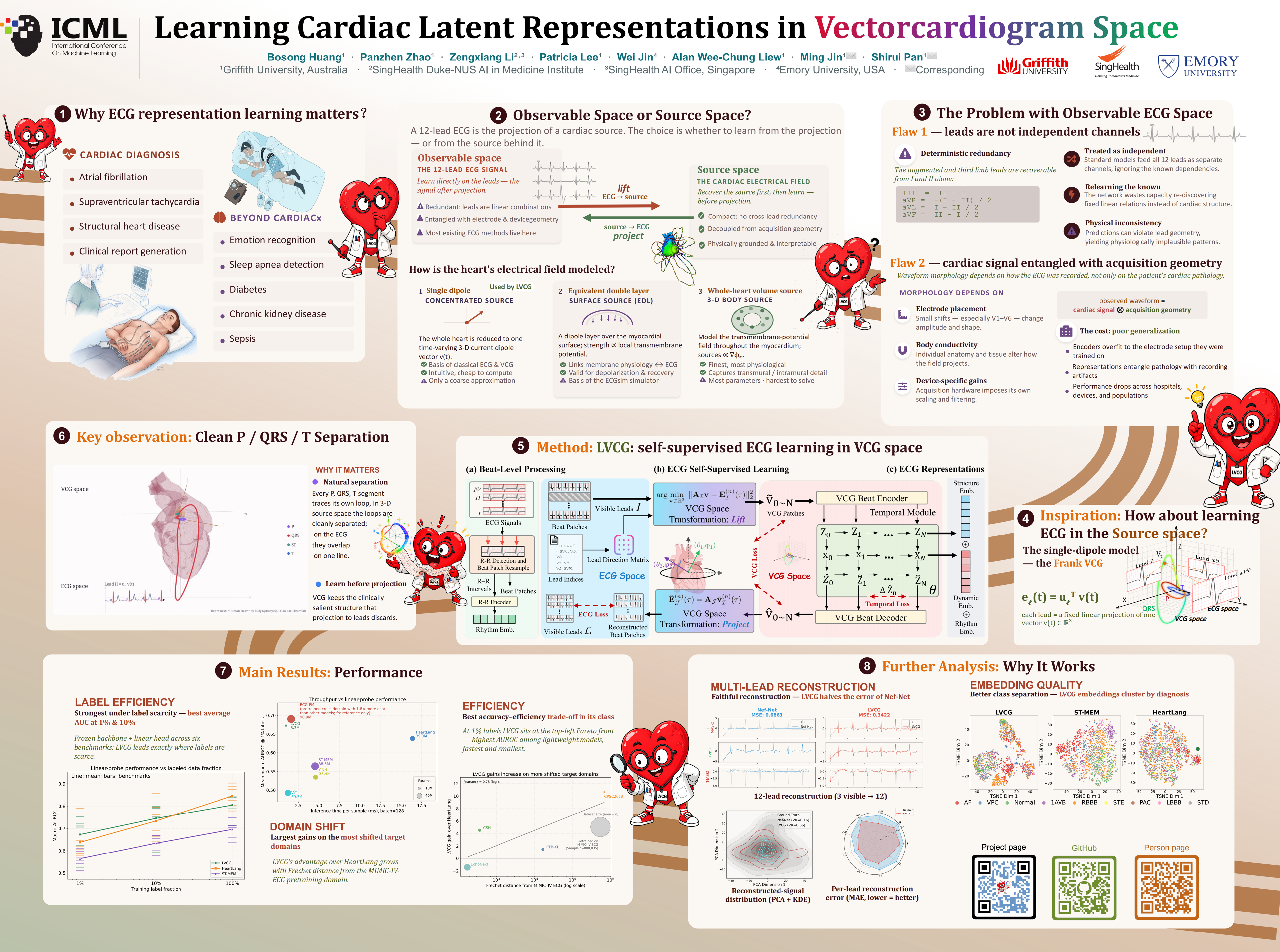
Electrocardiography (ECG) is a cornerstone of cardiac assessment, making the learning of informative ECG representations fundamental to tasks ranging from disease diagnosis to clinical report generation. However, existing methods operate almost exclusively in the observable ECG signal space. In practice, the standard twelve-lead ECG represents multiple projections of the same underlying cardiac electrical activity from different spatial orientations. Therefore, representation learning in the ECG space inevitably introduces substantial redundancy, which may lead to spurious correlations and increased risk of overfitting. To address this and motivated by the Frank vectorcardiogram (VCG) model, we propose learning a unified latent representation of cardiac electrical activity directly in the VCG space. We introduce LVCG, the first general self-supervised representation learning framework designed to operate in this physically grounded latent space. By learning view-invariant latent VCG representations rather than lead-specific artifacts, VCG minimizes redundancy and improves generalization. LVCG generally outperforms ECG-space baselines across tasks, demonstrating enhanced robustness and generalization, especially in domain shift settings. Our code has been made available at https://github.com/BosonHwang/LVCG.
Lay Summary
Electrocardiograms (ECGs) are widely used to assess heart health and are increasingly analyzed by AI systems for tasks such as disease diagnosis and clinical report generation. Most existing AI methods learn directly from the standard 12-lead ECG signals. However, these 12 leads are not independent measurements: they are different views of the same underlying electrical activity of the heart. This can introduce redundant information and make AI models focus on lead-specific patterns that do not generalize well across patients or devices. To address this problem, we developed LVCG, a new self-supervised learning framework that learns representations in vectorcardiogram (VCG) space, a three-dimensional representation of cardiac electrical activity inspired by classical cardiac electrophysiology. Instead of learning from individual ECG leads separately, our method learns a shared representation of the underlying cardiac dynamics. Our experiments show that LVCG produces more robust and transferable ECG representations than existing ECG-based methods, especially when evaluated on data from different hospitals or clinical settings. These findings suggest that incorporating physiological structure into AI models may improve the reliability and generalization of future ECG analysis systems.