
SPHERE: Mitigating the Loss of Spectral Plasticity in Mixture-of-Experts for Deep Reinforcement Learning
Abstract
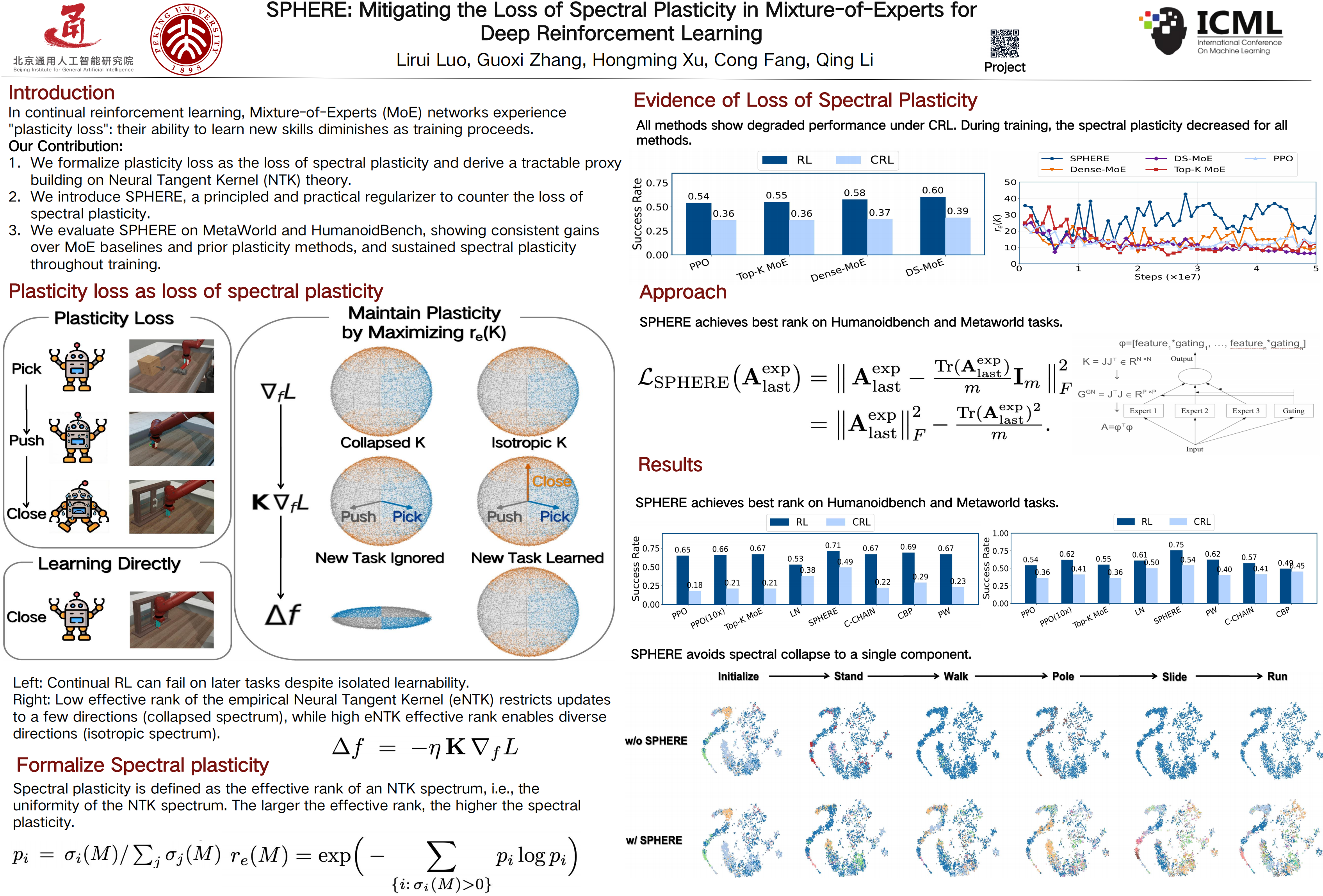
In DRL, an agent is trained from a stream of experience. In a continual learning setting, such agents can suffer from \emph{plasticity loss}: their ability to learn new skills from new experiences diminishes over training. Recently, Mixture-of-Experts (MoE) networks have been reported to enable scaling laws and facilitate the learning of diverse skills. However, in continual reinforcement learning settings, their performance can degenerate as learning proceeds, indicating a loss of plasticity. To address this, building on Neural Tangent Kernel (NTK) theory, we formalize the plasticity loss in MoE policies as a loss of \emph{spectral plasticity}. We then derive a tractable proxy for spectral plasticity, one expressible in terms of individual expert feature matrices. Leveraging this proxy, we introduce \emph{SPHERE}, a practical Parseval penalty tailored for MoE-based policies that alleviates the loss of spectral plasticity. On MetaWorld and HumanoidBench, SPHERE improves average success under continual RL by 133\% and 50\% over an unregularized MoE baseline, while maintaining higher spectral plasticity throughout training.
Lay Summary
AI systems learn by trying actions and using feedback. When training goes on for a long time, they can become less able to learn new tasks. We introduce SPHERE, a simple method that helps them stay adaptable and improves results on robot-control tasks.