
Geometrically Constrained Stenosis Editing in Coronary Angiography via Entropic Optimal Transport
Abstract
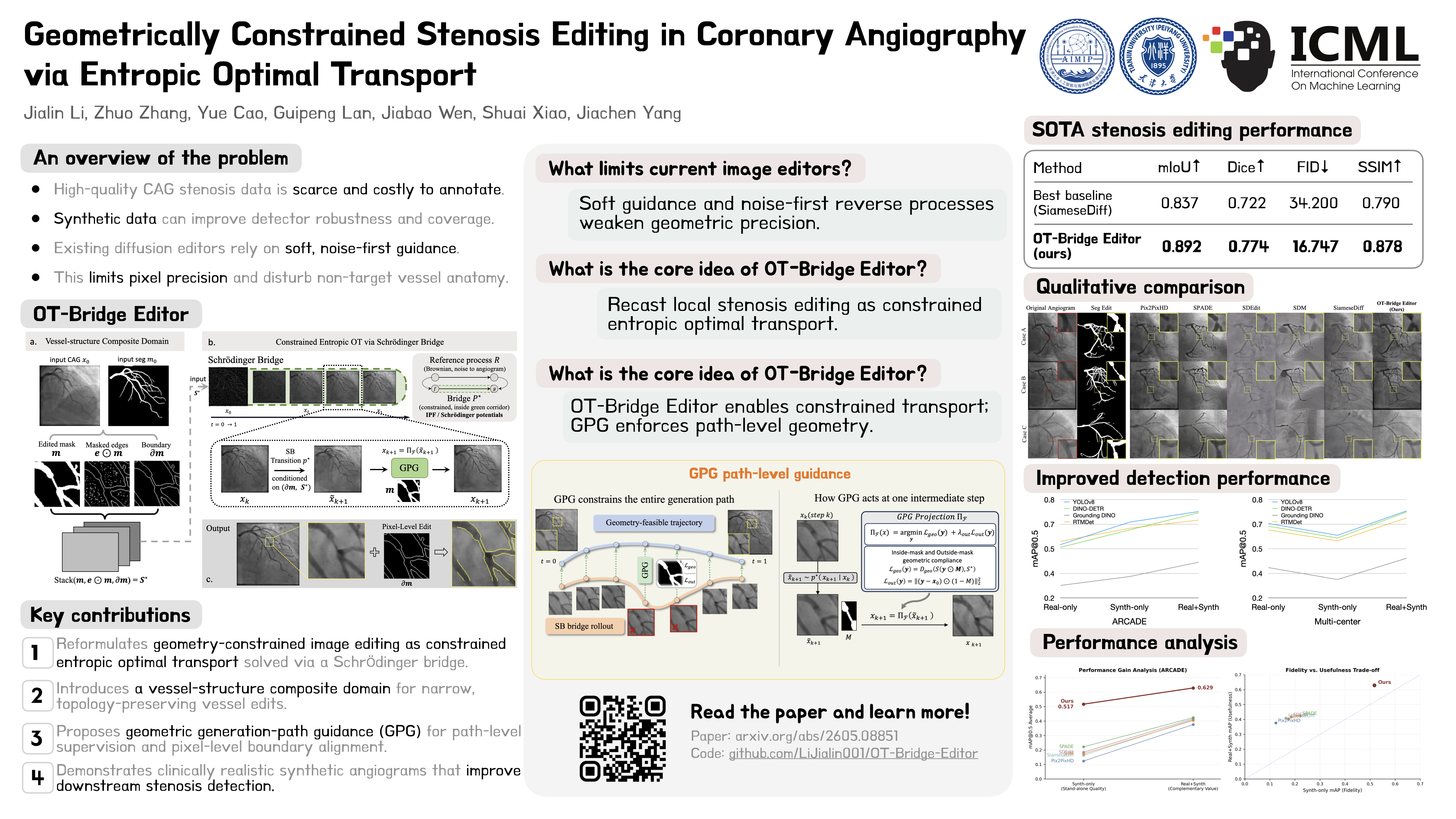
The scarcity of high-quality imaging data for coronary angiography (CAG) stenosis limits the clinical translation of automated stenosis detection. Synthetic stenosis data provides a practical avenue to augment training sets, improving data quality, diversity, and distributional coverage, and enhancing detection precision and generalization. However, diffusion-based editing commonly relies on soft guidance in a noise-initialized reverse process, offering limited pixel-level precision and structure preservation. We propose the OT-Bridge Editor, which reframes localized editing as a constrained entropic optimal transport (OT) problem and leverages geometric information to steer the generation path, enabling stronger geometric control. Extensive experiments show that our synthesized angiograms consistently improve downstream stenosis detection, yielding substantial relative gains of 27.8% on the public ARCADE benchmark and 23.0% on our multi-center dataset, supported by consistent qualitative results.
Lay Summary
Coronary angiography is an important medical imaging tool for finding narrowed blood vessels in the heart. However, building reliable artificial intelligence systems for this task requires many high-quality images with expert annotations, which are difficult and expensive to collect. One way to address this problem is to create realistic artificial angiography images that show different types of vessel narrowing and use them to help train detection systems. In this paper, we introduce a method for editing real angiography images so that new, realistic vessel narrowings can be added at precise locations while keeping the rest of the image unchanged. Our method focuses on preserving the shape and continuity of blood vessels, which is especially important because coronary vessels are thin and delicate structures. Experiments show that the generated images are realistic and useful: when added to real training data, they improve the ability of detection models to find coronary stenosis on both a public benchmark and a multi-center clinical dataset.