
MAC-NeRF: Motion-Aware Curriculum Learning for Dynamic LiDAR NeRFs
Abstract
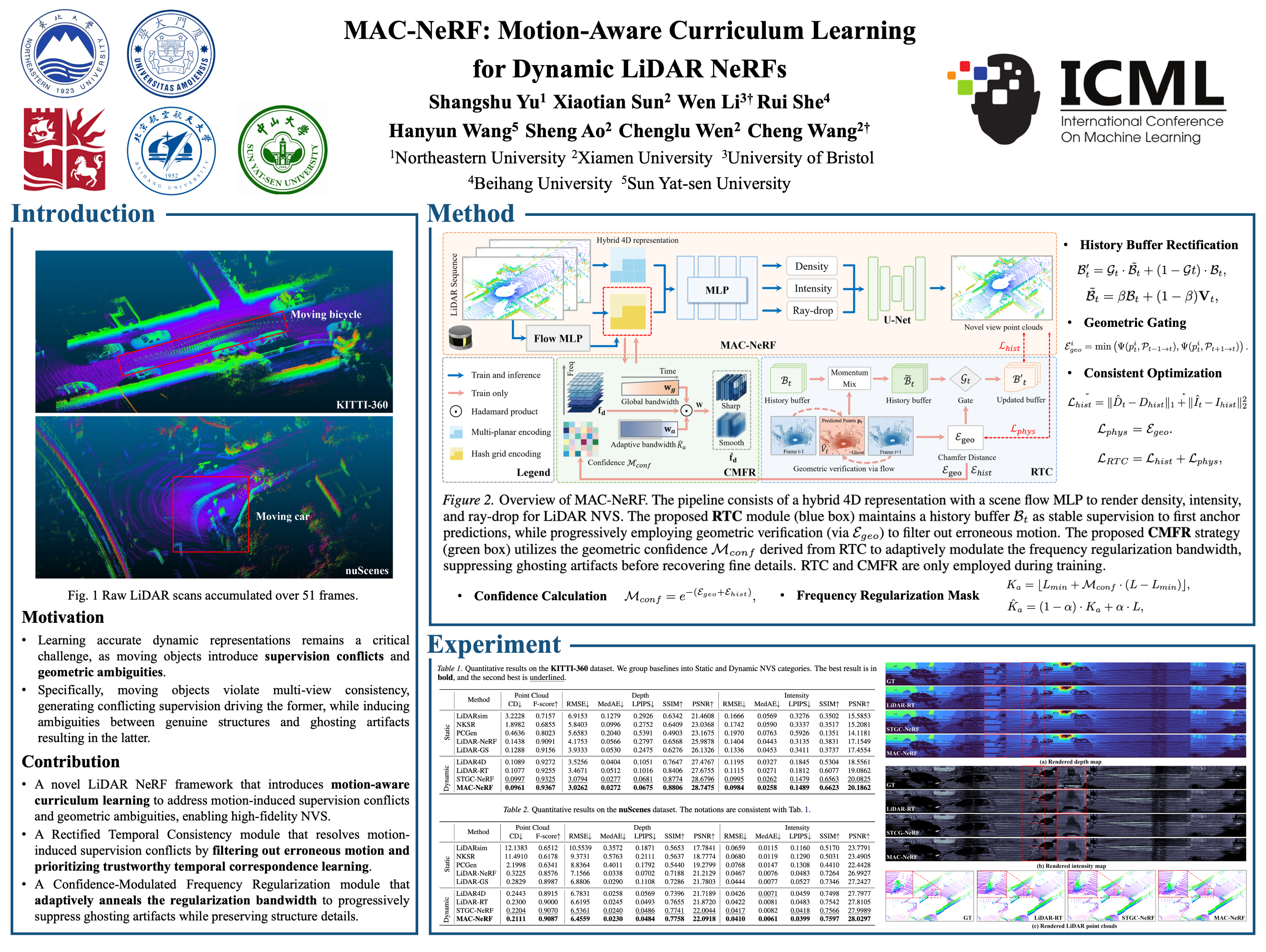
While LiDAR NeRFs excel in static environments, synthesizing dynamic scenes remains challenging as moving objects break multi-view consistency, causing conflicting supervision and ghosting artifacts across frames. Existing methods typically suffer from optimization difficulty from the start, struggling to disentangle valid geometry from motion noise when initial motion priors are unreliable. To address this, we propose MAC-NeRF, a novel LiDAR NeRF framework enhanced by motion-aware curriculum learning for high-fidelity dynamic scene synthesis. First, we propose Rectified Temporal Consistency to resolve motion-induced supervision conflicts. By filtering out erroneous supervision via forward-backward geometric verification, it creates a curriculum that prioritizes trustworthy temporal correspondences before handling challenging motions. Second, we propose Confidence-Modulated Frequency Regularization (CMFR) to eliminate geometric ambiguity. It adaptively modulates the frequency regularization bandwidth, progressively transitioning from strict low-frequency constraints for artifact suppression to full-spectrum modeling for fine-grained detail preservation. Extensive experiments on KITTI-360 and nuScenes demonstrate that MAC-NeRF significantly outperforms state-of-the-art methods in rendering quality.
Lay Summary
Self-driving cars rely on LiDAR — a laser-based 3D scanner — to see the road. Training these systems needs vast amounts of LiDAR data, but collecting it in the real world is costly. One alternative is to teach an AI to imagine new LiDAR scans from a small set of recordings. The problem is that today's methods fail when cars and pedestrians are moving: the AI gets confused and produces blurry, ghost-like trails. We solve this with a step-by-step training approach: the AI first learns from the easy, stable parts of a scene, then gradually tackles the moving parts. It cross-checks motion across nearby frames and only trusts what stays consistent, and it sharpens details only in places where it has grown confident. The result is cleaner synthetic LiDAR data, making it cheaper and safer to test self-driving systems on rare or dangerous scenarios.