
Best of Both Worlds: Multimodal Reasoning and Generation via Unified Discrete Flow Matching
Abstract
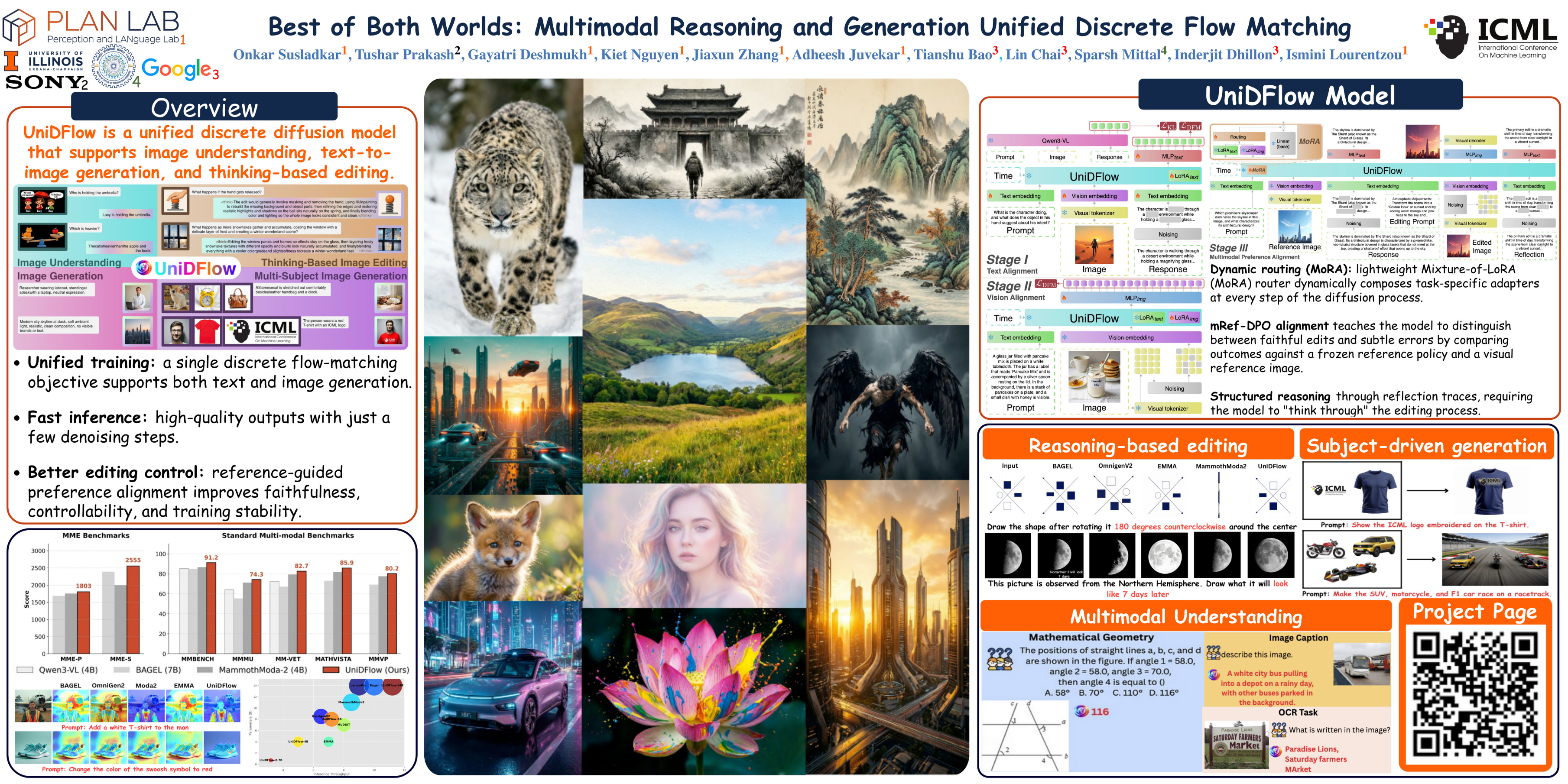
We propose UniDFlow, a unified discrete flow-matching framework for multimodal understanding, generation, and editing. It decouples understanding and generation via task-specific low-rank adapters, avoiding objective interference and representation entanglement, while a novel reference-based multimodal preference alignment optimizes relative outcomes under identical conditioning, improving faithfulness and controllability without large-scale retraining. UniDFlow achieves SOTA performance across eight benchmarks and exhibits strong zero-shot generalization to tasks including inpainting, in-context image generation, reference-based editing, and compositional generation, despite no explicit task-specific training.
Lay Summary
This paper introduces UniDFlow, a unified discrete flow-matching framework that handles three multimodal tasks within a single model: image understanding (visual question answering), text-to-image generation, and instruction-guided image editing. Most existing "unified" models entangle understanding and generation in shared parameters, so improving one capability often degrades the other. UniDFlow's key insight is to keep a strong pretrained vision-language backbone (Qwen3-VL) frozen and add lightweight, task-specific LoRA adapters; separate ones for understanding and generation; to avoid this interference. Everything is cast as a single discrete denoising process, unifying text and image generation under one objective rather than mixing autoregressive and diffusion objectives like hybrid models do.