
Identifiable Smooth Conjugacy Learning via Adversarial Orthogonality
Abstract
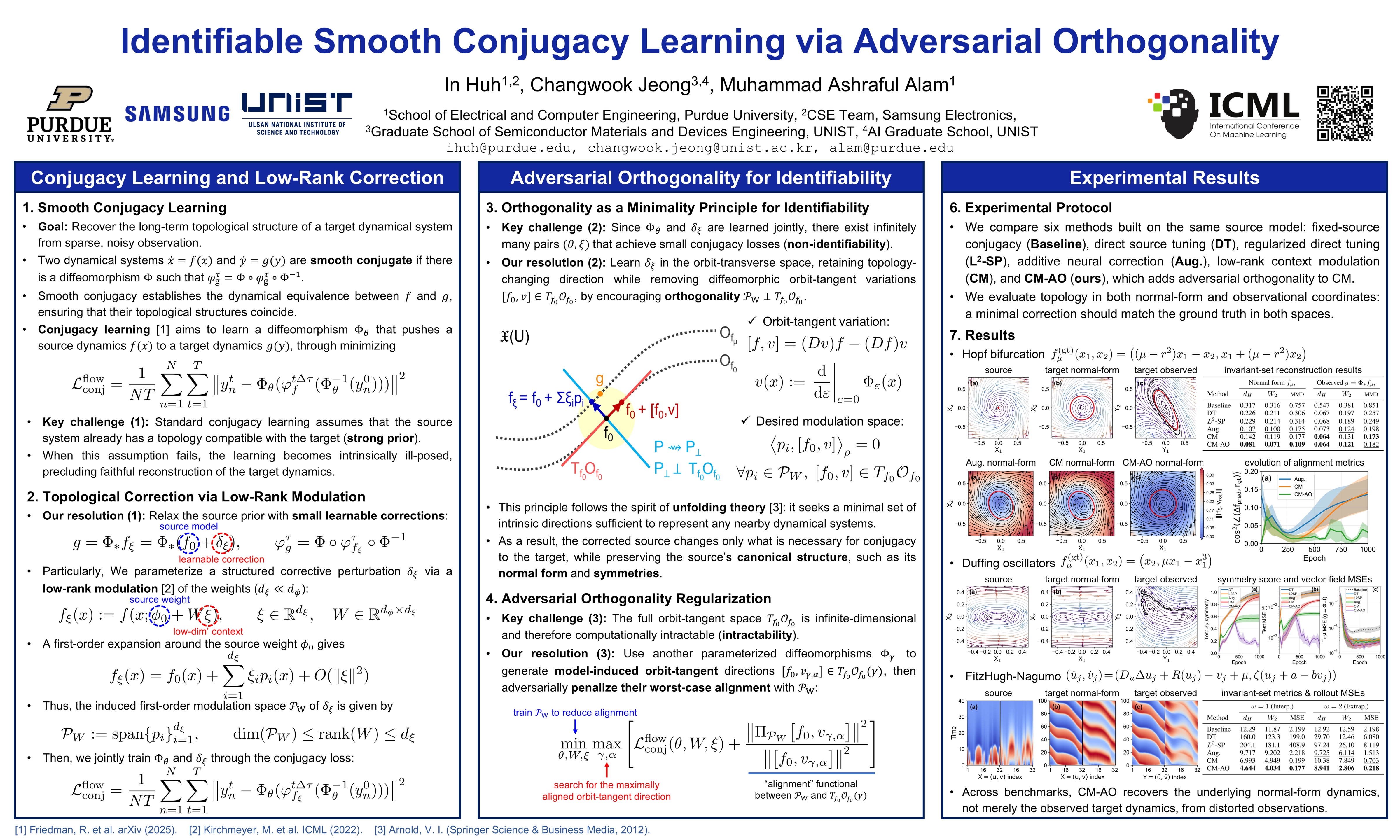
Data-driven dynamical system models often fail to recover the long-term structure of the underlying system, as their behavior is weakly constrained off the data manifold. Conjugacy-based approaches address this limitation by learning a diffeomorphism that pushes forward a source vector field to match observed dynamics, inheriting qualitative topology from the source. However, such methods typically presuppose that the chosen source system is topologically compatible with the target data. When this assumption is violated, the conjugacy problem becomes ill-posed, and arbitrary corrections can be traded off against diffeomorphic variation, leading to non-identifiability. We propose a framework that relaxes this assumed prior by jointly learning the diffeomorphic conjugacy together with controlled adjustments to the source dynamics via low-dimensional context modulation. Inspired by versal unfolding theory, we enforce the modulation space to be orthogonal to the worst-case orbit-tangent directions, obtained by adversarially searching over a class of parameterized diffeomorphisms. This promotes an identifiable decomposition of dynamical variation into diffeomorphic and intrinsic, topology-changing components, enabling interpretable corrections that recover the canonical structure such as normal forms and symmetries.
Lay Summary
Machine learning is increasingly used to model dynamical systems from observed data. However, a model that matches short-term measurements can still learn the wrong long-term behavior, such as missing a limit cycle, creating false equilibria, or destroying hidden symmetries. This is especially problematic when data are limited or collected only from a small region of the system’s state space. Our work develops a more reliable way to learn such systems. The method starts from a known source system and learns a smooth transformation that maps it to the observed target system, helping preserve qualitative behavior. When the source is not fully correct, the method also learns a small correction. The main difficulty is deciding which corrections are meaningful: some simply come from changing coordinates, while others reflect genuine changes in the underlying dynamics. We address this using an adversarial test that prevents the correction from imitating coordinate transformations. In experiments, this separation helps recover hidden structures such as limit cycles, symmetries, and bifurcations from sparse and distorted observations, making learned dynamical models more reliable beyond the training data.