
Toward Culturally Aligned LLMs through Ontology-Guided Multi-Agent Reasoning
Abstract
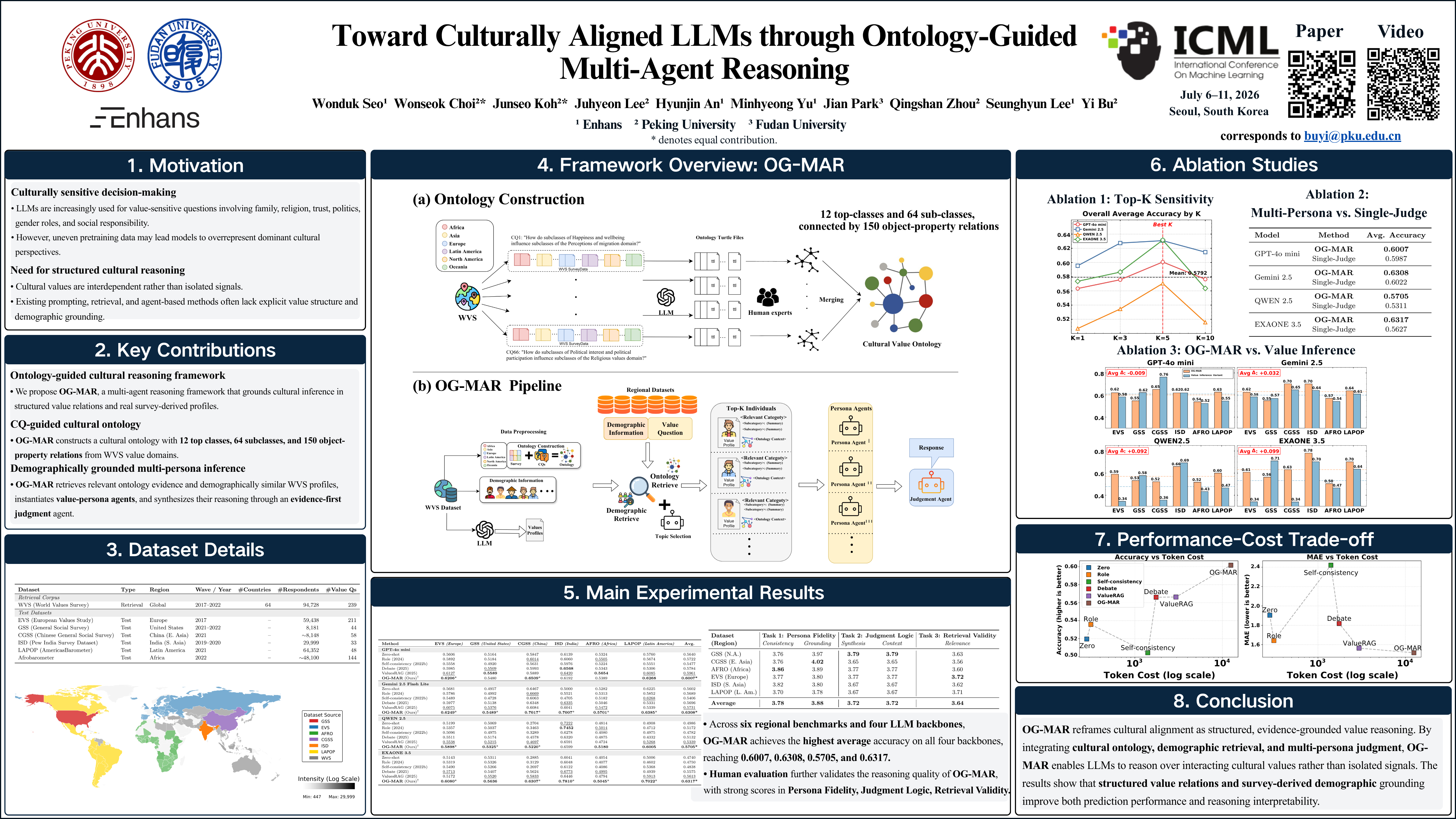
Large Language Models (LLMs) increasingly support culturally sensitive decision making, yet often exhibit misalignment due to skewed pretraining data and the absence of structured value representations. Existing methods can steer outputs, but often lack demographic grounding and treat values as independent, unstructured signals, reducing consistency and interpretability. We propose OG-MAR, an Ontology-Guided Multi-Agent Reasoning framework. OG-MAR summarizes respondent-specific values from the World Values Survey (WVS) and constructs a global cultural ontology by eliciting relations over a fixed taxonomy via competency questions. At inference time, it retrieves ontology-consistent relations and demographically similar profiles to instantiate multiple value-persona agents, whose outputs are synthesized by a judgment agent that enforces ontology consistency and demographic proximity. Experiments on regional social-survey benchmarks across four LLM backbones show that OG-MAR improves cultural alignment and robustness over competitive baselines, while producing more transparent reasoning traces.
Lay Summary
People around the world hold different views on family, religion, work, politics, and social norms. However, today’s AI language systems are often trained on uneven internet data, which can lead them to answer culturally sensitive questions from a narrow or dominant perspective. This paper introduces OG-MAR, a method that helps AI systems reason about cultural values in a more grounded and transparent way. It organizes survey-based evidence into a structured map, retrieves relevant cultural and demographic information, and creates several simulated viewpoints based on real survey profiles. A final decision step compares these viewpoints and selects the answer best supported by evidence. We test OG-MAR on social survey questions from multiple regions, including Europe, the United States, China, India, Africa, and Latin America. The results show that OG-MAR better reflects diverse cultural perspectives and makes AI reasoning easier to inspect.