
Capacity-Agnostic Parameter Isolation for Continual Graph Learning
Abstract
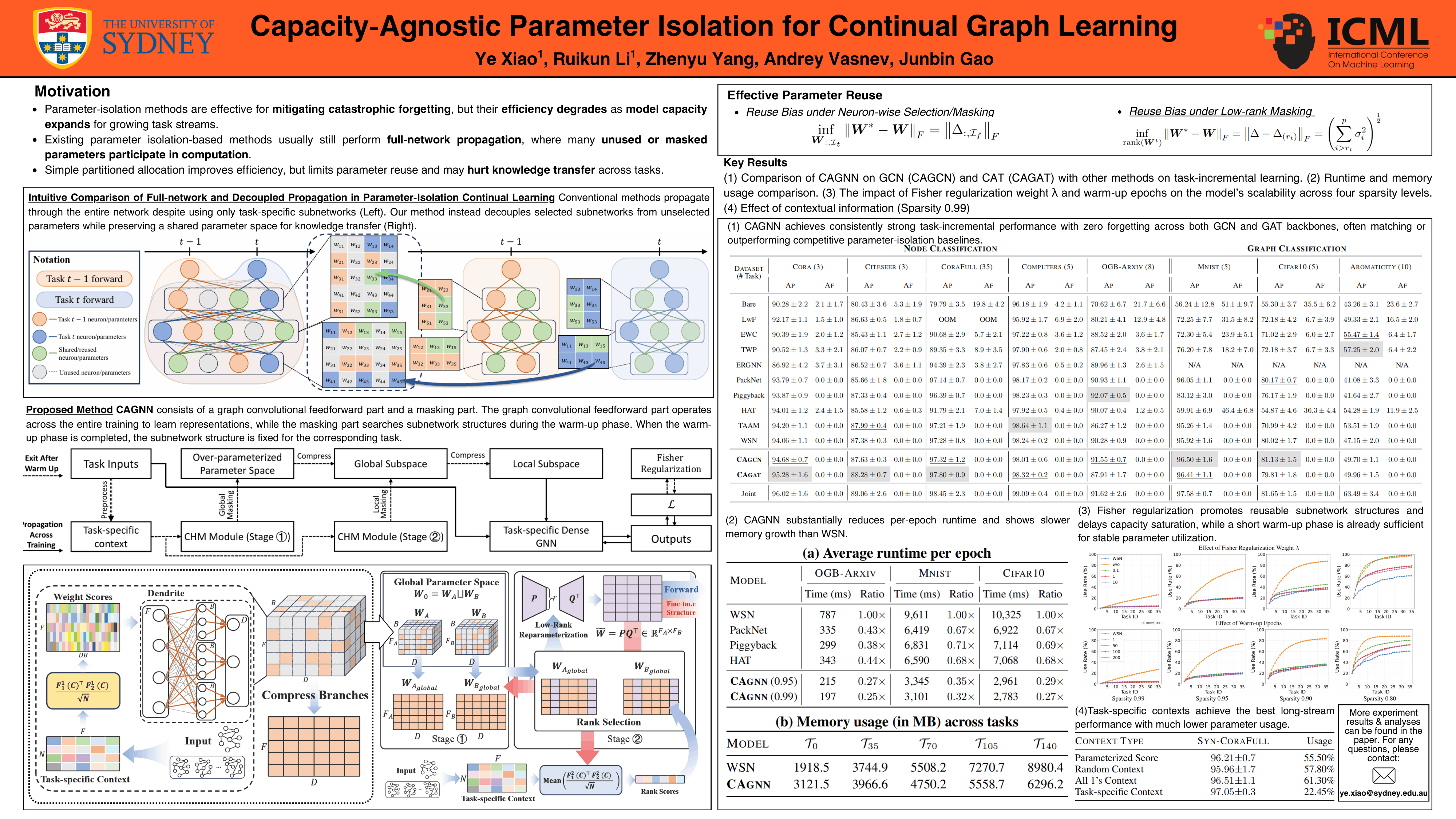
Existing parameter isolation-based continual learning methods employ diverse designs to accommodate more tasks within limited model capacity, but often incur increasing computational overhead as model capacity expands for growing task streams. To address this efficiency bottleneck, we propose CAGNN, a graph continual learning framework with a biological neuron-inspired architecture that features capacity-agnostic efficiency. CAGNN leverages graph contextual information to construct task-specific subnetworks and decouples them during training and inference, reducing full-network propagation overhead while enabling knowledge transfer across tasks. Extensive experiments demonstrate CAGNN's superior effectiveness and computational efficiency over state-of-the-art methods.
Lay Summary
Many real-world learning systems need to deal with information that arrives over time. A major challenge is that a model may forget what it learned before when it learns a new task. One category of existing methods often protects old knowledge by assigning different parts of the model to different tasks, but as more tasks arrive, the model usually demands a larger capacity to accommodate them, leading to slower computation for each task, even when many of its parameters are not actually useful for the current task. We propose CAGNN, a graph learning framework that learns a compact task-specific subnetwork for each new task. Inspired by how biological neurons use dendrites to respond to different contexts, CAGNN uses the context of each graph task to decide which parts of the model should be activated. After a short search stage, the selected subnetwork is fixed and can be trained and used independently from the entire model due to dendrites' structural superiority, avoiding unnecessary computation over unused parameters. This makes continual graph learning more efficient while still preserving knowledge from previous tasks. Our experiments show that CAGNN achieves strong performance and faster training across multiple node- and graph-classification benchmarks.