
Wasserstein Geometry-Aware Adaptive Control via Meta-Learning
Abstract
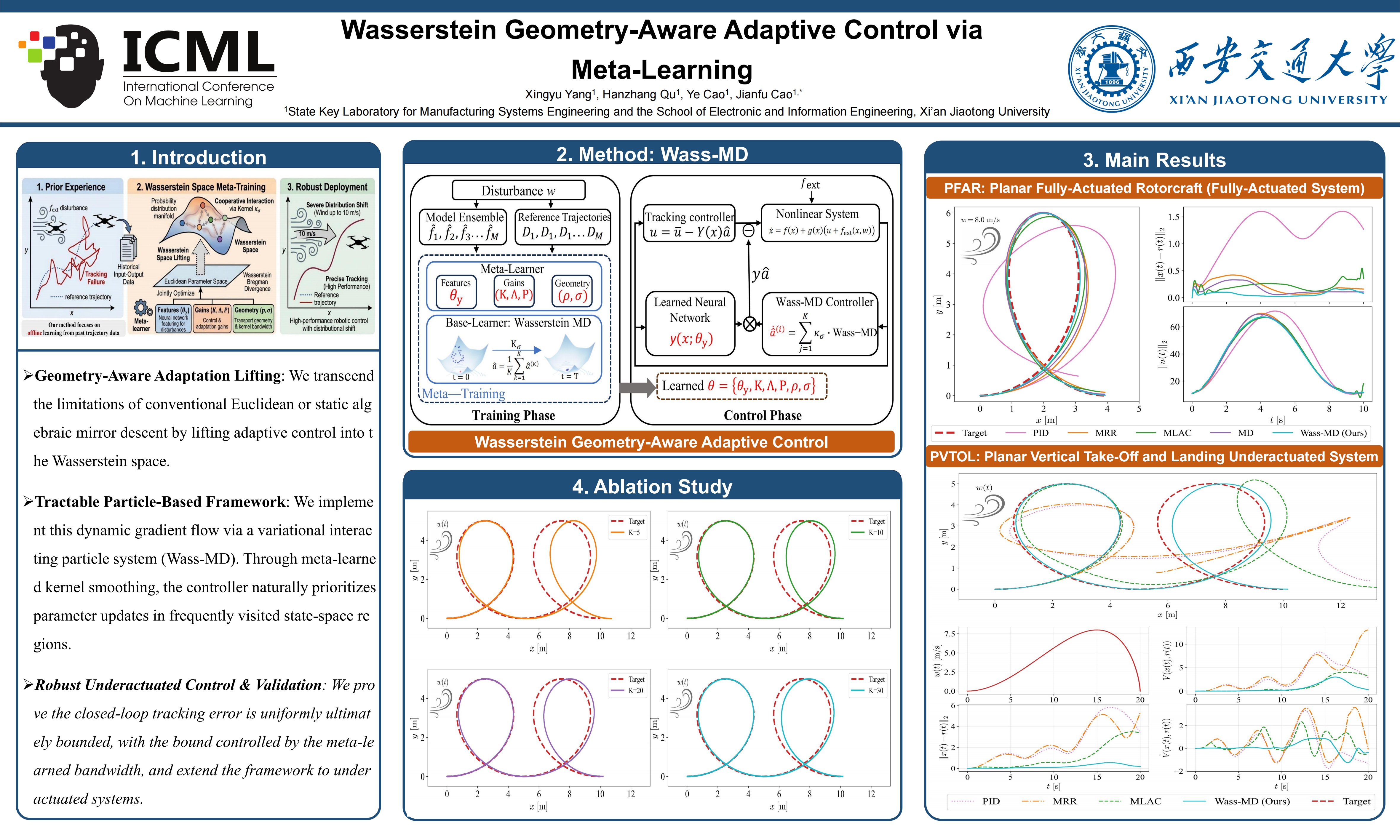
Adaptive control of nonlinear systems under unknown disturbances requires learning algorithms aligned with the downstream control objective. While control-oriented meta-learning addresses the mismatch between regression-based identification and tracking performance, existing methods rely on Euclidean or static algebraic geometries that fail to capture the distributional structure of system uncertainties. We propose a framework that lifts adaptation into Wasserstein space, measuring parameter estimation errors as the optimal transport cost between estimated and true system behaviors. By constructing a Wasserstein Bregman divergence over representative task distributions, we use meta-learning to jointly optimize nonlinear feature representations, control gains, and transport geometry. This adaptation law learns an adaptation geometry that captures structural properties of the underlying physical system, implementing a physically grounded, data-driven attention mechanism. Closed-loop tracking simulations demonstrate that our controller achieves optimal performance on both fully-actuated and underactuated nonlinear planar rotorcraft, maintaining robustness under significant distributional shifts between training and testing conditions.
Lay Summary
Drones and other robots often need to follow a planned path even when the world pushes back, for example when wind tries to blow them off course. To stay on track, a robot must constantly estimate these unknown forces and cancel them out. Recent methods let a robot learn this skill from past flight data, but they all measure an estimation mistake with one fixed ruler, treating every kind of mistake as equally important. We wondered whether the robot could instead learn its own ruler, one tuned to the situations it actually meets most often while flying. In our method the robot does not commit to a single guess about the disturbing forces. It keeps a small team of guesses that talk to each other and adjust together, and from simulated flight data it learns both how to sense the forces and how the team members should cooperate. We tested this on two simulated aircraft, including a harder one that cannot push directly in every direction, and found that it follows its target path more accurately and stays reliable even in winds far stronger than any it trained on. This is a step toward robots that cope gracefully with conditions nobody prepared them for, which is essential for using autonomous machines safely in the real world.