
Agentic Model Predictive Questioning Control in Visual Design
Abstract
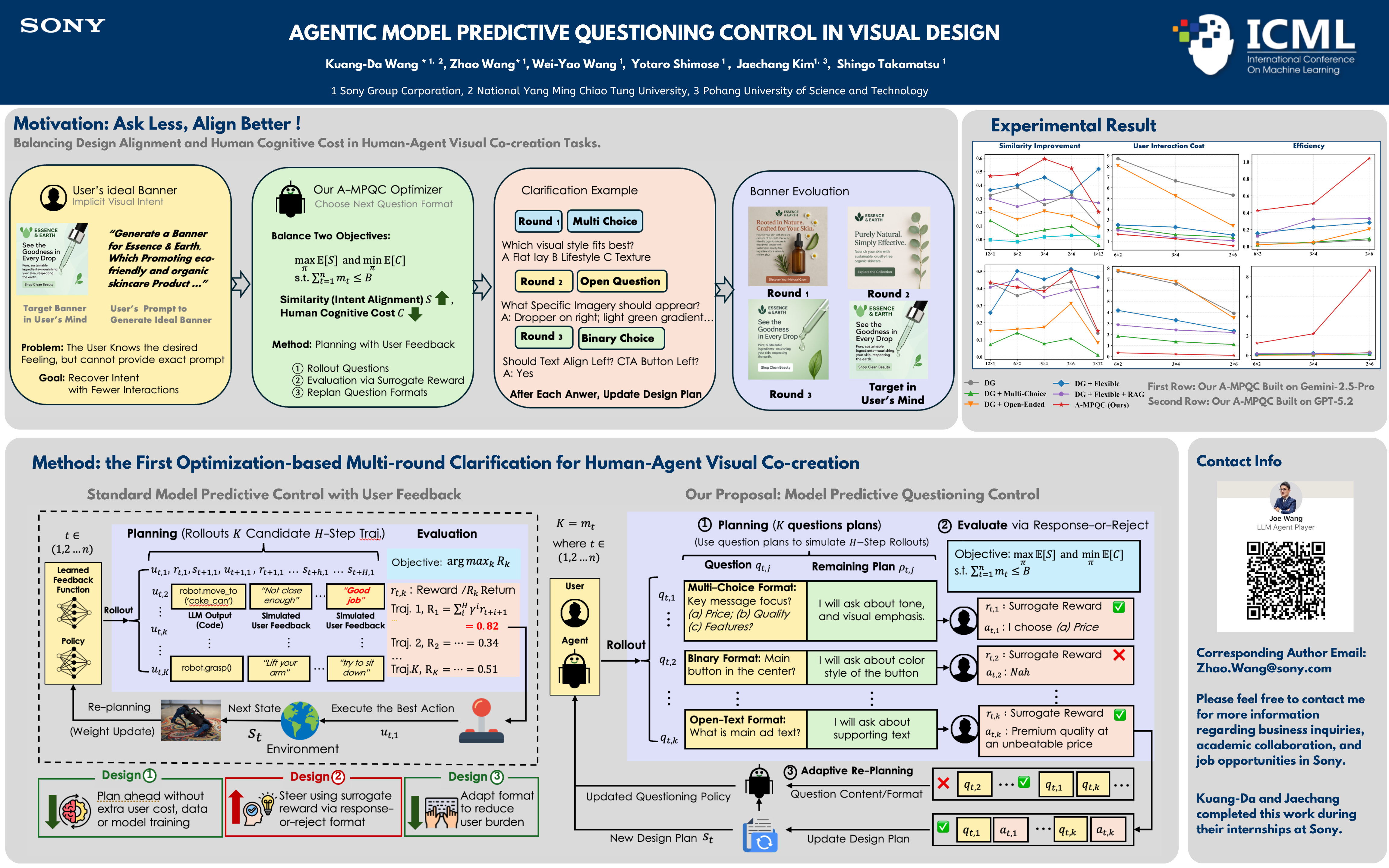
Recent Large Language Model based approaches for clarifying visual design largely focus on selecting questions that better uncover user intent, but often overlooks the cognitive burden imposed on users, i.e., the effort required to interpret and answer these questions, which is crucial for effective human-agent interaction. In this paper, we propose Agentic Model Predictive Questioning Control (A-MPQC), a test-time framework that reduces proxy-estimated user interaction burden while improving visual design alignment by formulating multi-round clarification as trajectory optimization with receding-horizon replanning to revise its questioning strategy. In addition, we introduce lookahead question plans to reduce ambiguity early, and a lightweight respond-or-reject surrogate reward to steer questions toward lower user-burden formats (e.g., yes/no). Experiments on webpage and ad banner generation benchmarks show that A-MPQC not only generates designs better aligned with user intent, but also achieves lower user-interaction cost across diverse interaction baselines, including fixed-format strategies (e.g., multiple-choice and open-ended) and a retrieval-augmented baseline, without retraining. This paper sets a new perspective that explicitly formulates and optimizes the human cognitive burden jointly with final design alignment, opening new opportunities to advance human-agent interaction.
Lay Summary
When people use AI to help with visual design tasks, such as creating a webpage or an advertisement, the AI often asks questions to clarify the user's vision. While current models are improving at asking relevant questions, they frequently overlook the mental effort required for a person to answer them. Asking many complex or open-ended questions can quickly become exhausting. In this paper, we introduce a framework called Agentic Model Predictive Questioning Control (A-MPQC). Rather than asking questions in isolation, our system treats the entire dialogue as a strategic sequence that it optimizes during the interaction. It steers the conversation toward simpler formats, such as "yes or no" questions, to minimize the cognitive burden on the user. We used a Large Language Model-based proxy to simulate user responses and estimate interaction effort. Our results show that A-MPQC improves design alignment while reducing interaction cost, without requiring additional training. This work points toward more effective and less demanding human-AI collaboration in visual design.