
Towards Efficient Large Language Reasoning Models via Extreme-Ratio Chain-of-Thought Compression
Abstract
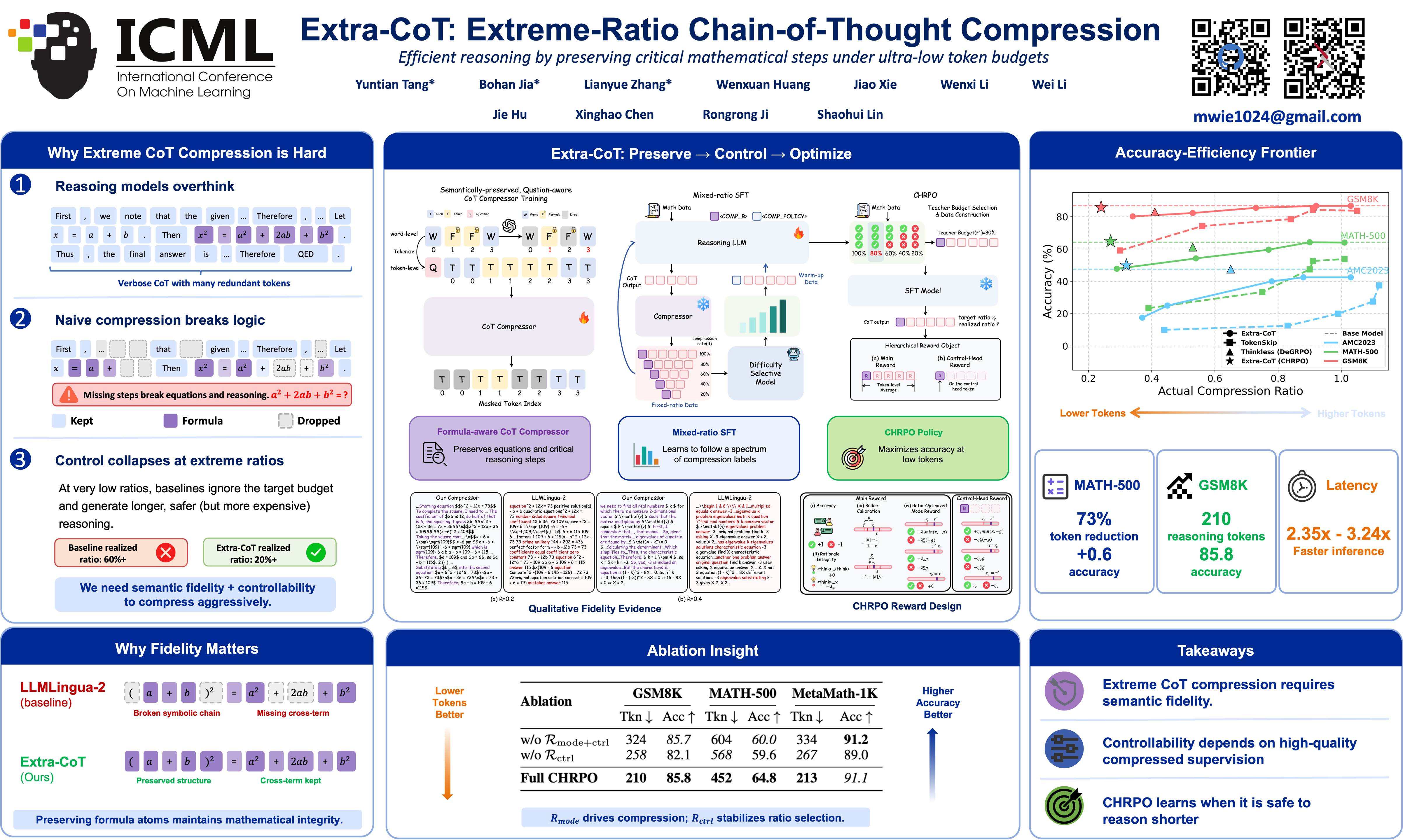
Chain-of-Thought (CoT) reasoning successfully enhances the reasoning capabilities of Large Language Models (LLMs), yet it incurs substantial computational overhead for inference. Existing CoT compression methods often suffer from a critical loss of logical fidelity at high compression ratios, resulting in significant performance degradation. To achieve high-fidelity, fast reasoning, we propose a novel EXTreme-RAtio Chain-of-Thought Compression framework, termed Extra-CoT, which aggressively reduces the token budget while preserving answer accuracy. To generate reliable, high-fidelity supervision, we first train a dedicated semantically-preserved compressor on mathematical CoT data with fine-grained annotations. An LLM is then fine-tuned on these compressed pairs via a mixed-ratio supervised fine-tuning (SFT), teaching it to follow a spectrum of compression budgets and providing a stable initialization for reinforcement learning (RL). We further propose Constrained and Hierarchical Ratio Policy Optimization (CHRPO) to explicitly incentivize question-solving ability under lower budgets by a hierarchical reward. Experiments on three mathematical reasoning benchmarks show the superiority of Extra-CoT. For example, on MATH-500 using Qwen3-1.7B, Extra-CoT achieves over 73\% token reduction with an accuracy improvement of 0.6\%, significantly outperforming state-of-the-art (SOTA) methods. Our source codes are released in the Supplementaries.
Lay Summary
Large reasoning models often solve difficult problems by writing long step-by-step explanations before giving an answer. While this improves accuracy, it also makes inference slower and more expensive, because the model must generate many extra tokens. This paper studies how to make such reasoning more efficient by compressing the model’s chain-of-thought while preserving the important logical steps. We propose Extra-CoT, a training framework that first builds high-quality compressed reasoning traces, then teaches a language model to follow different compression budgets, and finally uses reinforcement learning to choose very short but still accurate reasoning paths. A key idea is to preserve mathematical expressions and essential reasoning steps rather than simply shortening text. Experiments on mathematical reasoning benchmarks show that Extra-CoT can greatly reduce reasoning tokens while maintaining, and sometimes improving, answer accuracy. This suggests a practical path toward faster and cheaper reasoning models without sacrificing reliability.