
PRISM: Distribution-free Adaptive Computation of Matrix Functions for Accelerating Neural Network Training
Abstract
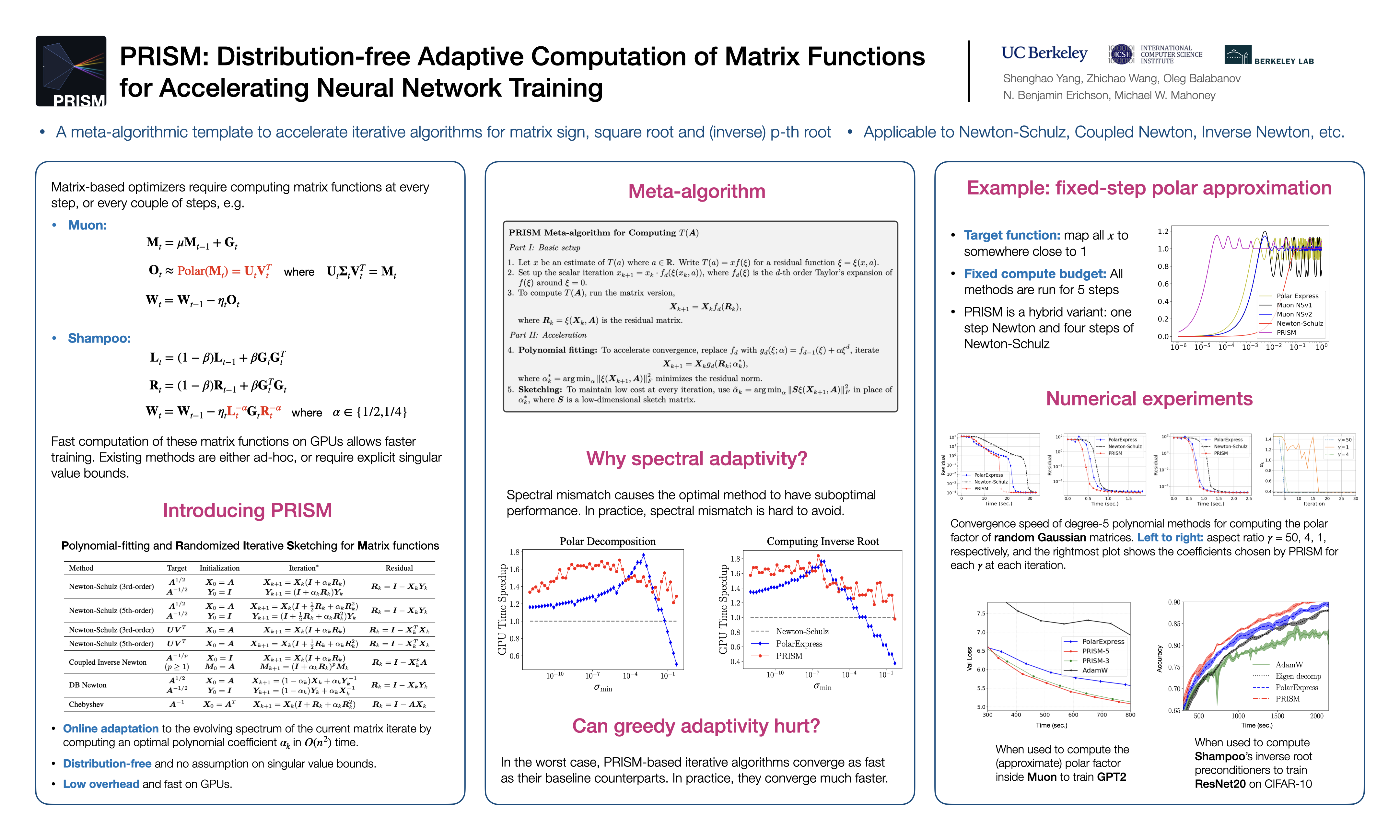
Matrix functions such as square root, inverse roots, and orthogonalization play a central role in preconditioned gradient methods for neural network training. This has motivated the development of iterative algorithms that avoid explicit eigendecompositions and rely primarily on matrix multiplications, making them well suited for modern GPU accelerators. We present PRISM (Polynomial-fitting and Randomized Iterative Sketching for Matrix functions computation), a general framework for accelerating iterative algorithms for computing matrix functions. PRISM combines adaptive polynomial approximation with randomized sketching: at each iteration, it fits a polynomial surrogate to the current spectrum via a sketched least-squares problem, adapting to the instance at hand with minimal overhead. We apply PRISM to accelerate Newton–Schulz-like iterations for matrix square roots and orthogonalization, which are core primitives in machine learning. Unlike prior methods, PRISM requires no explicit spectral bounds or singular value estimates; it adapts automatically to the evolving spectrum. Empirically, PRISM accelerates training when integrated into Shampoo and Muon optimizers.
Lay Summary
We present PRISM, a meta-algorithmic framework for accelerated computation of matrix functions (such as orthogonalization, square roots and inverse) using GPU-friendly matrix-matrix multiplications. PRISM can be used inside the Muon and Shampoo optimizers to accelerate the computation of gradient/momentum matrix orthogonalization and inverse root preconditioner computation. We show that integrating PRISM-based matrix algorithms inside these optimizers accelerates neural network training.