
Generalizing Multi-Scale Time-Series Modeling with a Single Operator
Abstract
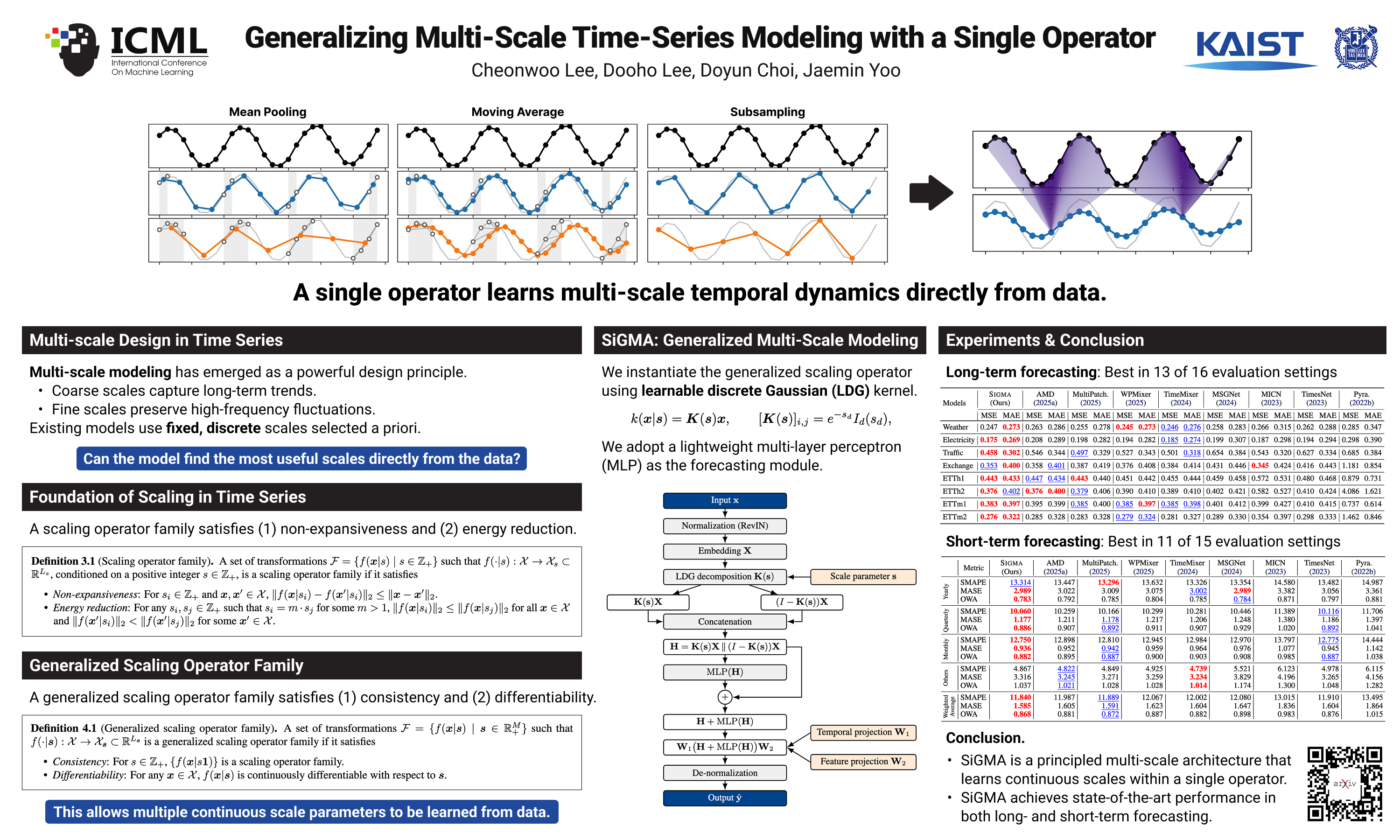
Multi-scale modeling has emerged as an effective design principle for time-series forecasting by capturing temporal dynamics at multiple resolutions. As no principled foundation has been established in the literature, we unify existing scaling methods into a scaling operator family, revealing a fundamental limitation of existing approaches: reliance on fixed and discrete scaling. To address this limitation, we propose SiGMA (Single Generalized Multi-scale Architecture), which enables distance-aware scaling via the learnable discrete Gaussian (LDG) kernel grounded in scale-space theory. We evaluate SiGMA comprehensively on long- and short-term forecasting benchmarks against state-of-the-art multi-scale baselines. SiGMA outperforms all competitors on both tasks, especially achieving the best performance in 13 out of 16 long-term evaluation settings. Beyond accuracy, SiGMA significantly improves training speed by up to 5.3 times and reduces memory consumption by up to 3.8 times over the strongest competitors. Code is available at https://github.com/cheonwoolee/SiGMA.
Lay Summary
Many real-world datasets record how something changes over time, such as electricity use and financial prices. These data often contain patterns that happen at different speeds: some changes are quick and local, while others unfold slowly over time. Forecasting models typically handle this with multi-scale modeling, which looks at data at different levels of detail, like using different zoom levels. In our work, we extend this idea: can the model find the most useful scales directly from the data? We introduce SiGMA, a forecasting model that captures multiple scales using one adjustable scaling operator. This operator learns how much detail to keep or smooth out in different parts of a time series. As a result, SiGMA can adapt to useful temporal patterns in the data, capturing both short-term fluctuations and long-term trends. We also provide a clearer way to understand and design flexible scaling mechanisms. Across forecasting tasks in various domains, SiGMA improves prediction accuracy while training faster and using less memory than strong existing methods. These results make accurate time-series forecasting more efficient and practical for real-world applications.