
Step-Level Sparse Autoencoder for Reasoning Process Interpretation
Abstract
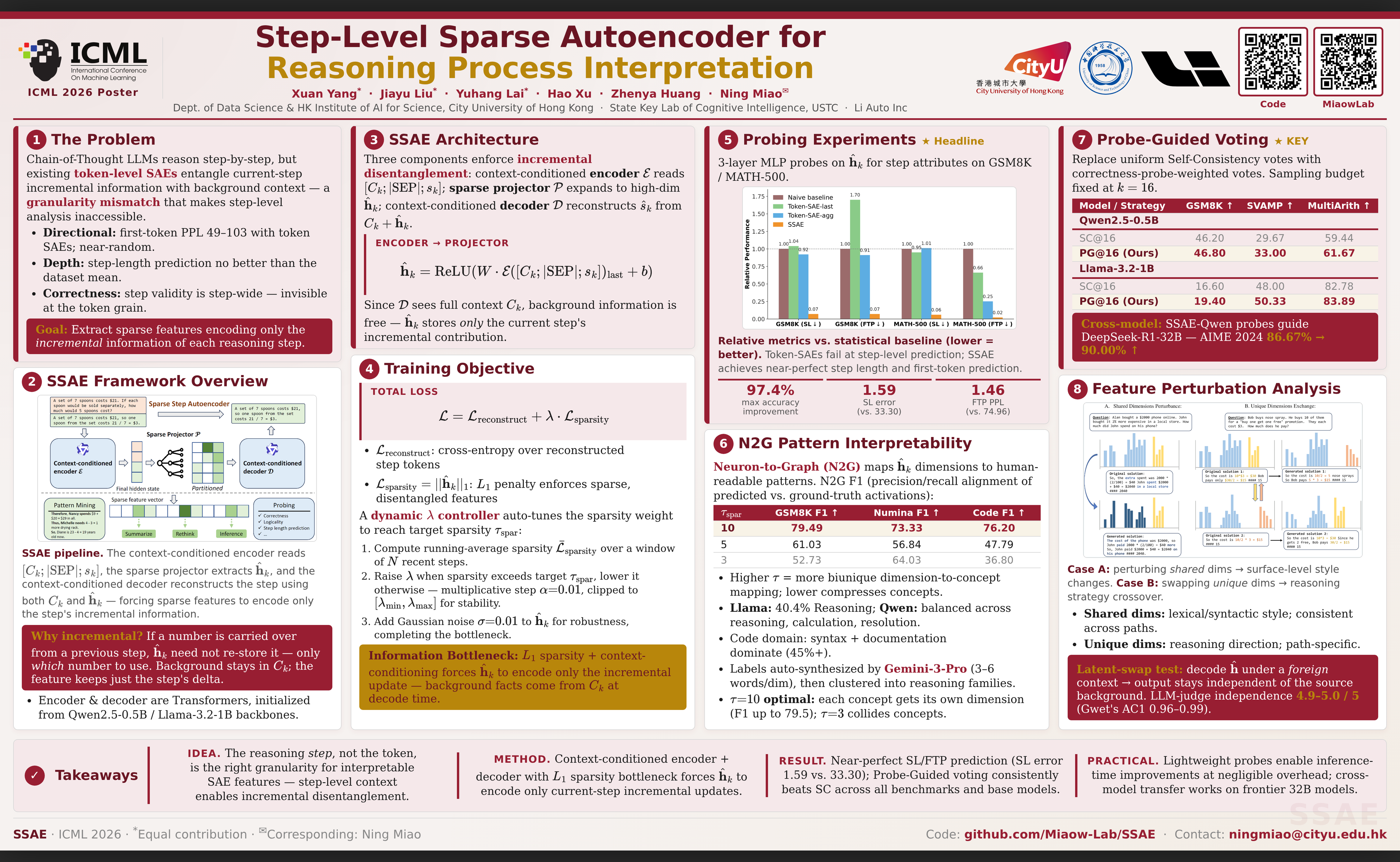
Large Language Models (LLMs) have achieved strong complex reasoning capabilities through Chain-of-Thought (CoT) reasoning. However, their reasoning patterns remain too complicated to analyze. While Sparse Autoencoders (SAEs) have emerged as a powerful tool for interpretability, existing approaches predominantly operate at the token level, creating a granularity mismatch when capturing more critical step-level information, such as reasoning direction and semantic transitions. In this work, we propose step-level sparse autoencoder (SSAE), which serves as an analytical tool to disentangle different aspects of LLMs' reasoning steps into sparse features. Specifically, by precisely controlling the sparsity of a step feature conditioned on its context, we form an information bottleneck in step reconstruction, which splits incremental information from background information and disentangles it into several sparsely activated dimensions. Experiments on multiple base models and reasoning tasks show the effectiveness of the extracted features. By linear probing, we can easily predict surface-level information, such as generation length and first token distribution, as well as more complicated properties, such as the correctness and logicality of the step. These observations indicate that LLMs should already at least partly know about these properties during generation, which provides the foundation for the self-verification ability of LLMs. Our code is available at https://github.com/Miaow-Lab/SSAE.
Lay Summary
Artificial intelligence models can now solve complex problems by "thinking" step-by-step, but exactly how they do this remains a mysterious black box. Current tools try to peek inside by analyzing them one word at a time. However, this microscopic view misses the bigger picture, failing to capture the broader logical leaps that happen across entire reasoning steps. To solve this, we created a new analytical tool that examines AI reasoning at the step level. By cleanly separating the newly generated information in a specific step from the older background context, our method isolates the pure logical leap. It untangles this complex mix of data into clear, distinct patterns that are much easier for humans to analyze. Using this tool, we discovered that an AI's internal signals can predict whether a logical step is correct—suggesting the AI partially "knows" its step is logical before it even finishes generating it. This insight lays the groundwork for building reliable, self-correcting AI systems.