
Evolution Strategies at Scale: LLM Fine-Tuning Beyond Reinforcement Learning
Abstract
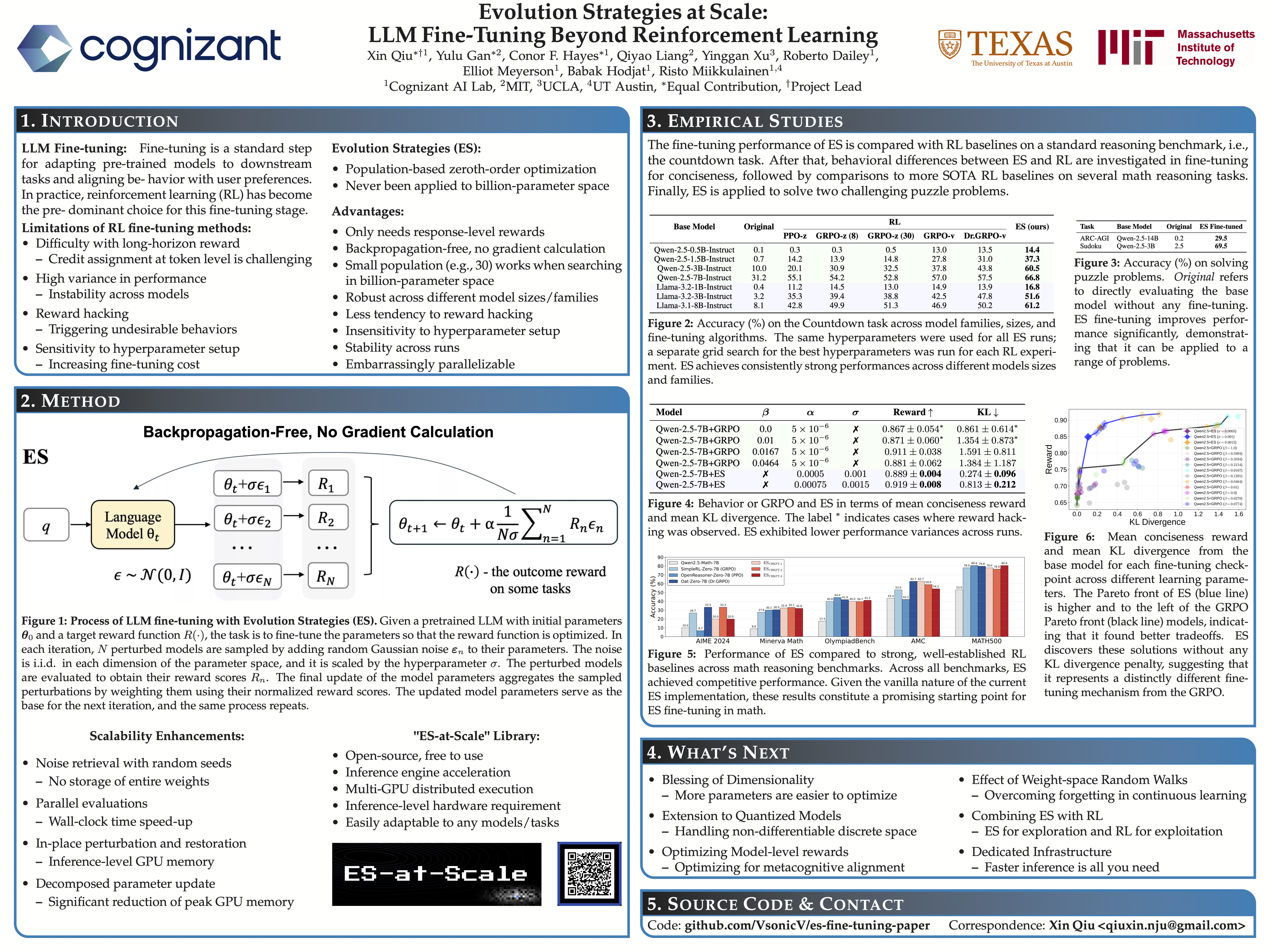
Fine-tuning large language models (LLMs) for downstream tasks is an essential stage of modern AI deployment. Reinforcement learning (RL) has emerged as the dominant fine-tuning paradigm, underpinning many state-of-the-art LLMs. In contrast, evolution strategies (ES) has largely been overlooked due to the widespread belief that it does not scale to modern model sizes. This paper overturns this assumption by demonstrating the first successful application of ES to full-parameter fine-tuning of LLMs at the billion-parameter scale, without dimensionality reduction. ES can indeed search over extremely high-dimensional parameter spaces and outperform established RL implementations across multiple axes, including improved tolerance to long-horizon and delayed rewards, robustness across diverse base LLMs, reduced susceptibility to reward hacking, and improved training stability. These findings suggest that ES is not merely a viable alternative to RL, but a fundamentally different and powerful backpropagation-free post-training paradigm that opens a new direction for LLM fine-tuning beyond current RL-based approaches.
Lay Summary
Evolution Strategies (ES) is a family of search algorithms that try to find good solutions in traditional optimization problems. However, when it comes to searching for good model parameters, i.e., model training, ES has largely been overlooked due to the widespread belief that it does not scale to modern model sizes. Instead, Reinforcement Learning (RL) became the dominant training paradigm. In this work, we scaled up ES to search for billions of parameter for large language models (LLMs). Surprisingly, ES can indeed search over extremely high-dimensional parameter spaces and outperform established RL approaches across multiple axes, including improved tolerance to long-horizon and delayed rewards, robustness across diverse base LLMs, reduced susceptibility to reward hacking, and improved training stability. These findings suggest that ES is not merely a viable alternative to RL, but a fundamentally different and powerful approach that opens a new direction for LLM training beyond current RL-based methods.