
The Deterministic Horizon: When Extended Reasoning Fails and Tool Delegation Becomes Necessary
Abstract
Lay Summary
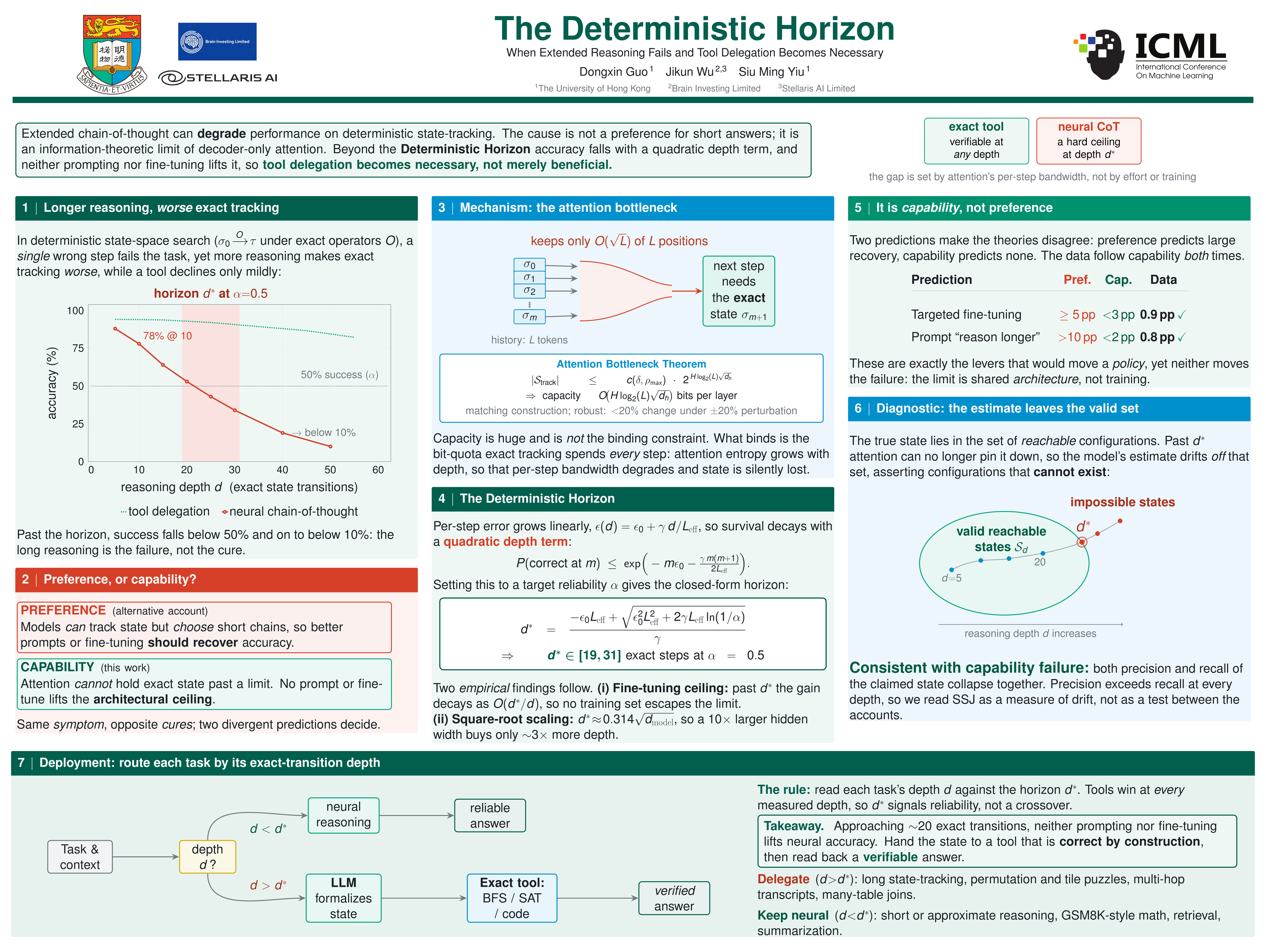
The newest AI systems are built to "think out loud," working through a problem one step at a time, assuming more thinking means better answers. For many problems this helps, but for one kind of task it backfires. Some tasks demand an exact chain of steps, like solving a puzzle, following a precise plan, or keeping a set of records consistent, where a single wrong step ruins the whole answer. We found that on these tasks, today's leading models grow less accurate as their step-by-step explanations get longer. We traced this to a basic limit in how much exact information these systems can track while they work. Once a problem passes a threshold of roughly 19 to 31 steps, their accuracy collapses, and training them harder does not repair it. The lesson is that beyond this point an AI should stop reasoning on its own and pass the work to an outside tool, like a calculator or a dedicated program, that computes the answer exactly. Across twelve AI systems and eight kinds of tasks, this tool-assisted approach proved far more reliable. Our work offers a clear rule for when an AI should think for itself and when it should delegate.