
Beyond Independence: Learning Correlated Views for Variational Incomplete Multi-View Clustering
Abstract
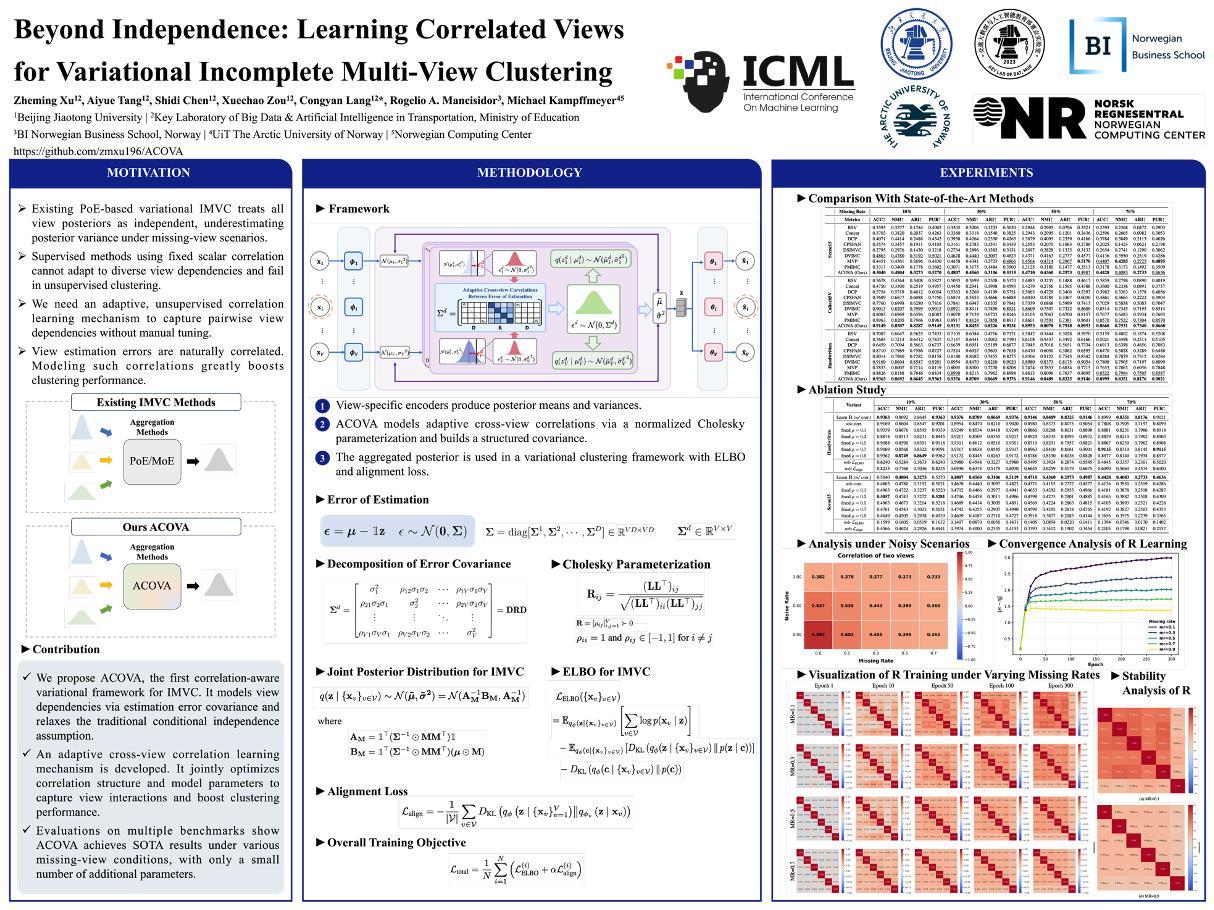
Incomplete multi-view clustering (IMVC) aims to uncover shared cluster structures from data with partially observed views. Although recent imputation-free methods based on variational inference demonstrate robustness to missing views, they commonly rely on a conditional independence assumption across views, which fails to capture the inherently structured and potentially correlated nature of multi-view data. In this paper, we propose a variational framework that explicitly goes beyond this assumption by introducing a learnable cross-view correlation structure. Specifically, we explicitly model and learn correlations between views by utilizing the covariance structure of posterior estimation errors. To facilitate robust and efficient learning, the correlation matrix is parameterized through a normalized Cholesky decomposition, ensuring positive definiteness and enabling the entire model to be trained jointly through a unified variational objective. Extensive experiments on multiple IMVC benchmarks demonstrate that our method consistently outperforms state-of-the-art approaches across a wide range of missing-view settings. These results highlight the effectiveness of adaptive correlation modeling in variational IMVC, demonstrating the need to go beyond the independence assumption in IMVC.
Lay Summary
Machine learning systems often need to combine information from multiple sources, such as images, text, or different sensors. In real-world data, some of these sources are missing or unreliable, which makes grouping similar samples much harder. Most existing methods treat each source as if it were independent, even though sources are usually related. This can make models either overconfident or easily misled when data are incomplete. We propose ACOVA, a probabilistic method that learns how different sources are correlated and how uncertain each source is. Instead of trusting every source equally, ACOVA adaptively weighs them based on both reliability and cross-source relationships. This lets the model form a more stable shared representation even when many views are missing. Across six benchmark datasets and multiple missing-rate settings, ACOVA consistently improves clustering quality over strong baselines, with only a small increase in model complexity. Our results suggest that explicitly modeling dependencies between data sources is a practical way to make multi-source learning more robust in noisy, incomplete settings.