
A Generalist Pair-wise Progress Critic Model for Vision-Language-Action Robots
Abstract
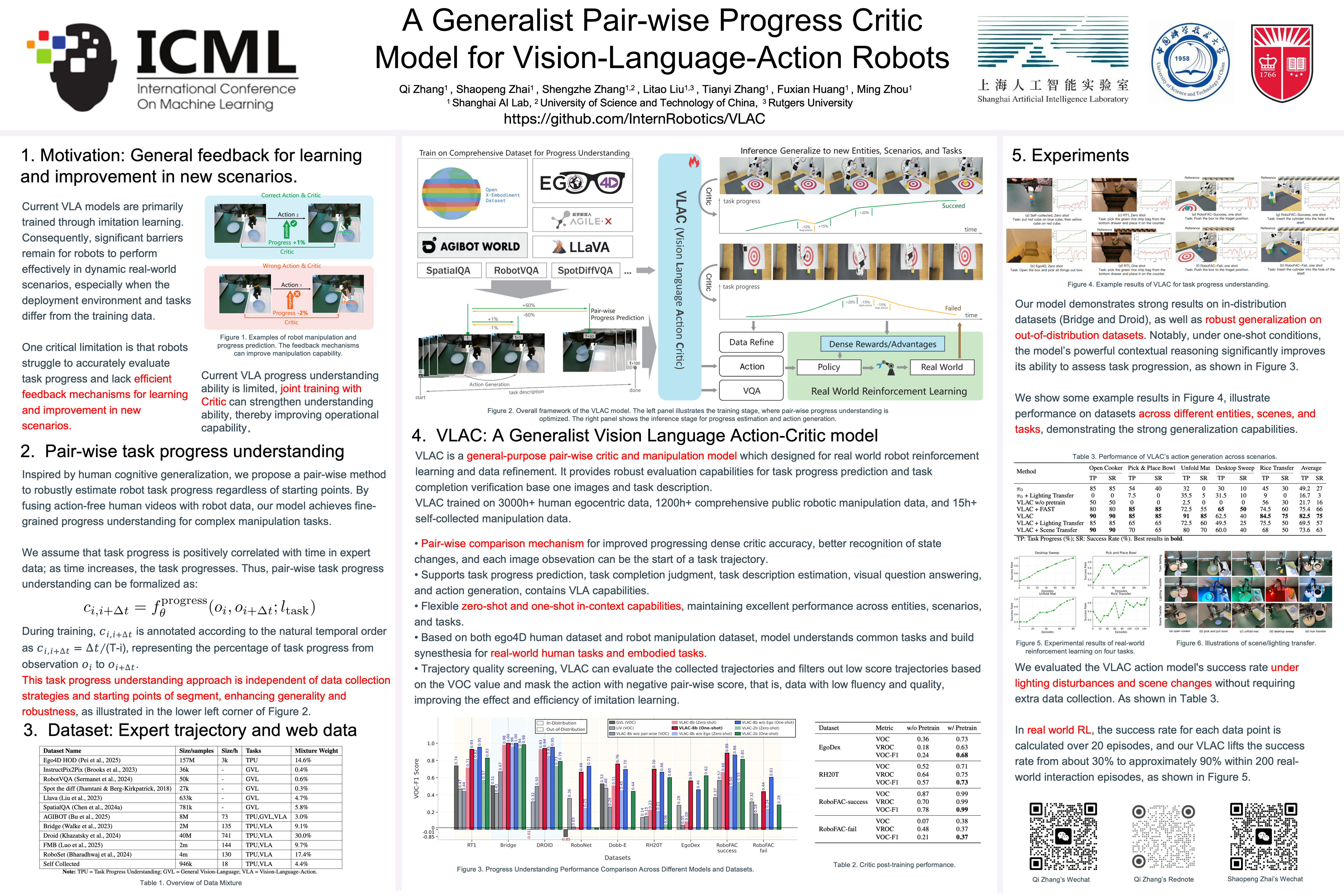
Recent advances in Vision-Language-Action (VLA) models have significantly improved robotic perception and manipulation capabilities, but still struggling to adapt in dynamic, open-ended real-world environments due to a lack of reliable task progress feedback and improvement mechanisms. To address these challenges, we propose a generalist Vision Language Action-Critic model, VLAC, which can integrate both human and robot data, and unify action policy and task progress critic within a single autoregressive architecture. Specifically, we propose a scalable and generalizable pair-wise progress understanding approach that can predict the delta of task progress between two steps in a trajectory and generate correct actions to complete the task. Then, we trained the model on large-scale, multi-source human, robot, and general vision-language data for a generalist. Furthermore, we deploy reinforcement learning where VLAC can autonomously evaluate task progress to provide intrinsic rewards. Extensive evaluations demonstrate that our model generalizes effectively across diverse tasks and environments, leveraging its pair-wise progress understanding to provide reliable dense rewards, robust action generation, and significant improvements in real-world reinforcement learning. Our codes are available at \url{https://github.com/InternRobotics/VLAC}.
Lay Summary
(1) Robots struggle to judge whether they are making progress toward completing a task, making it hard to learn in unpredictable real-world environments. (2) We built VLAC, a single AI model that acts as both a robot controller and a self-critic, trained on large-scale human and robot data to estimate task progress at every step. (3) This allows robots to learn autonomously without constant human supervision, bringing us closer to robots that reliably assist people in everyday settings.