
TurboGS: Accelerating 3D Gaussian Splatting via Error-Guided Sparse Pixel Sampling and Optimization
Abstract
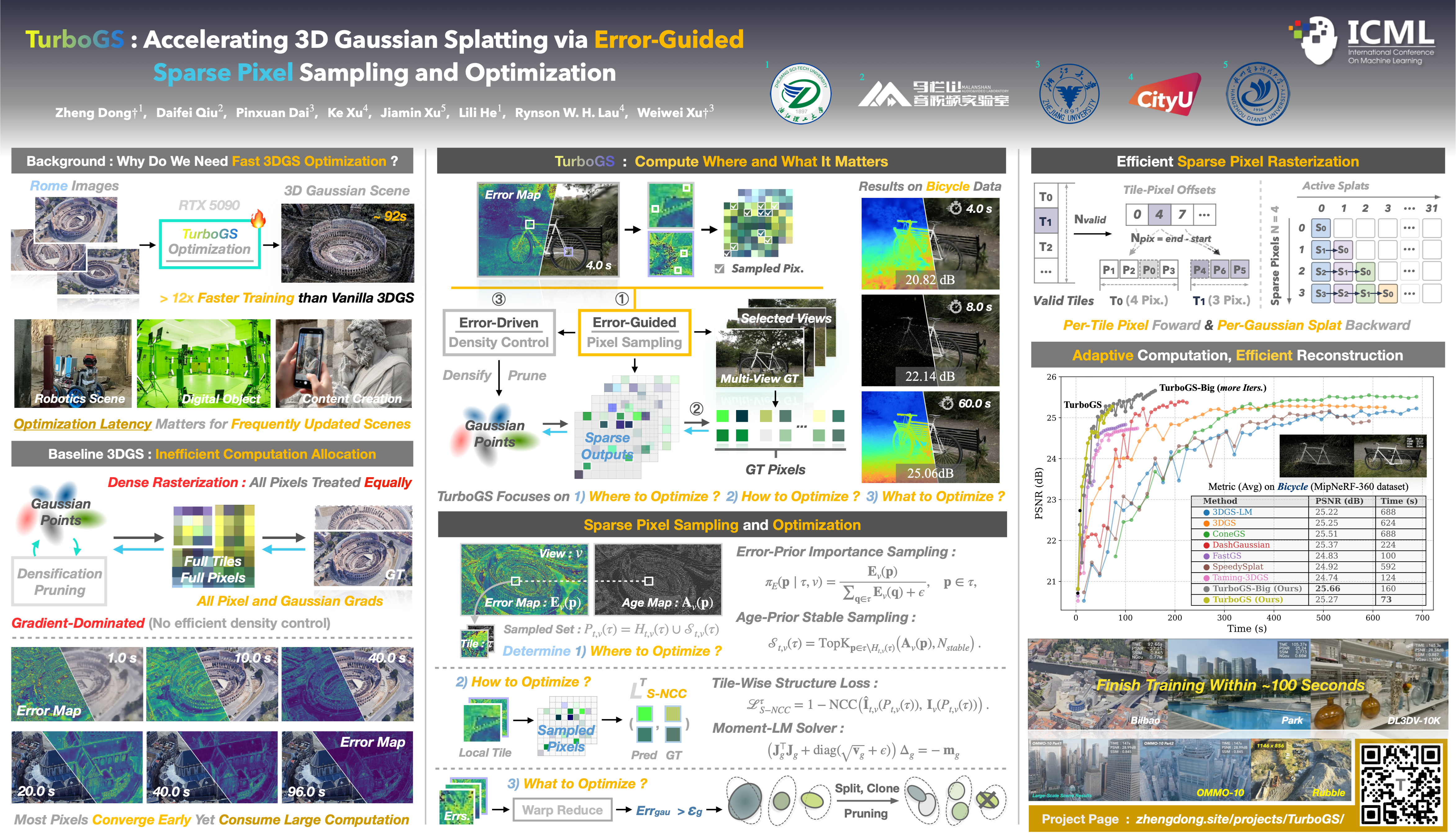
Consumer-level applications require fast optimization of 3D Gaussian Splatting (3DGS) with high-fidelity novel view rendering. However, existing 3DGS acceleration approaches still incur substantial computation on redundant pixels while sacrificing fine details. In this paper, we present TurboGS, an error-guided training framework that accelerates 3DGS by concentrating optimization on perceptually informative pixels. TurboGS is built upon four core components: (1) a tile-wise sparse pixel sampling, which, driven by multi-view reconstruction errors during training, prioritizes challenging regions and skips well-reconstructed ones to avoid redundant gradient computation; (2) a tile-wise structure-aware loss with sparse Normalized Cross-Correlation, which provides sparse yet effective supervision to preserve fine details and stabilize training; (3) an error-driven Gaussian density control strategy, which dynamically allocates model capacity and removes redundant primitives; and (4) a tailored hybrid optimizer that couples Hessian-informed updates with Adam moment damping to stabilize and improve convergence under sparse supervision. Experiments on standard benchmarks demonstrate that TurboGS can deliver on par or superior rendering quality within 100 seconds (up to 10x training speedup over vanilla 3DGS).
Lay Summary
TurboGS speeds up a popular 3D scene reconstruction technique called 3D Gaussian Splatting (3DGS), which can create realistic new views of a scene from images. While existing approaches can produce impressive results, they often spend too much time repeatedly processing easy-to-reconstruct image regions, making training slow and computationally expensive. Our idea is to focus computation on the most informative parts of a scene. Instead of treating all pixels equally, TurboGS identifies challenging regions and allocates more effort to refining them, while spending less computation on already well-reconstructed areas. We also introduce mechanisms to preserve fine details, adaptively adjust scene complexity, and stabilize training. Experiments show that TurboGS can reconstruct high-quality 3D scenes much faster than existing methods — often within about one to two minutes — while maintaining comparable or even better visual quality. This makes high-fidelity 3D scene reconstruction more practical for consumer-level applications.