
SGERA: Stein-Guided ECG-Report Alignment for ECG Representation Learning
Abstract
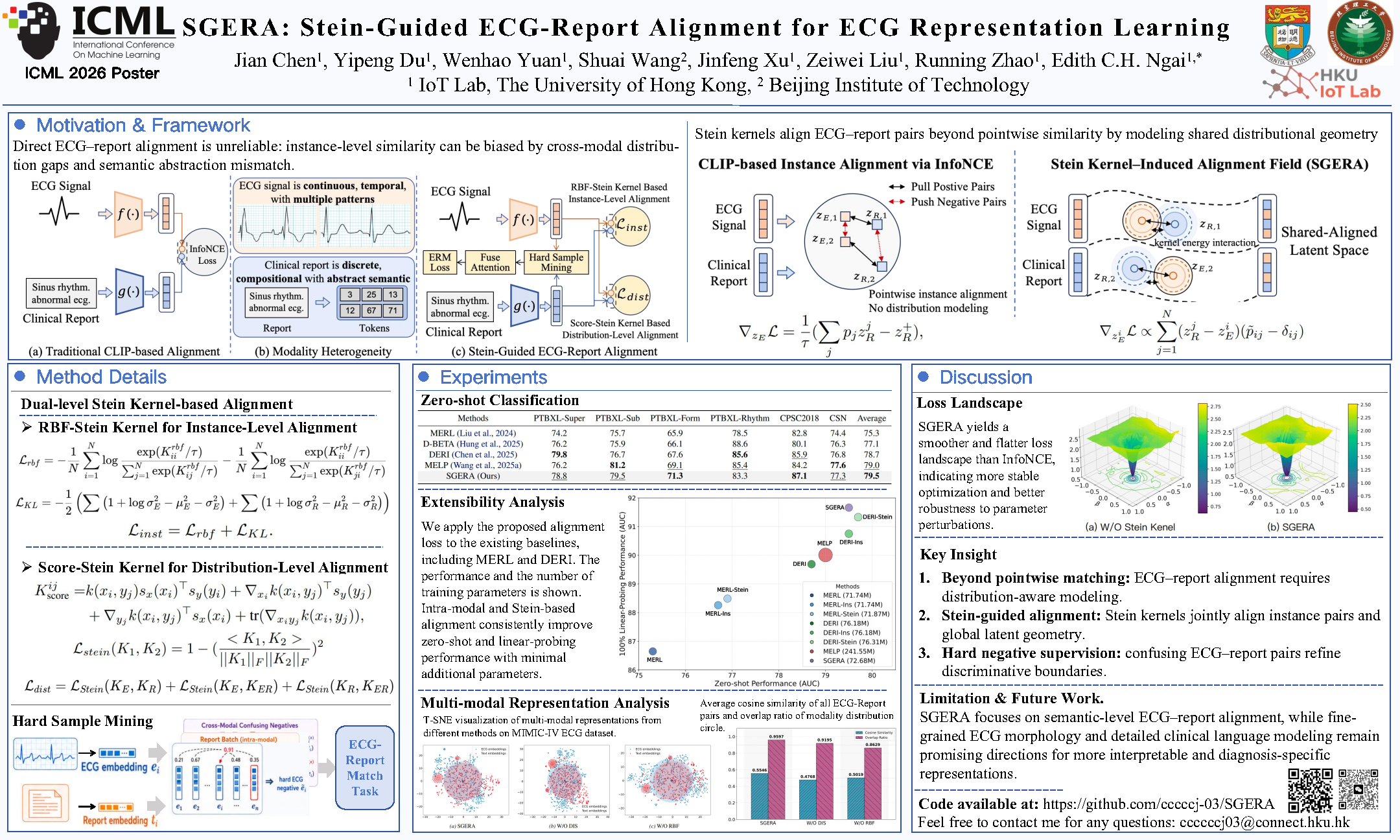
Electrocardiogram (ECG) representation learning via ECG-report alignment is often hindered by the inherent structural and statistical divergence between signals and natural language. Existing methods struggle to bridge this gap with simple contrastive objectives, but struggle with distribution dependencies between heterogeneous features. To address this, we propose SGERA (Stein-Guided ECG-Report Alignment), which leverages the unique properties of Stein kernels to provide a more rigorous geometric alignment in the latent space: instance-level alignment via a Stein-RBF kernel enforces pairwise consistency between ECG and report embeddings and distribution-level alignment via a Stein-Score kernel captures higher-order interactions for global alignment. Furthermore, we introduce an ECG-Report matching task with a Hard Sample Mining strategy to refine discriminative boundaries. Experiments across three public datasets demonstrate that SGERA significantly outperforms state-of-the-art SSL methods in zero-shot classification, linear probing, and transfer learning, proving the superiority of Stein-guided alignment in handling complex medical modalities. Code is available at supplementary materials.
Lay Summary
Electrocardiograms (ECGs) and clinical reports describe the same heart condition, but they are very different types of data, making it difficult for AI models to learn from them together. Existing ECG-report alignment methods often use simple contrastive learning, which may miss complex relationships between signals and medical text. We propose SGERA, a method that uses Stein kernels to align ECG signals and reports more effectively at both the individual-pair and overall-distribution levels. We further train the model to recognize hard mismatched ECG-report pairs, helping it learn more discriminative medical representations. Experiments on three public ECG datasets show that SGERA improves zero-shot classification, linear probing, and transfer learning over existing self-supervised methods. This can support more reliable ECG analysis models that benefit from routine clinical reports with less manual annotation.