
Solving the Offline and Online Min-Max Problem of Non-smooth Submodular-Concave Functions: A Zeroth-Order Approach
Abstract
Lay Summary
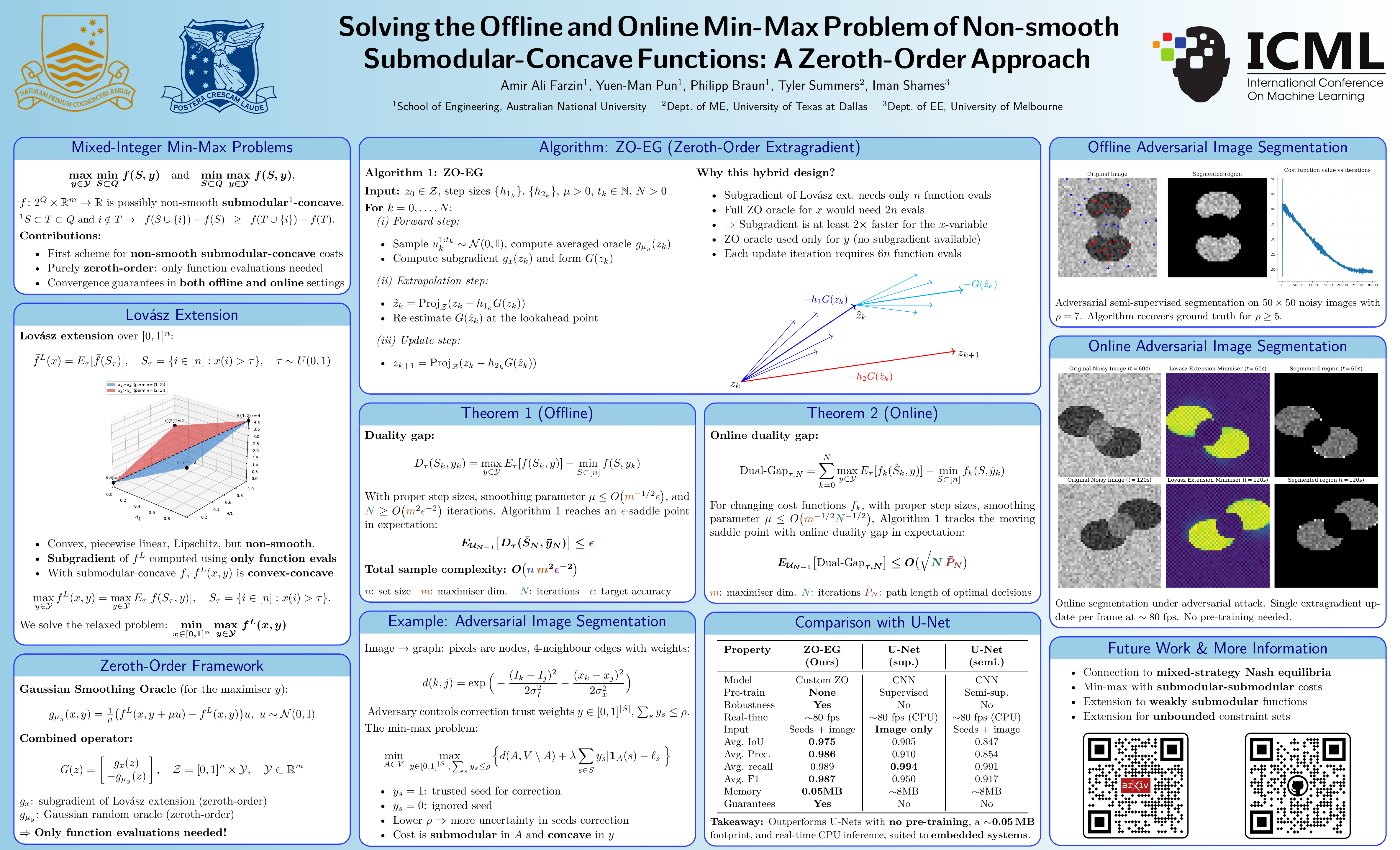
Many real-world decision-making problems involve selecting the best option from a discrete set while simultaneously guarding against worst-case scenarios, for example, determining which pixels belong to an object in an image when some labels may be unreliable or adversarially corrupted. These problems are naturally formulated as min-max optimisation problems, where one player selects a subset and another chooses continuous parameters to make the task as difficult as possible. However, solving such problems is challenging because the discrete structure and potential non-smoothness of the objective prevent the use of standard gradient-based methods. We developed an algorithm that solves these mixed discrete-continuous min-max problems using only function evaluations, without requiring derivatives. The method combines combinatorial techniques for the discrete component with a randomised smoothing approach for the continuous component. We prove convergence guarantees for both fixed (offline) and time-varying (online) settings. In experiments on adversarial image segmentation, our method outperformed trained neural networks while requiring no pre-training, no large datasets, and requiring less memory. These properties make it promising for resource-constrained and safety-critical applications, such as autonomous systems that must make reliable decisions in real time without relying on pre-collected training data.