
Robust Signal Enhancement via Fractional Detail Views and Knowledge Guided Multi-view Fusion
Abstract
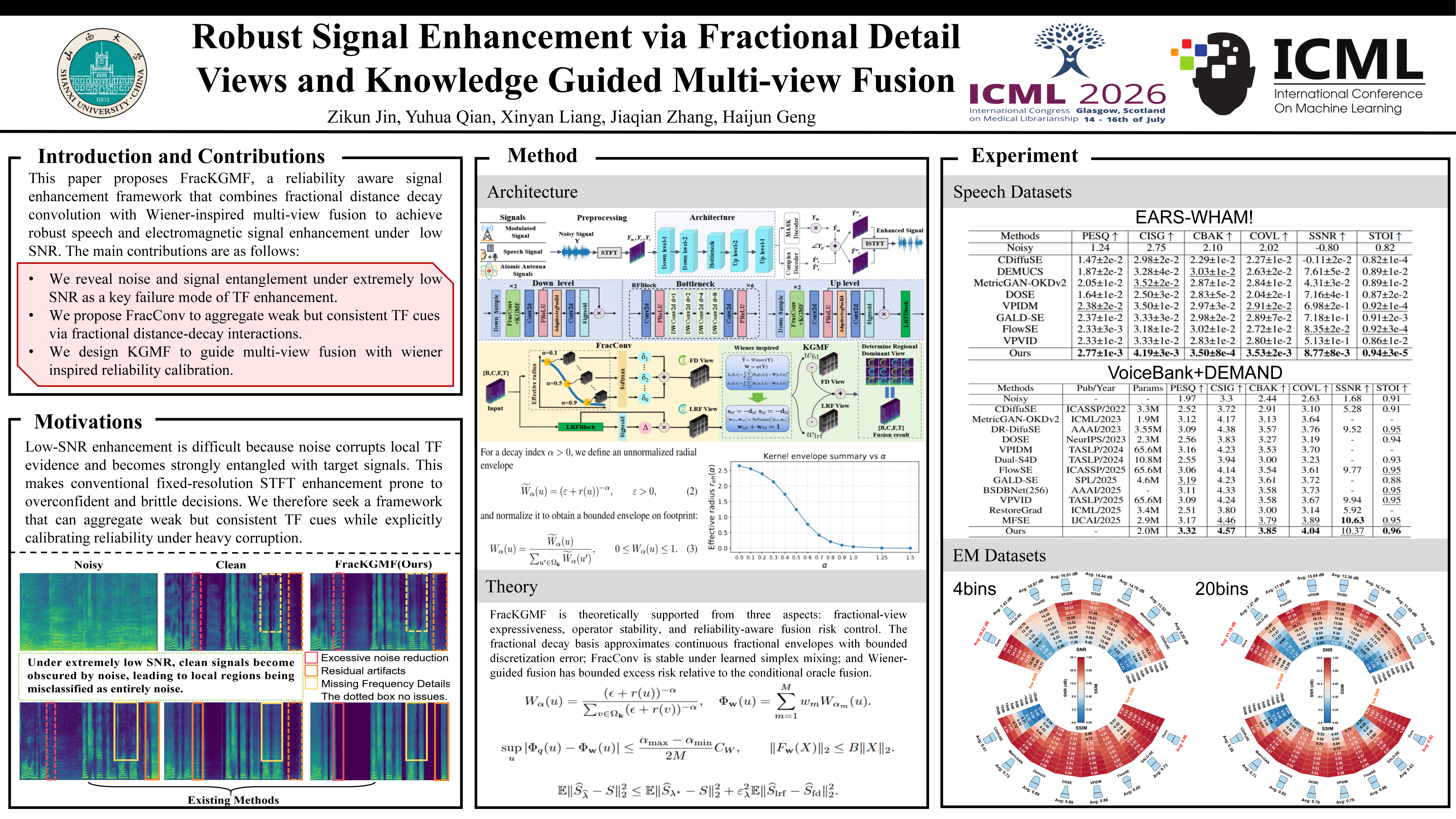
Robust signal enhancement at low SNR is fundamentally challenging because noise becomes strongly entangled with the signal and corrupts local time–frequency (TF) evidence. In this regime, fixed resolution short time Fourier transform (STFT) enhancement with purely data driven convolutional biases can become overconfident in unreliable TF regions, causing unstable suppression or residual artifacts. We propose FracKGMF, which couples Fractional Distance Decay Convolution (FracConv) with Knowledge Guided Multi-view Fusion (KGMF) for expressive TF modeling and reliability aware decisions under heavy corruption. FracConv introduces a lightweight fractional distance decay family that reshapes local interactions into long tailed receptive patterns, enabling aggregation of weak but globally consistent cues when per-bin observations are ambiguous. KGMF uses a wiener inspired reliability prior to calibrate multi-view fusion and reduce excessive suppression in uncertain regions. Experiments on speech and EM benchmarks show consistent improvements over state-of-the-art baselines, with particularly large gains under extremely low SNR, including a 33 dB average improvement on EM signals at -20 dB.
Lay Summary
Real-world signals, such as speech or wireless communication signals, are often recorded in very noisy environments. When the noise is extremely strong, the useful signal can be almost hidden, making it hard for enhancement systems to decide which parts should be kept and which parts should be removed. Existing methods often analyze signals with a fixed time-frequency view and may trust unreliable noisy regions too much, which can lead to missing signal details or leaving artifacts. We introduce FracKGMF, a new signal enhancement method designed for these difficult low-SNR conditions. Its first component, FracConv, gathers weak but consistent information from a wider context rather than relying only on local observations. Its second component, KGMF, uses a reliability cue inspired by classical Wiener filtering to guide how different signal views are combined. This helps the model make more cautious decisions in uncertain regions and avoid removing useful signal components. Experiments on speech and electromagnetic signal benchmarks show that FracKGMF improves enhancement quality, especially in extremely noisy cases, including large gains for electromagnetic signals at −20 dB.