
FlexiFlow: decomposable flow matching for generation of flexible molecular ensemble
Abstract
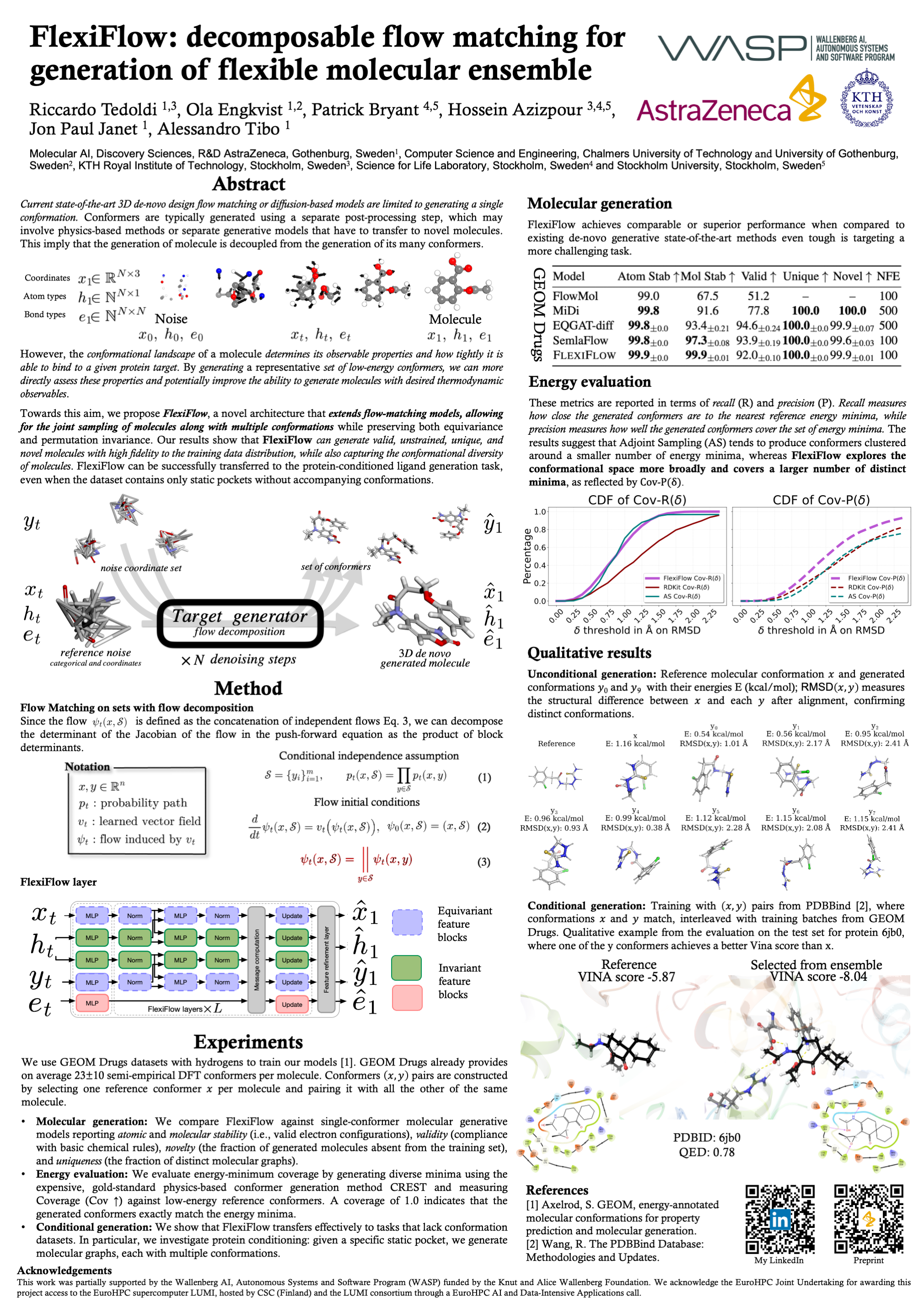
Sampling useful three-dimensional molecular structures along with their most favorable conformations is a key challenge in drug discovery. Current state-of-the-art 3D de-novo molecular design generative models are limited to generating a single conformation. However, the conformational landscape of a molecule determines its observable properties and how tightly it is able to bind to a given protein target. By generating a representative set of low-energy conformers, we can more directly assess these properties and potentially improve the ability to generate molecules with desired thermodynamic observables. Towards this aim, we propose \textit{FlexiFlow}, a novel architecture that extends flow-matching models, allowing for the joint sampling of molecules along with multiple conformations while preserving both equivariance and permutation invariance. We demonstrate the effectiveness of our approach on the QM9 and GEOM Drugs datasets, achieving state-of-the-art results in 3D molecular generation producing valid, unique, and novel molecules with high fidelity to the training data distribution. Moreover, we show that our model can generate unstrained conformational ensembles capturing the conformational diversity and providing similar coverage to state-of-the-art physics-based methods at a fraction of the inference time. Finally, FlexiFlow can be successfully transferred to the protein-conditioned ligand generation task, even when the dataset contains only static pockets without accompanying conformations.
Lay Summary
What is a 3D molecular ensemble? A molecule can adopt multiple three-dimensional shapes, called conformations, which are crucial for determining its properties and interactions. For example, a drug molecule may need to adopt a specific conformation to bind effectively to a target protein. The generation of such conformations remains both challenging and resource intensive; moreover, existing 3D de-novo design generative models are constrained to producing only one conformation per molecule. In our paper, with FlexiFlow, we propose a novel paradigm which aims to extend flow-matching models to allow for the joint sampling of molecules along with multiple conformations. This means that our model can generate a representative set of conformers for each molecule, which can provide insights into their observable properties. We show that our model maintains strong 3D molecular generation performance, producing conformational ensembles comparable coverage to state-of-the-art physics-based methods at a much lower inference cost. Our findings have implications for drug discovery and molecular design, as they suggest that generating multiple conformations can lead to a better understanding of a molecule's properties and interactions, potentially improving the ability to design molecules with desired thermodynamic observables.