
Identifying Learnwares via Reduced Neural Conditional Mean Embedding
Abstract
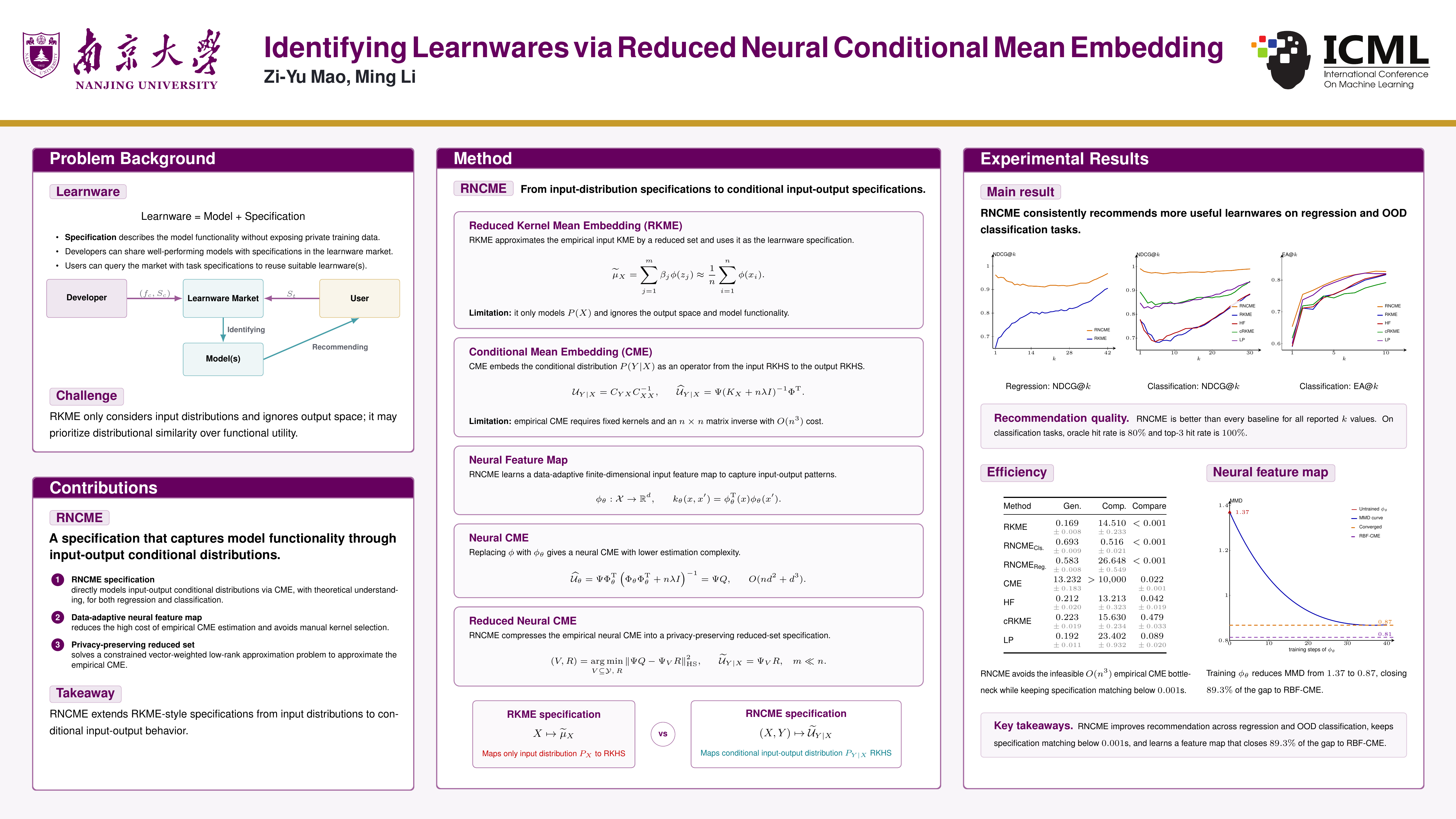
The learnware paradigm aims to establish a market of learnwares, each of which is a well-trained model combined with a specification that describes its functionality without leaking data privacy. The market enables users to efficiently reuse relevant models based on specifications on their own tasks instead of training models from scratch. Recent works have attempted to generate specifications using Reduced Kernel Mean Embedding (RKME), which maps input distributions into Reproducing Kernel Hilbert Space (RKHS) while ignoring the output space, causing models trained on similar input spaces to yield similar specifications, even when their functionalities differ. Many labeled-RKME improvements attempt to address this by indirectly modeling the input-output conditional distributions, but they remain limited to classification tasks and lack clear theoretical explanations. In this work, we propose Reduced Neural Conditional Mean Embedding (RNCME), a novel specification generation method that directly models input-output conditional distributions via Conditional Mean Embedding (CME). Our RNCME method has a clear theoretical understanding based on CME and is applicable to both regression and classification tasks. Empirical experiments demonstrate the effectiveness and efficiency of our RNCME method.
Lay Summary
When solving a new machine learning task like predicting emotions in cartoon faces, training a model from scratch is expensive and often impractical. A promising alternative is to reuse existing models from a shared marketplace. However, current systems struggle to match a user's task with the right model because they focus too much on how the input looks, such as cartoon versus real faces, rather than what the model actually does, such as recognizing expressions. We developed a new method called RNCME that captures the true relationship between inputs and outputs, not just the input distribution. This allows our system to understand that an expression recognition model trained on human faces can be useful for cartoon faces, even though the images look different. Our approach works for both regression and classification tasks, and it preserves data privacy. This brings us closer to a practical model marketplace where users can quickly find and reuse the right tool for their job without starting from scratch.