
Beyond Gemini-3-Pro: Revisiting LLM Routing and Aggregation at Scale
Abstract
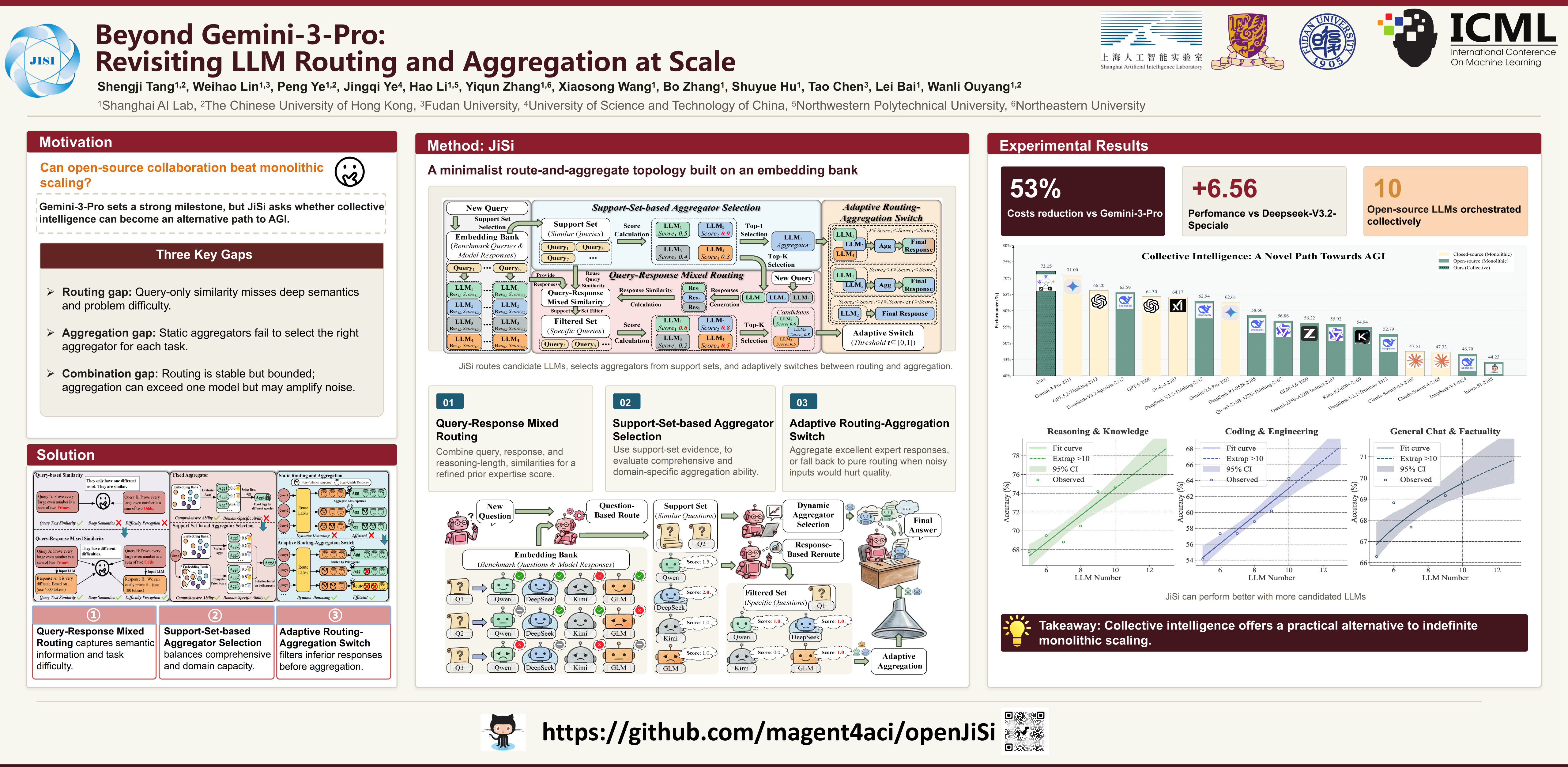
Large Language Models (LLMs) have rapidly advanced, with Gemini-3-Pro setting a new performance milestone. In this work, we explore collective intelligence as an alternative to monolithic scaling, and demonstrate that open-source LLMs' collaboration can surpass Gemini-3-Pro. We first revisit LLM routing and aggregation at scale and identify three key bottlenecks: (1) current train-free routers are limited by a query-based paradigm focusing solely on textual similarity; (2) recent aggregation methods remain largely static, failing to select appropriate aggregators for different tasks; (3) the complementarity of routing and aggregation remains underutilized. To address these problems, we introduce JiSi, a novel framework designed to release the full potential of LLMs' collaboration through three innovations: (1) Query-Response Mixed Routing capturing both semantic information and problem difficulty; (2) Support-Set-based Aggregator Selection jointly evaluating the aggregation and domain capacity of aggregators; (3) Adaptive Routing-Aggregation Switch dynamically leveraging the advantages of routing and aggregation. Comprehensive experiments on nine benchmarks demonstrate that JiSi can surpass Gemini-3-Pro with only 47% costs by orchestrating ten open-source LLMs, while outperforming mainstream baselines. It suggests that collective intelligence represents a novel path towards Artificial General Intelligence (AGI).
Lay Summary
Artificial Intelligence (AI) has recently seen massive leaps, mostly by building larger, more expensive "super models" like Gemini-3-Pro. But is building one giant, energy-hungry brain the only way forward to advanced AI? In this paper, we explore a different approach: teamwork. We introduce "JiSi", a new system that proves a group of smaller, open-source AI models working together can actually outperform the world's most powerful standalone models. Instead of relying on one AI to know everything, JiSi acts like a smart group. When asked a question, it evaluates how hard the problem is and matches it to the specific AI expert best suited to answer it. Then, it makes a smart decision: if the question is straightforward, it just uses that single expert's answer; if the problem is complex, it gathers answers from a team of AIs and combines them into a single, superior response. Our results show that by organizing a team of ten open-source models, JiSi not only beats Gemini-3-Pro in performance but does so at less than half the cost. This proves that "collective intelligence is a highly effective and affordable path toward future Artificial General Intelligence.